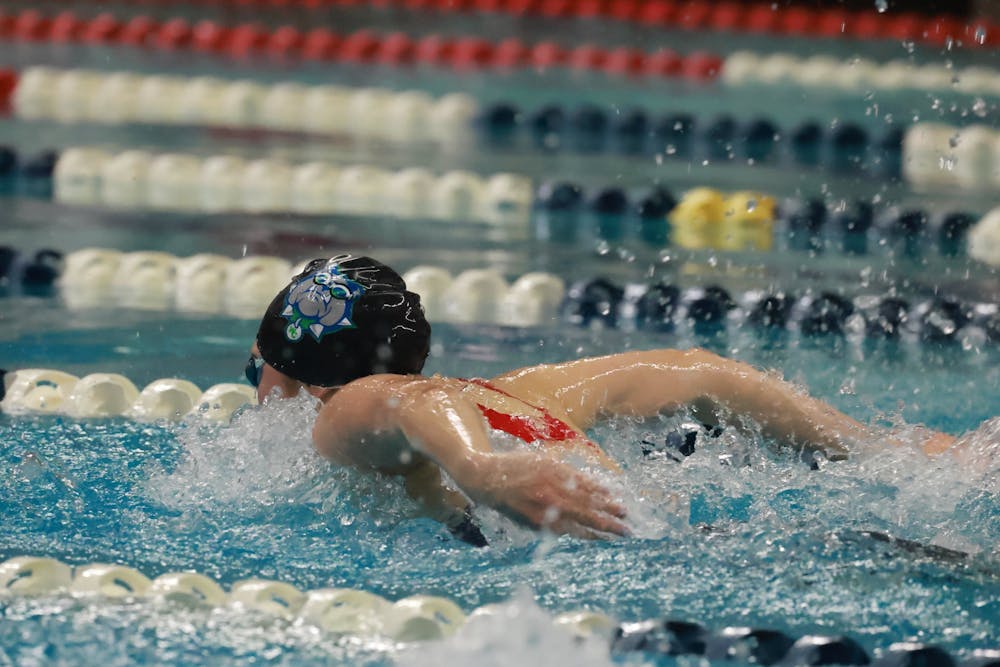

In the midst of the crowded Rec Center, there is one place that contrasts the noise of running treadmills, shoes squeaking on the court and weights clanging together: the pool. To find it, you must head downstairs, past the weight rooms, where you will find a narrow hallway that will lead you to it. As you enter, the scent of chlorine will greet you instantly, as if you’ve walked through a portal to another world. You’ll hear the sound of water dancing, an ambience so different from the rest of the rec.
Just the simple smell of chlorine brings back so many memories of when I was competitively swimming. When I first learned how to swim, I instantly fell in love with being in the water. There is just something so freeing about it. Simply floating for a few seconds can somehow make all the difference, relaxing your body, releasing all tension and making the whole world go silent. I also distinctly remember “playing mermaids” with my friends — we would wear fins and kick through the water with our legs together to mimic swimming with tails.
Seeing how happy being in the water made me, my parents decided to let me try competitive swimming, and so that is what I did from childhood to the end of high school. However, I soon realized that I wouldn’t always feel like a mermaid in the water.
As a competitive swimmer, I would have 4 a.m. morning practice, and then proceed to eat breakfast in the car while my mother drove me straight to school. Or I’d head straight to practice after a long, draining day of classes. Some days, I would even have to do both.
I definitely got used to the rhythm of things, but even then, jumping into a freezing cold pool, somehow forcing myself to pull and kick faster, never got any easier when I was already mentally and physically exhausted. My association of the pool as this relaxing atmosphere that allowed my imagination and creativity to flow was soon struck down by a wave of stress and frustration.
The competitive component of competitive swimming became more transparent as I grew and got faster, and I was constantly pushing myself to the limit to beat the clock. Every millisecond counts as a swimmer, and I would be grateful if I even had five seconds of rest to breathe at the wall during a sprint set. Nonetheless, despite how impossibly difficult it could seem to kick and pull when all the lactic acid made my whole body burn and resist movement, I always ended up in a better state of mind after swimming.
After completing a tough practice, there was no comparable feeling to taking your cap and goggles off and doing a dunk in the water, letting all your hair flow in unity. The first breath you take, the moment you reach the surface, is by far the most calming and rejuvenating. It seems that the water washed away all my problems, or at least made them seem smaller than before.
I remember learning about Maslow’s hierarchy of needs in psychology, which basically explains how we don’t think about our deepest desires until our basic needs are met. Amid a hard swimming set, when I can feel the fatigue and the need to grasp for air, all I can think about is taking that next breath and taking that next stroke. I am not thinking about the plethora of organic chemistry mechanisms I need to remember or the fact that I still am not entirely sure what career I want to pursue in life. All these problems and stressors that I came to the pool with either fade or lessen when I leave.
Now that I am no longer competitively swimming, I am not obligated to go to practice, but I do somehow miss that obligation. It kept me accountable, and now I must rely on my own discipline. Sometimes, I’ll go for a swim at 12 p.m., in between a morning and late afternoon lecture, or I’ll go in the evening after all my classes and activities are finished. Ultimately, no matter how tired and unwilling to get in the water I may be, I know the aftermath of it is too good to miss out on.
Catherine Chan is a freshman studying Molecular and Cellular Biology Potomac, Md. She is a Social Media Manager for The News-Letter. Her column consists of reflections on various moments in her life, from the distant past to the current present, in pursuit of discovering the underlying impact they have on her life’s story.