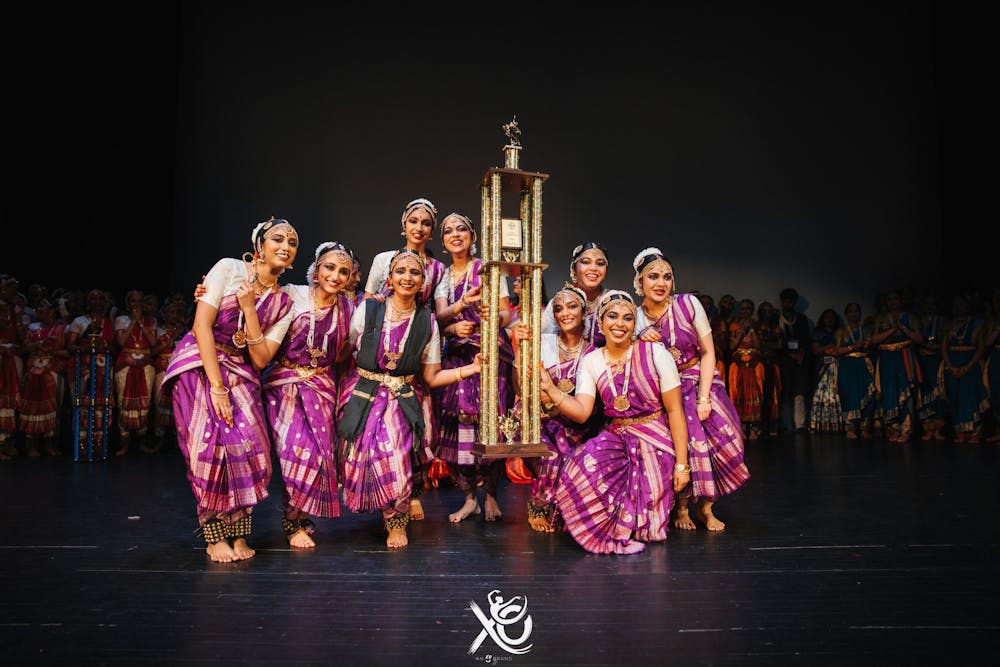
On April 4, 2026 the Shakti dance team won first place at the 2026 Origins National Dance Competition in Trenton, New Jersey. This marked the team’s second consecutive national title, as it had also won the 2025 competition in Chicago.
Shakti, which performs Bharatanatyam, an Indian classical dance style, competed against approximately 50 other colleges to earn a spot at nationals. After placing third, second and first at a series of “bid competitions” all throughout the country, the team earned enough points to rank among the top nine collegiate Indian classical dance teams. Among the finalists, who were typically teams from public or larger universities, Shakti stood out as a team representing a smaller private school.
In an interview with The News-Letter, junior Neuroscience and Public Health major Maya Britto, a captain and choreographer of Shakti, spoke about how last year’s victory gave the team confidence going into this season, although it was still exciting and unexpected.
“I think it was such an unexpected win last year… That really showed us that it's not out of the realm of possibility to do well,” Britto said. “But, we still have imposter syndrome up until the very end. Even on the national level stage, we… never really think that [winning is] going to happen, so it was a massive shock that we did.”
Bharatanatyam is an ancient Indian classical dance form that originated from Tamil Nadu, a region in South India. Bharatanatyam is a form of dance theater that combines storytelling with intricate choreography. It involves several components: Nritya (the storytelling and narrative aspect), Abhinaya (the use of facial expressions and emotions) and Nritta (the pure technical dance and footwork).
While Bharatanatyam is typically based in traditional Hindu mythology, this year, Shakti choreographed a dance about intimate partner violence, a more contemporary issue. In an interview with The News-Letter, captain and choreographer Simren Shah, a senior Biomedical Engineering major, emphasized how Shakti prioritizes staying true to the traditional execution of Bharatanatyam while also incorporating modern themes.
“We’re using the style of dance [Bharatanatyam] but going beyond the strict boundaries that we may have learned growing up, and [we’re] using it creatively to talk about modern issues,” Shah said. “We really try to move a little bit beyond what is traditionally called Bharatanatyam.”
This year’s piece was inspired by a Malayali folktale from Kerala, India about Kalliyankattu Neeli, a woman who becomes a yakshi, a female spirit who haunts people. While there are many iterations of the story, Shakti’s version centers on Neeli as a woman who is in a happy marriage that quickly turns abusive. Neeli faces internal struggles about whether or not to leave her husband, but she ultimately decides to confront him, resulting in Neeli being murdered by her husband and returning as a yakshi to haunt him.
Not only did Shakti’s piece address a serious problem, requiring them to handle the topic thoughtfully, but the captains also noted how their performance also stood out for being a part of the horror genre, which is not common within the competitive circuit of Indian classical dance.
Ultimately, the team’s creative risks resonated strongly with both the judges and audience members. The captains recounted how several audience members expressed how deeply they were moved by Shakti’s dance, and the judges also praised their performance for being authentic and impactful.
“The judges really loved our piece and made it a point to tell us that our performance didn't come across to them as a team that was just focused on winning, but a team that really believed in their message and their story,” Britto said. “We're so proud of how it resonated emotionally with them and also with a lot of audience members.”
Shakti’s success is rooted in its teamwork, as every member contributes to its success, beyond simply dancing in the performance. When asked what makes Shakti unique in an interview with The News-Letter, captain and choreographer Ananya Ashok, a senior Molecular and Cellular Biology major, said that Shakti is unique because the team’s work is entirely student-led.
“Every member of our team contributes to our success not just by being a dancer. For example, the music that we dance to is put together and created by someone on our team. [One member] pieces everything together… for [the] stylistic effect and to convey the horror,” Ashok stated. “Everyone on our team comes together to get us to competitions, create our piece and contribute in many different ways.”
Outside of competitions, Shakti also leads community events in Baltimore, such as teaching a dance class at Creative Alliance, an arts collective organization in Baltimore. Shah described how participation in these classes has continued to grow and that community engagement is one of the reasons why she loves being on the team.
Another reason why members love being a part of Shakti is that the team provides a strong sense of community and connection to their culture. Many of the team’s dancers have been trained in Indian classical dance since childhood, making it an important part of their life and identity. Ashok spoke specifically about how she joined Shakti because the team provided a community for her away from home.
“When I came to Hopkins, [Shakti] was a way to connect to my home life, my family and myself in a way that I wouldn't be able to do with other dance forms or on other teams,” Ashok said. “[It was a way to] find a community of women who just enjoy an artistic outlet like this and to continue doing what we love together while also conveying messages that are really meaningful out in the real world.”
Britto also explained that through being on the team and participating in the competitive circuit, she has learned more about Bharatanatyam as a dance form, especially how it continues to evolve among college teams and younger generations.
“The circuit has shown me that this dance form is very alive… outside of the very traditional, sometimes siloed institutions where this art form is practiced... There [are] ways that you can personally express yourself through this form, and there [are] communities of college kids our age that are as passionate about it as we are,” Britto said. “It's made it more of a tool for advocacy and general connection across so many college campuses, [which] I think is just really powerful.”