I’ve never had a reason for wanting to be a writer. My relationship with writing has always been that of a high-school love your parents don’t approve of, in part because it reminds them of all their old mistakes — that is to say, fueled by contradiction and inexplicability. Every time someone assumes I want to be a writer, I don’t, and when they think I must want to become something else, then I’ve only ever wanted to be a writer. I’m not saying this is a good way of life, but I am claiming it as mine. At least I’m honest — until you call me honest, and then I’m a liar.
These mental hoops and charades surrounding if I am or am not a writer all guard one core memory, which recently I’ve realized is the truest motivation I have. It starts where most good things do: at my grandma’s house.
Her house is decorated as if there were a going-out sale on all things apple and bird. Cardinal lamps and small ceramic figurines of other soft-winged things I don’t know the names of. Wooden apple trinkets and fridge magnets and teacher-sloganed memorabilia. Even the wallpaper in her bathroom is trimmed at the top with nests of various birds, unspooling around the perimeter like a strip of film. In her kitchen, an apple-shaped cookie jar where there was candy when I was younger; when I saw a similar one at my doctor’s as a child, I described my grandma’s as “more romantic” because I thought the word just meant special.
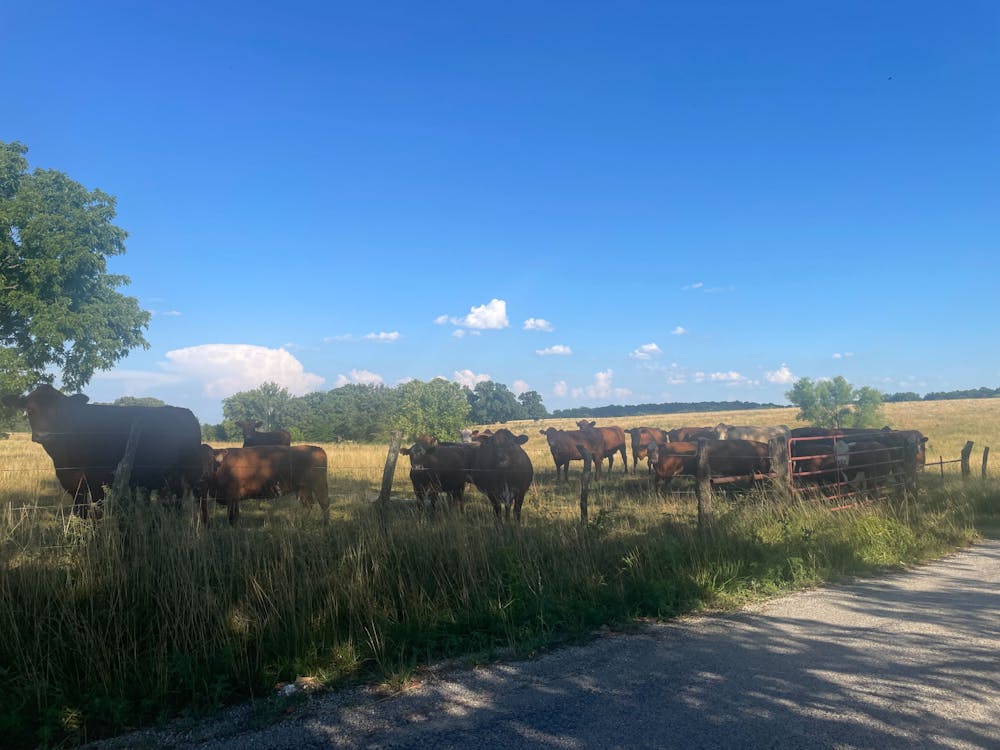
Everything at grandma’s was more romantic. I thought the deep freeze in the garage was heavenly. The cows across her street and their landmines of shit were the closest I ever came to a more primitive life, and the way they reverently stared you down with eyes like sink drains and jaws moving in slow figure-eights made me feel almost messianic. I guess cows are the closest I’ve felt to being worshipped. Once my grandma picked a daddy long legs off her door on the porch and said, “Point to the cows, daddy,” and in response it waved a hairlike leg across the street with perfect accuracy, and I felt like cows were somehow beasts of truth in this universe, known by all and knowing all, which made their appraisal and approval of me even sweeter.
So, my grandma’s house always came to mind in connotations of magic. Maybe that makes my grandma a witch, the type nicer than I’ve ever known from storybooks. She certainly had at least one witch-like ability, which — if I remind myself why I sat down to write this article — is that call to writing I’ve only recently realized.
All my Fourths of July have been spent at my grandma’s, going to the fireworks festival hosted by the town’s Southern Baptist college. It always seems that she knows everyone there, including now-grown kids that were in her elementary school classes. After the festival, we would go back to her long concrete driveway and nightcap our festivities with fireworks of our own: modest ones that spun out on the ground, that shot up and fell short of the old trees in her yard, and sparklers that we waved like a maestro’s baton from fold-up lawn chairs.
Then came sleep, always easier and with less of a fight than when I attempted it in my own bed. As a child, I shared a bed with my grandma in her room, her quilted covers over us and many pillows behind us, the antique marble-topped “bureau” from her own grandma sleeping beside us. To coax me into slumber, my grandma told bedtime stories. Or really, only one bedtime story: Goldilocks — with a twist. If I had to guess where the twist came from, I would point to one of those Fourth of July nights.
By twist I mean reimagining. Intervention. Improvisation. Creative liberties. Call it what you want. It went like this: “Grandma, can you tell me Goldilocks, but this time Fourth of July-themed?” Both of us would be lying supine, my eyes screwed shut and hers, I imagine, fixed to the popcorn ceiling in the room’s dark. If there was no holiday or specific occasion, my requests for Goldilocks became strange. Things like, “Goldilocks, but maybe something to do with a dentist,” and so on. If she ever hesitated or was at a loss, it never showed. She always dove in at once with the composure of a surgeon or army general.
So, the Goldilocks I’m most familiar with was always breaking into the bears’ house not while they were out on a walk, but while they were at the fireworks festival. She was a more sympathetic character in my grandma’s retelling, a testament to my grandma’s saintly character. Goldilocks was an envious child, seeing all of her own friends go to the fireworks festival while she had no one to take her, which is why she found herself wishing she could inhabit another’s life — and house — for just one night. I know, as I’m writing this, that I cannot do it justice; my memories now are something more like foxed and holed pages of letters I took for granted, assuming they would be ever-pristine.
My grandma was an English minor at her state college in Missouri, and perhaps selfishly or reductively — sorry, Grandma — I want to consider this the feat of her studies, the capstone. Every night, she respun Goldilocks into new configurations and mischief for me. She dragged the girl into modern context like a sorry child to the principal’s office.
There was, of course, Goldilocks on Fourths of July. In my grandma’s stories, not only was Goldilocks more sympathetic, but the bears were less punitive as well. Those Fourths of July in the Goldilocks world, her night ended not with her fleeing in terror, but with the bears welcoming her into their family and sharing their fireworks with her in their own driveway, even if she missed the festival.
There was Goldilocks sipping hot cocoa in winter. Goldilocks sharing a birthday with baby bear, but only his family bought him gifts. Goldilocks and something somehow with a dentist, if my memory is accurate in telling me I once requested this. Goldilocks and a million other lives my grandma gave her, too few of which I can perfectly recall.
When I am asked now why I want to be a writer, I know why. I believe in the original storyteller, that progenitor of all myth in this world, and her name is Susan.
Riley Strait is a sophomore from Olathe, Kan. studying Writing Seminars and English. He is an Arts & Entertainment Editor for The News-Letter. His column, "In Medias Res," translates from Latin to "into the middle of things," shares narratives that bury occasional insights within fluff that often leave the reader wondering, "Did I ask?"