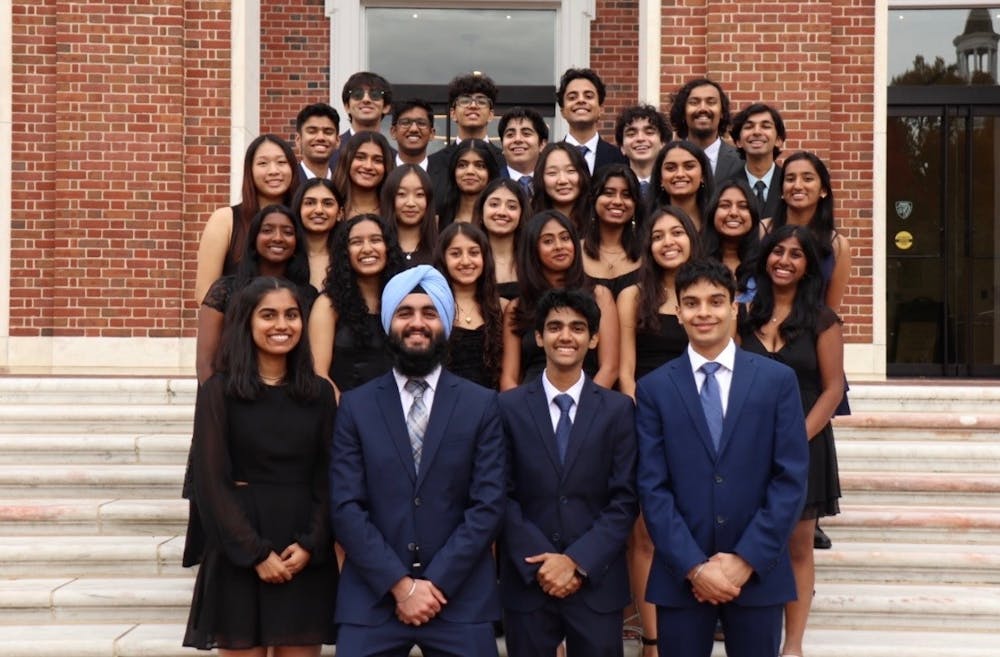
On Saturday, April 4 the Blue Jay Bhangra (BJB) team competed at the highest level of collegiate Bhangra: Bhangra Blowout, a national bhangra competition that brings together eight of the top collegiate teams in the country.
For the team, the moment they qualified did not feel entirely real at first. In an email to The News-Letter, sophomore neuroscience major Arjit Singh, a captain of the team, described his initial reaction to qualifying for the tournament.
“My immediate reaction was honestly just shock. It was a moment where I just thought of all the hard work, time, and effort that we were putting into the team to succeed, and it all just felt like it was coming to fruition at that moment,” he wrote.
Another dancer, junior Neuroscience major Anshu Sharda, described the experience of celebrating after the competition.
“Everyone was hugging each other, laughing, crying — there were so many tears and smiles; it was such a bittersweet moment, and I was overwhelmed with emotion,” Sharda wrote of their Blowout performance. “We danced for each other, for our family we’ve built.”
This year marks the first time in 26 years that the team has qualified for nationals, making their performance not only a personal milestone, but a historical moment for the team and the University.
Bhangra is a traditional folk dance that originated in Punjab, historically performed in celebration of the harvest festival Vaisakhi. Known for its high energy and expressive movements, bhangra is performed to the beat of the dhol, a double-sided drum, often accompanied by lyrics that tell stories of love, strength and celebration.
Dancers wear clothing rooted in Punjabi culture with men performing in a kurta (long shirt), pagh (turban) and chaddar (loose pants), while the women wear a salwar kameez and dupatta. These outfits are often adorned with intricate embroidery, jewelry and glitter, designed to enhance the energy and visual impact of performance. Accessories extend beyond clothing, including the Rumaalan, a handkerchief tied around a dancer’s wrist to accentuate fast, expressive hand movements.
Props also play a central role in performance, most notably sapp and khunde, which dancers manipulate to add rhythm, texture and visual intensity to the set.
Today, bhangra has evolved into a global performance event, particularly within collegiate circuits, where teams blend traditional elements with modern choreography.
Sami Muhammad, a senior physics major and dancer on the team, talked about the range of bhangra dance styles in an email to The News-Letter.
“Bhangra is incredibly rich both in the depth of its form and also the breadth of styles,” he wrote. “When we perform a set on campus, it’s not just one bhangra performance. It's really an amalgamation of different sub-genres like jhummar or dhamaal, each of which have unique histories in Punjab region.”
For members of Blue Jay Bhangra, this balance between tradition and individuality is part of what defines the team’s identity. In an interview with The News-Letter, neuroscience sophomore Agalya Ramkumar explained the importance of expression among the members.
“What makes BJB truly unique is the concept of nakhra: the individual flair and confidence each dancer brings to the stage,” she wrote. “Rather than being completely uniform, our team is a blend of distinct personalities and styles, and I think that's what makes watching us so exciting.”
Behind the energy of competition lies months of preparation, and behind every performance is a level of planning and precision that often goes unseen. For Blue Jay Bhangra, much of that responsibility falls on captains Samhith Bhrugubanda, Milun Jain, Avani Daga and Arjit Singh.
In the weeks leading up to major competitions like Blowout, practices can stretch to three to four hours a day, on top of regular weekly rehearsals. Dancers spend this time refining synchronization, adjusting choreography and building stamina.
Forming a top 10 bhangra team is no easy feat. While designing the set and refining moves, the captains are involved in nearly every aspect of the team’s performance. They lead practices, teach choreography and ensure that each dancer is aligned, not just in steps but also in timing, energy and expression.
In an interview with The News-Letter, senior biomedical engineering major and a captain on the team, Samhith Bhrugubanda explained the responsibilities that come with leading the team.
“The biggest challenge about being a captain is balance,” he wrote. “Duties involve making choreography, creating formations, building a mix, leading practice... organizing schedules, handling logistics, and so much more.”
For dancers like Tanvi Ranade, a senior majoring in Biomedical Engineering and Computer Science, that effort is visible in the final performance, as she described in an email to The News-Letter.
“After all the grit and dedication every single team member poured into the season, performing on that stage felt like the final piece clicking into place,” she wrote.
This year’s success did not come from a single performance or a single person, but from steady growth throughout the season from the whole team.
“I’d give a lot of credit to our four amazing captains for designing such a strong set and really believing in the dancers on this team,” Ranade wrote. “At the same time, it was the collective commitment from everyone on the team... [that] made this season so successful.”
For many members, the most meaningful experiences happened offstage. In response to a question about his favorite memory on the team, Muhammad recalled a moment of team bonding after a competition in Miami.
“We all spontaneously went to the beach right before our 6 a.m. flight. Between the immediate feeling after placing at the competition, and also the immense closeness we all felt over that weekend, it was a surreal moment at a pretty crazy time in the night that felt very special,” he wrote.
Singh also described how those interested in joining the team can get involved by following BJB on social media (@bluejaybhangra) for information about tryouts.
“We’re looking for things like energy, willingness to learn and understanding of the fundamentals. There is NO prior experience necessary, so anyone and everyone interested should definitely try out,” he wrote.