I’ve been thinking about my arrival at Hopkins a lot, especially because my amazing academic advisor Christine sent me an email talking about the big decision I will have to make soon: declaring my major.
Instead, I think back to orientation week, when everything felt possible and terminal at the same time. The air inside the Hopkins pre-med bubble was, and still is, dense with ambition. Everyone speaks in acronyms: MCAT, JHMI, CGPA, BSPH. Back then, during orientation week, everyone had a plan. Everyone knew where they were going. Or at least, they knew how to say it.
I intend to do research. I used to say this with hesitancy because medicine was always there, an optional path I could go down, gleaming at the edge of every “What do you want to do with your life” conversation. It beckoned like a gold star.
Medicine is legible. It’s noble in a way everyone understands. There’s a white coat at the end of the tunnel. There’s a salary you can Google. It puts a clock next to your passion and asks how fast you can start prepping for THE BIG SCARY MCAT®. The path is paved here. There are upperclassmen who can tell you exactly where each stone leads.
By no means is the path of Medicine easy, but in a place like Hopkins, it is not unfamiliar.
Research is harder to narrate. It doesn’t get that reaction.
It’s pipettes and failed experiments and staring at data that refuses to behave. It’s years of training with no guaranteed endpoint. It doesn’t come with a ceremony as cinematic as Match Day. There is no single moment where the world applauds and says, “Yes, you made it.”
When I first told people I intended to do research, I said it defensively. Like I needed to justify it. Like I was explaining a deviation instead of announcing a desire. But the truth is, medicine beckoned because it was visible. Research pulls me because it feels magnetic. There’s something deeply unsettling — and deeply thrilling to me — about not knowing. About standing at the edge of what’s understood and deciding to push. About spending months, maybe years, trying to untangle one small segment of the vast universe’s logic.
Coming to college almost stole this from me, but I don’t blame Hopkins for any of this. After all, it is known for producing doctors. The hospital looms large. The history is tangible, of course students arrive wanting to wear white coats. Of course a large percentage of us come in pre-med. Of course the culture bends toward what it does best.
Which is why I think about my “Biology in Deep Time” lecture a lot.
To be clear, no one has ever asked me in an interview to identify avian synapomorphy, and, to my quiet disappointment, no recruiter has leaned across a table and whispered, “But what do you think about the taxonomic evolutionary transition from theropods to birds?” But I often think about what it felt like to sit in that lecture hall at eighteen years old, watching Prof. Amy Balanoff talk about her evolutionary biology research questions with the kind of reverence most people reserve for their gods, their mothers, their dead.
She didn’t just teach fossils, she held them close to her heart, sometimes in her palm, sometimes only in slides of a PowerPoint presentation. She spoke about bone not as structure, but as story. About avian skeletons, hollow, impossibly light, as living evidence that the past is never really past. That evolution in flight is a history refined by patience.
And I remember sitting there, stunned by scale.
By the audacity of studying life not in semesters or decades but in hundreds of millions of years.
That biology, at its deepest, is time made visible.
What stayed with me wasn’t the terminology. It was the feeling.
The sense that the world was made of questions worth asking. That asking was enough. That asking was the point.
I think about that class now because it reminds me of a version of myself untouched by the Hopkins Pre-Med Bubble. That somewhere between the doubt and the choice, between the walks to the Hutzler Reading Room and the LinkedIn updates, the world asked me to justify my awe by how respectable it would make me. And I, eighteen, ambitious, slightly afraid, started doing the math on my dreams.
So now, I’m working toward stopping the hesitation from creeping in.
I intend to do research.
Full sentence. No footnote.
Because to me, research is loving a question enough to let it ruin your week.
And I’m starting to realize I’ve always been drawn to question marks.
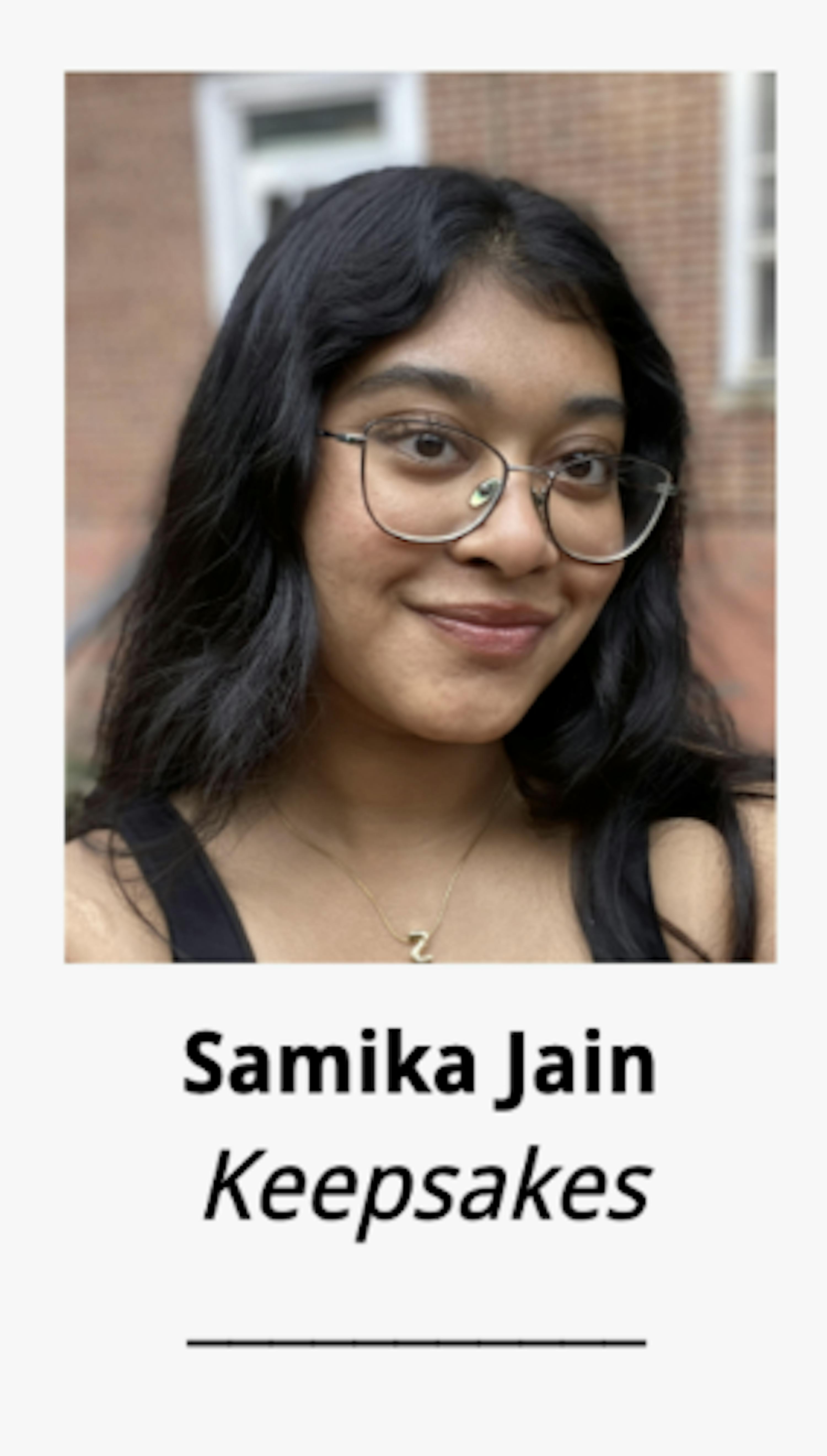
Samika Jain is a freshman from Mumbai, India, majoring in Molecular and Cellular Biology. Her column holds onto things she probably should’ve forgotten by now, but she writes them down anyway.