The area surrounding Hopkins is home to many species of birds commonly found in the Baltimore region. On Friday, April 10, the Behavioral Biology Steering Committee organized a birding expedition open to students across all majors to explore and appreciate the campus avians.
After snacks in Dunning Hall and the distribution of binoculars, reference sheets and field guides, the adventure began. Given the warm springtime weather, the day was suited for birdwatching. Students were encouraged to download the Merlin Bird ID app, a tool developed by the Cornell Lab of Ornithology to identify bird calls and songs. Walking past the Ralph S. O’Connor Recreation Center and subsequently the Imagine Center, some of the species often roaming campus could be identified – including the bright, red-colored northern cardinal and the American robin with its distinctive orange underbelly.
The bulk of the excursion was spent traversing the Stony Run Trail at Wyman Park Drive. Historically, the trail has suffered environmental challenges, including soil erosion and potential pollutant fallout. Through volunteer work and significant community involvement, the location is now considered a beloved park by residents.
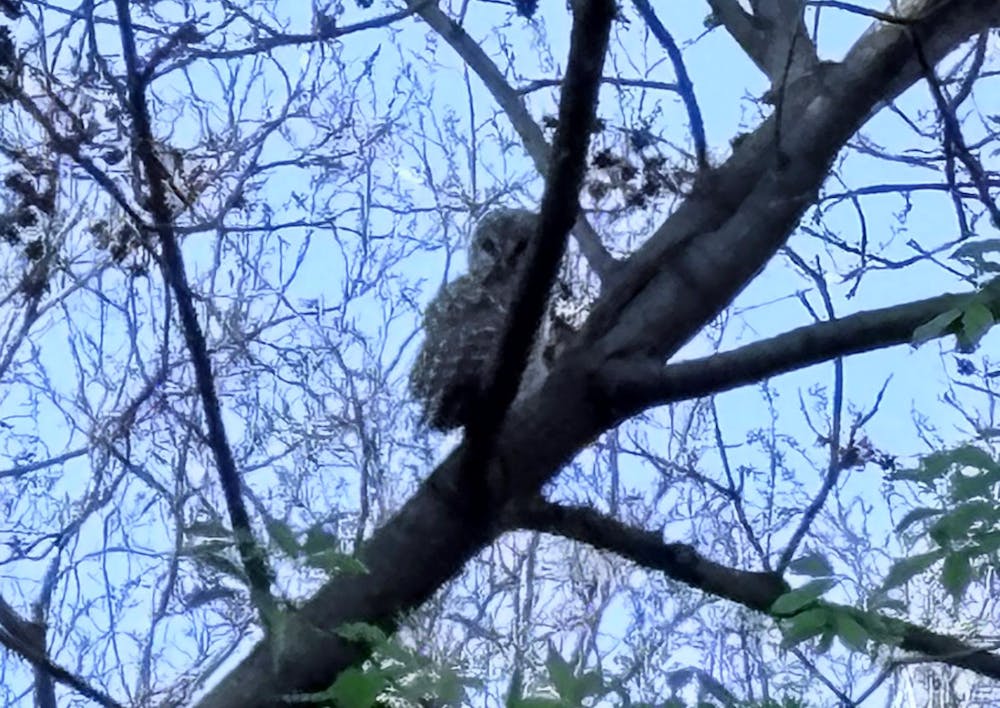
As dusk approached, many birds could be spotted exchanging calls and heading into their nests. From white-throated sparrows to carolina wrens and even one lone barred owl, a wide array of species could be caught in action by observant students. Discovery was not limited to the skies, as one student uncovered the lower jawbone of an unidentified rodent on the trail.
Senior Alexander Jeffords, majoring in Behavioral Biology and Environmental Science, was one of the leaders of the excursion. When asked about the kinds of birds that could be found around campus, he responded in an email to The News-Letter.
“I think there are quite a number of exciting birds around Hopkins. The barred owl (Strix varia) that we saw on Friday was a first for me, and one of the birds that I've been trying to see for a while. I also think that the red-winged blackbird (Agelaius phoeniceus) is a very cool bird as well, though quite common on campus and the greater Baltimore area as well. I think one of the coolest birds that we caught on recording was a wild turkey (Meleagris gallopavo), though I have no clue where in Wyman Park that could be. Finally, one of my favorite birds of prey, the osprey (Pandion haliaetus), is quite rare to see in Baltimore City, but we have a few recordings.”
Participating student Amelia Joseph, a freshman majoring in Chemical and Biomolecular Engineering, described her experience favorably.
“I enjoyed meeting fellow students interested in ornithology and learning more about our behavioral biology department. The organizers' excitement was particularly contagious, especially when we spotted a barred owl. This made me want to keep looking for unique bird species to cross off my list,” she stated in an email to The News-Letter.
When the sun began to set, students returned from their expedition. Organizer Tom Wang, a senior majoring in Behavioral Biology and Public Health, described the organization of the event and upcoming experiences to keep track of in an interview with The News-Letter.
“We did [a birding expedition] last semester, and thought that it would be fun to do it again this semester. There’s a fishing trip run by Behavioral Biology on May 1st,” he said.
For any students with further interest in ornithology and bird research, there is much work being done at Hopkins. Elaborating in an email to The New-Letter, senior Alexander Jeffords highlighted some key faculty including Amy Balanoff and her research into the evolution of avian brains. He also addressed some projects around campus that are linked to investigating our campus birds.
For example, one project under the guidance of Balanoff, Kirsten Bohn and Jerry L. Burgess aimed to establish both a biodiversity index for bird species around Homewood campus as well as understand the effect of the campus architecture on their mortality. Using microphones recording outside Olin Hall during 2025’s major migratory periods and processing this acoustic data using the deep learning software BirdNET, up to 153 species could be detected. Furthermore, inspections of campus buildings resulted in the discovery of 30 bird carcasses over the course of the study.
“However, I do want to make it clear that this is likely an underestimation, as there are birds that could have been scavenged, died later after flying off, or were at buildings we simply didn't survey,” Jeffords wrote.
These results have led to presentations at the Hopkins Annual Sustainability Symposium and chapter meetings of the Ecological Society of America, highlighting the potential scientific depth of the area’s avians.