The Hopkins Student Disability Services (SDS) aims to guide “accessibility and inclusion for students with disabilities.” The News-Letter has previously covered limitations in the services provided through SDS, especially for students with mental disabilities, but a recent article revealed that students with physical disabilities are not provided with adequate accommodations at Hopkins.
The University explicitly states their compliance with the Americans with Disabilities Act (ADA) and Section 504 of the Rehabilitation Act of 1973. However, though it meets several legal requirements, the pathways available for individuals with temporary or permanent physical disabilities are long and convoluted. Journeys that are typically straightforward for able-bodied individuals can take significantly longer for individuals with disabilities on Homewood Campus. We argue that the University must improve the availability of SDS services for students with physical disabilities and emphasize physical accessibility as much as academic accessibility.
While SDS is designed to support all students, its initiatives often center on accommodations that suit those with mental disabilities, leaving physical accessibility underemphasized. Examples of accommodations listed on the SDS website primarily address cognitive or sensory disabilities over mobility-related disabilities. Though this list is not necessarily comprehensive, it reflects a lack of transparency about available resources for these individuals.
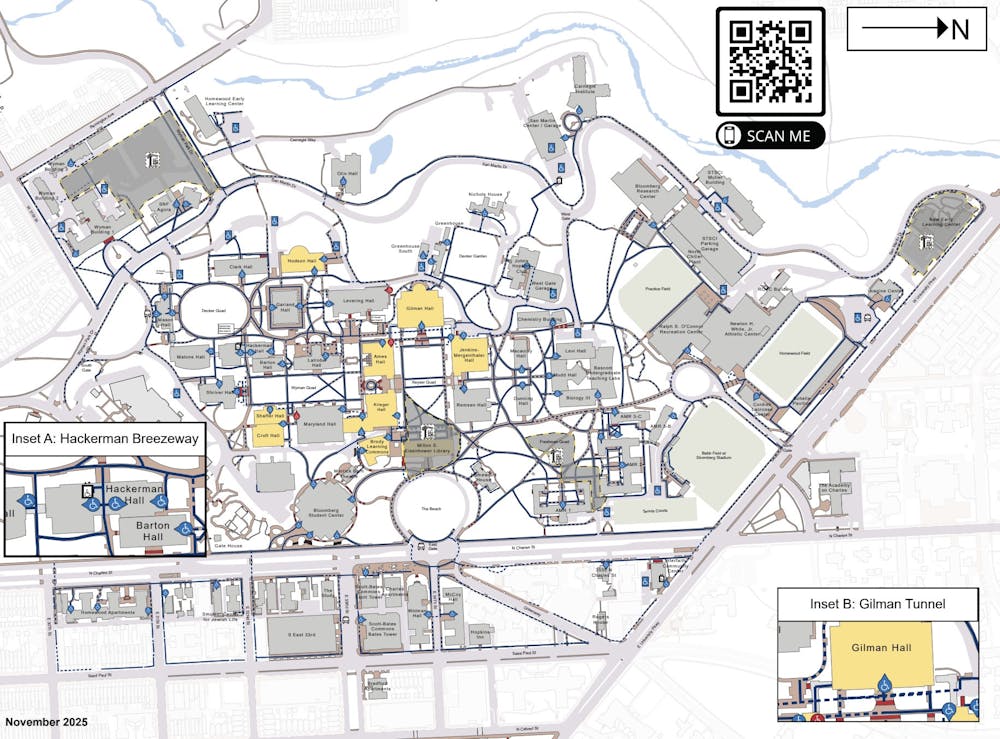
Even though the campus is officially ADA-compliant, meaning that an accessible pathway exists between all buildings or locations on campus, these paths are oftentimes inefficient and greatly increase travel time between locations. For example, the walk from Gilman Hall to Remsen Hall normally takes only a minute by walking through Keyser Quad. However, an ADA-compliant route from Gilman to Remsen requires taking the elevator down to the bottom floor, walking northeast on Bowman Drive and entering the bottom floor of Remsen Hall through an obscured entrance, which takes much longer. Navigating within buildings across floors is an additional barrier because the University is often delayed in fixing or maintaining elevators – notable examples include elevators in dorms such as Scott-Bates Commons and the elevator in Shaffer Hall, where the SDS office is located.
It is important to note that the University has made active efforts to improve accessibility on Homewood Campus, one of them being Milton S. Eisenhower (MSE) Library, one of the buildings that was formerly criticized as “insensitive to the needs of disabled students.” According to the Sheridan Libraries, one of the key design priorities in the reimagining of the Milton S. Eisenhower library is the prioritization of universal design with enhanced usability and accessibility. The renovated library will meet all modern accessibility requirements in accordance with ADA, including upgrades on building systems, infrastructure and interior architecture.
The prioritization marks both a positive step in the direction of a more accessible campus and shows that the school is aware of the lacking accessibility at Homewood. While these construction efforts show institutional commitment to long-term accessibility in new buildings, they have also introduced immediate disruptions and barriers for students with physical disabilities, rerouting foot traffic through even longer and less navigable routes. Prioritizing future improvements should not jeopardize the current experiences of those with physical disabilities.
In order to truly demonstrate a commitment to accessibility, the University must show equal prioritization of cognitive and physical disabilities, and this starts by building an accessible campus and experience that expands beyond the classroom. Hopkins should seek better communication between SDS and affiliates, provide more structured alternate routes and implement clear accessibility plans during all construction projects. These initiatives will help create a campus and culture that is accessible and enjoyable for Hopkins students, faculty and staff.