“What’s going on here?”
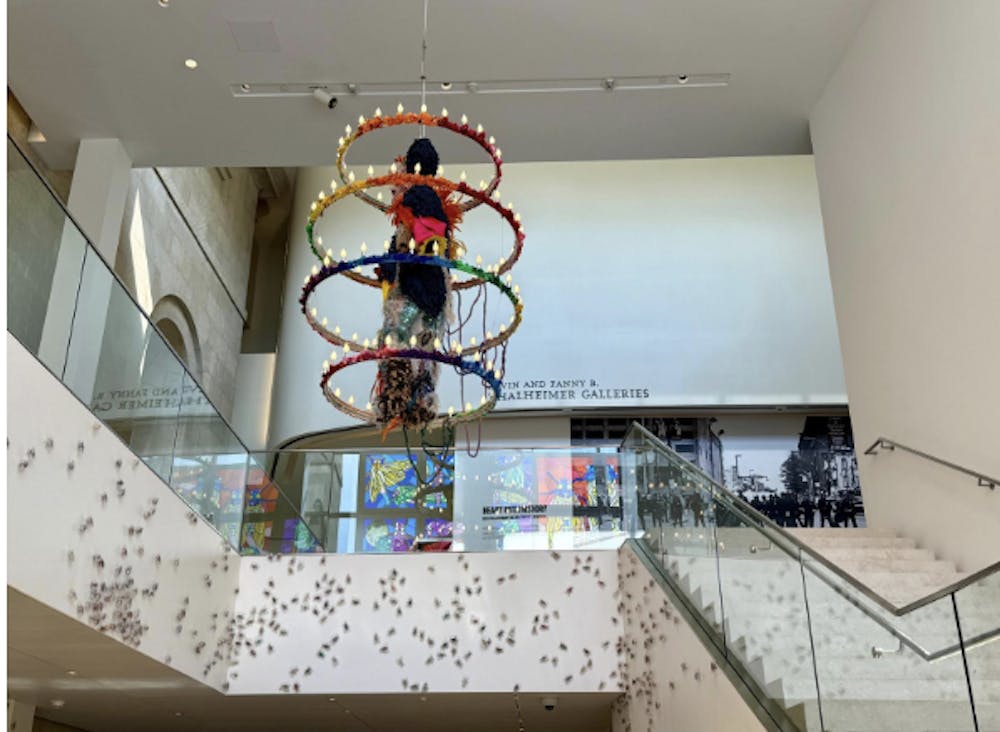
It was the first question our guide asked as my First-Year Seminar (FYS) clustered around a statue of three brown rings at the Baltimore Museum of Art (BMA). I side-eyed my friend. Literally nothing, I thought. As we stood in complete silence, I could feel my STEM brain scrambling for a definition or some data to interpret, anything measurable or concrete. Instead, all I saw were… rings. Yet, the guide didn’t look impatient or concerned at our obvious discomfort. She waited, as if the statue was offering more than I knew how to look for. Over minutes of looking and looking away, details revealed themselves: grooves, the texture of the marble, the impossible smoothness of the statue’s curves, the deliberate shadows cast by the museum lights. At the BMA, I realized you aren’t asked to solve anything; you’re asked to truly see. That shift felt both unsettling and addictive.
During my first week at Hopkins, I spent more time surrounded by art during the Baltimore Arts pre-orientation than I had in my whole life. Wandering through the Walters Art Museum and the American Visionary Art Museum, I recall feeling overwhelmed by the talent and history that I was so woefully unprepared to understand. In front of a Mary Proctor collage of buttons and fabric, a guide unraveled stories of race, gender and spirituality seamlessly. It was like there was an invisible curtain separating me from an entire world I hadn’t known existed. I wasn’t an artist, and I was terrified of public speaking, but I wanted to belong to that world — to speak about objects that appeared ordinary with clarity and conviction until their histories spilled off the wall. So when my FYS professor forwarded a one-line email about a new BMA student guide program, I applied without thinking.
In our first training session, I stood before a hazy Matisse landscape without knowing anything about Impressionism or the industrial Europe it depicted. The other trainees included art history majors, physics students and pre-meds, and we built the picture together. Someone noticed a shadow that someone else turned into a boat. Someone pointed out faint sticks that, after two comments, reassembled themselves into smokestacks. I added an observation about the light on the water, half expecting it to be dismissed, but the instructor turned it into a discussion about the time of day the painting was depicting. It was the first time I felt that my eye mattered. I didn’t need to be an “art person” — I just needed to trust that what I saw was worth saying.
Those questions at the core of our Visual Thinking Strategies (VTS) rewired the way I directed my attention: What do you see? What do you see that makes you say that? What else can we find?
As training continued, they became a framework for approaching the world that felt radically slower than how I was used to thinking. Using VTS, we practiced examining sculptures from every angle, paying attention to orientation, mass and balance. We used the museum’s arrangement to give us clues, and discovered how curators manipulate lighting not just to illuminate but to reveal: a ridge worn down by hands two centuries ago, a hairline groove left by an intentional chisel or an accidental slip. We lingered in front of portraits for half an hour, long after the average visitor’s twenty-seven seconds had evaporated. The questions didn’t go away; they kept multiplying, asking me to notice what I didn’t know I’d seen.
Writing my first tour tested that for real. I spent a week trying to connect the Buddhist Water Guang-yin statue carved thousands of years ago with a Cézanne painting from the 1900s. At first, the pairing felt absurd. But the deeper I looked, the more patterns emerged: the human body shaped by devotion; the natural world softened, abstracted, made symbolic; the way artists keep returning to the same longing for stillness, transcendence and form. Guiding turned out to not be about delivering the “right” interpretation, but rather building a story with strangers. It was a mosaic of observations offered tentatively and held up to the light. Together, we moved from texture to intention to cultural meaning and then back to the work itself.
The invisible work mattered just as much as the visible. Choosing the order of artworks became a kind of choreography: when to shift rooms, when to linger, how to pivot from silence to discussion without demanding either. I learned to read the micro-signals — a visitor’s foot tapping, hesitation before a comment, the instinctive glance at a label. I got to decide what to reveal, and more importantly, what to hold back so viewers could discover it for themselves.
One of the first questions we were asked in training was, “What makes you feel at home in a new space?” I wrote down warm lighting, somewhere to put my stuff, someone who expects me to be there. Later, I realized that was exactly what guiding asks of us — not to lecture, but to host. To create a space where visitors feel anticipated, where the bar for participation is simply being present and paying attention to what is already in front of them.
The museum has become a counterweight to Hopkins’ acceleration. My academic life moves in deadlines, problem sets and meetings double-booked on my Google Calendar; the museum moves in stillness. There, I stand in front of a painting until my eyes stop scanning and start noticing the bristles stuck in the paint, intentional imperfections that point to a human behind the frame. That slowness has leaked into the rest of my life: how I walk across campus, how I listen to my roommate, how I remember to look twice before assuming I understand anything at all.
I entered the BMA student tour guide program convinced someone would tap me on the shoulder one day and expose me as an impostor. I thought guiding required authority in the form of knowledge I didn’t have and language I hadn’t learned, but the museum’s visitors don’t need expertise — they need space. These past few weeks, I’ve peeled back assumptions, returned to the evidence and built outward again. I’ve stopped trying to extract meaning from art and started creating an environment to look, wonder and share, where interpretation is collaborative rather than a personal performance. I may not be an artist, but I’ve become a translator of attention, a facilitator of curiosity, a witness to the moment a roomful of strangers begins to see together.
Vidhi Bansal is a freshman from Upper Saddle River, N.J., studying Neuroscience. In “Meanwhile,” Bansal finds meaning in the unfinished and the unglamorous, showing how the in-betweens are often where life actually happens.