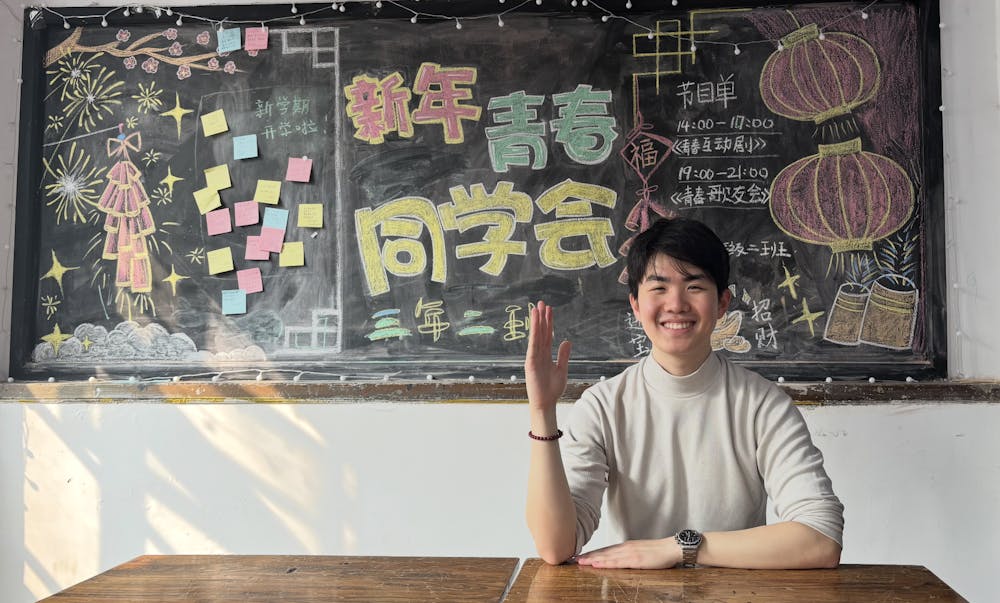
Stone Meng, a senior majoring in Biomedical Engineering (BME) at Hopkins, was the 112th student body president and is the co-founder of Higher Grounds Vending. In an interview with The News-Letter, Meng discussed his experiences during his undergraduate years, ranging from his time in the Student Government Association (SGA) to his research in the field of dentistry.
The News-Letter: You were the 112th Student Body President in your junior year as well as the Class of 2026’s Freshman and Sophomore Class President. As you took on new responsibilities and dilemmas with each year, along with the changes occurring on campus, how did your mindset as a representative change?
Stone Meng: My experience being the freshman and sophomore class president versus student body president was quite different in the first two years. As class president, my main focus was more tangible, smaller goals that impacted my class, as well as events like the class formal. As student body president, it shifted to overseeing the whole school and helping make sure every senator [in SGA] is able to help their class. The focus shifted from independent, short-term wins to a mentorship role, where I prioritized planting seeds for future generations. While we do not always see the immediate fruits of that labor, knowing it will benefit the student body years down the line is very fulfilling.
N-L: As you reflect, what is the cause or change that you championed for that you are the most proud of? Is there anything you hope the future classes can consolidate and compound upon your work?
SM: One of my favorite changes, because it affects me and almost everybody I know, is the initiative I worked with other Senators on, including Vice President Amy Li, to make iClicker and Achieve free. Initially, we made just iClicker free for everybody. Later, we made learning software like Achieve for classes such as physics, chemistry and biology free. This helps students save a lot of money. The administrator who mainly helped with this was Tiffany Mfume. This is something that we started back in late freshman year and continued all the way till now. But recently, I also worked with junior class president Tarini Basireddy on a classroom renovation project involving all the major lecture halls, like Remsen 101.
I think one thing that I also really focused on was not just these initiatives, but also trying my best to make SGA a very collaborative and approachable environment, where senators felt comfortable asking questions. And I try to do that with my easy-going personality, with my entire administration, and I hope that's something that SGA can push for going forward. This current administration is doing a good job just kind of creating this environment – if we can get senators to take more initiatives and just send more emails, then we could see more change.
N-L: Is there anything students should be more aware of when it comes to SGA and its work?
SM: SGA meets publicly every Tuesday night at 7 p.m. in Hackerman Hall. I also think that every SGA administration, including mine, could do a better job broadcasting what we are doing to the student body via Instagram and perhaps Sidechat. So I think it's our role to make people more aware, especially because I think the majority of students don't really care about SGA. That’s fine, but even if that's the case, I think we should be pushing for things that students want. Even if they don't speak to us directly about it.
N-L: You are also the founder of Higher Grounds, a startup that provides coffee and tea vending machines. How did that journey begin?
SM: The initial point was in spring of my freshman year, where I took the class EN.660.105, Foundations of America Enterprise, with Mia Russell. That was a really good class, and she had us do a project to identify an issue on campus. The project identified a lack of affordable, 24/7 coffee options on campus. Campus cafes were often expensive or closed during the late-night hours when students needed them most. We proposed coffee vending machines. After the class ended, I asked my teammates if they would be interested in turning this project into something real. My teammate Marco Azar stuck with me, and I also called my friends Alice Fedotova and Taliyah Huang, forming the founding group of four people. We joined the Pava Marie LaPere Center for Entrepreneurship’s Summer Incubator program, I really recommend that. It was great because it helped us work on the project without any distractions. We were able to make so much progress so quickly and get the machine out before the fall semester of my sophomore year. We have worked on it for more than three years now, and it is one of my most enjoyed hobbies. We have three machines right now, and we're expanding to other campuses in the US.
N-L: There must have been challenges or difficulties along the way. What principles guide decisions when there’s no obvious solution?
SM: Initially, our focus was on coffee because we thought that every college student would want coffee, but then we found out that the drink machine only selling coffee was not getting much attention or customers at all, but the [machines with] more sugary drinks that we had, like cocoa and matcha, were getting a lot of attention. We decided to pivot to sell and focus more on the specialty drinks instead of our caffeinated drinks, starting in the fall of 2024. I think that was a very successful pivot. Now we’ve introduced a lot more Asian and Chinese drinks, such as taro milk tea, banana milk and other specialty drinks you can't find in standard campus cafes. That pivot really took off. Students love our new drinks like the Thai milk tea, and I think that's going to be the focus going forward, not just at our campus, but new other campuses. With other issues, mainly operational, like a shortage of supplies or machine electronics, we just stayed up late and woke up early to fix them.
What I do when we encounter an issue that we don't know how to fix: personally, I normally take a hot shower first, whenever it's a difficult problem. Then, I always consult my friends, mentors and my parents. I think it's always great to hear other people's opinions. Sometimes, you just have to commit to a direction. In startups, we often get bogged down in analysis paralysis, but really we should just think about it, decide on the best option and go forward with it and stick with that. That [mindset] has helped me with a lot of things.
N-L: Where can students find and learn more about Higher Grounds Vending?
SM: Check out our Instagram page, @highergroundsvending, and the vending machines in the 2nd floor of Scott-Bates Commons by the laundry room, the 2nd floor of the Milton S. Eisenhower Library Annex, and the campus store. We’re looking to place one in the Student Center too!
N-L: What do your future plans look like?
SM: I will be attending dental school this fall, currently deciding between three schools and am waiting to hear back from one more.
N-L: You have conducted research in the dental field, such as your time as a design team leader. How was that experience?
SM: I did design team in freshman year and also, most recently in junior year. It was really incredible and it lived up to my expectations; the BME Design Team Program was one of the main reasons I chose my major as BME. We were able to collaborate closely with a doctor that we got paired with, and also engage in all aspects of turning an idea or problem into a solution. That was awesome. We researched a lot, especially through papers online. We also spoke to patients and other doctors in the field, and also got to shadow in-person at the Johns Hopkins Hospital and other places. My first year, I did something on traumatic brain injuries. In junior year, I was a team leader, and with that one, we actually got to speak to many different dentists and see the procedures in-person. It’s great that our school offers this opportunity to really pursue this.
We actually pivoted initially in our dental project. Originally, our design team's problem was to fix the scattering due to metal objects in your mouth when taking a cone beam computed tomography, which is a type of X-ray. But after a lot of research and interviews, we found that that was not really an issue anymore, and that modern technology has corrected this. So we decided to pivot to a new problem. We found that a common problem concerned dental implants and how they were prone to difficult-to-detect infections for certain populations. After doing a lot of brainstorming and research, we found that there was a way to use pH as a novel method to detect when the new implant is accumulating bacteria near it.
N-L: When conducting research, how do you quantify your success in terms other than numerical results?
SM: It's the same way I consider my fulfillment during my four years at Hopkins: through the people I meet and the friendships I make. It sounds cliché, but I really think that the best part of college is the people I meet here. In that regard, I have had a very successful four years. In all of my endeavors, from my pre-orientation hiking group to Higher Grounds, SGA, and Design Team, I’ve been fortunate to meet so many good people. I can’t help but smile when looking back at my photo album, and that’s how I know for sure I loved Hopkins.
N-L: How would you describe your time at Hopkins in a sentence?
SM: It’s like eating an orange. There are definitely parts that are a bit sour, but, mostly, it’s very sweet.