My thumb flipped the page, and I sat up straighter, holding my breath as my eyes glossed over the next page. Wait — what? How did the main character’s brother just get killed like that? He was alive in the last chapter...
I stifled a gasp. I was in the Student Center, after all, surrounded by swarms of people. My left hand carded through half-written cheatsheets that lay scattered on the birch table in front of me.
In what felt like only a couple minutes — which gave way to a key plot development in Kelly Rimmer’s The Things We Cannot Say, a historical fiction novel on the German invasion of Poland during World War II — half an hour had ticked by. I had gotten lost in a story, again.
This hasn’t happened in a while or, rather, it happens less frequently now. In high school, there were a few instances where I dived deep into great stories – turning the pages of Born a Crime by Trevor Noah or When Breath Becomes Air by Paul Kalanithi – until my fingers scaled over the back cover. But perhaps the last time I got lost in stories consistently was when I was in middle school. I vividly remember sitting on the couch with one leg tucked beneath me as I read The Book Thief by Markus Zusak the summer after sixth grade. My mind synthesized the words on the page to conjure images of what was going on, and perhaps it was that emotional investment that fueled my interest in history, specifically as it concerned World War II and the postwar era. Flipping those pages prompted me to dig through online museum pages, articles and artifacts to learn more.
These days, it’s so hard to get lost in a story. Part of the reason is time: when I get immersed in a story, reminders of homework assignments, studying or other “more productive pursuits” linger at the back of my mind, pulling me out of the story until the images of characters facing their biggest obstacles are replaced with benzene molecules, reminding me that I should really be studying organic chemistry or exploring such scientific topics further. That would be more useful for my career, right?
Time isn’t the only reason, though. It’s not that I don’t enjoy reading as much as I used to. Rather, I enjoy it too much, so I feel that I need to have a focused mindset for reading — one where my head isn’t cluttered with the seemingly endless obligations of school and extracurriculars. Mindlessly scrolling the Internet — whether it’s Reels, Reddit, LinkedIn or YouTube — eats up minutes each day; yet, those are just ways for me to fill in brief breaks within the day, passing time. Meanwhile, reading is a way to take a break and spend time valuably. The barrier here is entirely self-created: it’s the feeling that I have to enter a flow state to get the most out of reading. But, maybe I don’t have to. In a mostly packed schedule, little pages scattered throughout the day add up. They don’t only have to come from books, but can also stem from longer, reflective articles such as those found in The New Yorker.
I’m not sure if I could ever fully tame the guilt that creeps into the forefront of my mind, reminding me that I could be doing something better with my time whenever I read. Then I remember: reading is what got me here in the first place. It was Kalanithi’s When Breath Becomes Air that helped me define what a potential career at the intersection of medicine, innovation and the humanities could look like. Thrity Umrigar’s The Secrets Between Us painted a vivid picture of urban Mumbai that remains etched in my mind even though I’ve never visited the city, reminding me that it’s possible to find good in an unfair world while also serving as an inspiration for some of my creative writing.
Maybe that’s where the heart of reading lies: in being inspired and getting exposed to worldviews and perspectives that otherwise may not come to light. Succinct yet powerful dialogues have popped up in my head during times of stress, providing insight I didn’t know I needed. Blurry visions of characters and plot twists from a book I read months ago brings comfort when I suddenly remember them, as well as unexpected clarity while I’m pondering a decision. Stories have shaped my values and motivations, in turn dictating my actions — allowing me to turn the page in my own story.
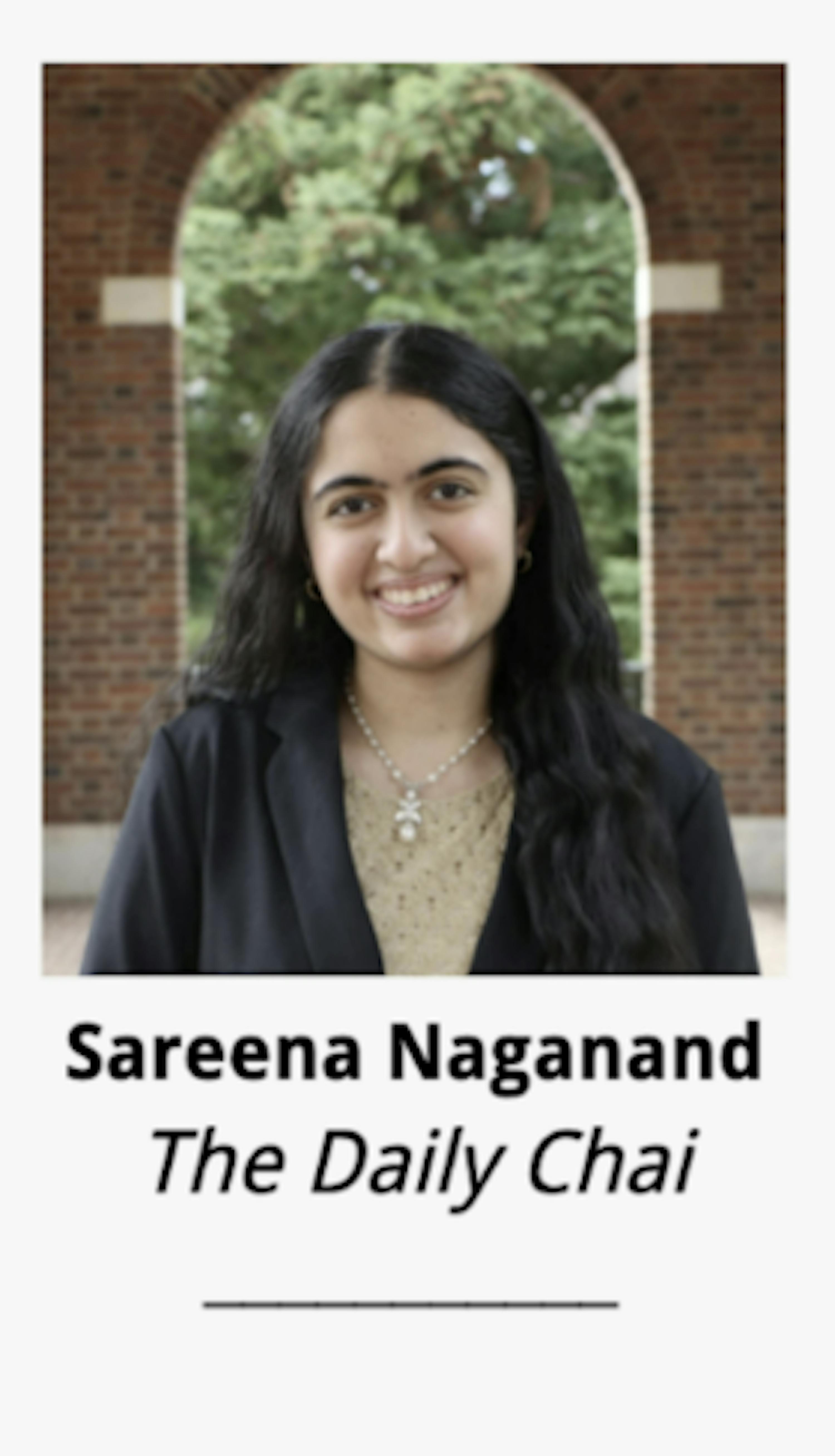
Sareena Naganand is a sophomore from Piscataway, New Jersey majoring in Biomedical Engineering. Her column, “The Daily Chai,“ is about finding happiness in simple, insignificant moments: the kind that makes us smile, wrapping around us like the warmth that comes from drinking a cup of tea.