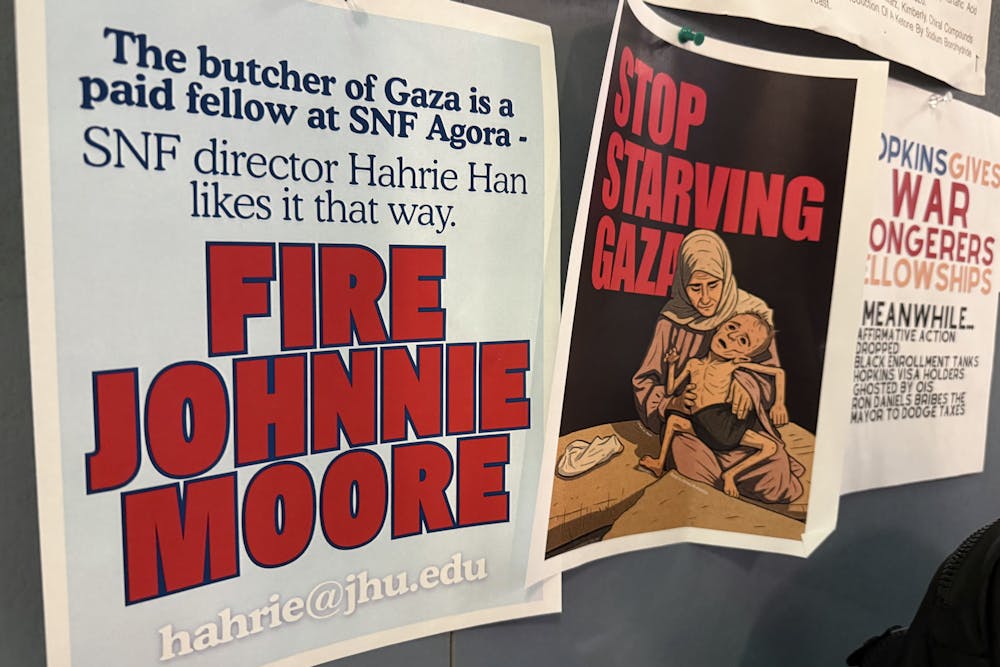
As part of the visiting fellowship program at the Stavros Niarchos Foundation (SNF) Agora, successful applicants across the ideological spectrum receive funding to pursue research projects alongside Hopkins faculty and students. Since the reveal of this academic year’s fellows, Johnnie Moore, a 2025–26 SNF Agora visiting fellow, has faced backlash due to his professional background.
Background
Moore is an evangelical who was part of a coalition of Christian leaders who visited the White House and attended policy briefings as part of the 2016 Trump presidential campaign’s evangelical advisory board. Moore served twice on the U.S. Commission on International Religious Freedom under both the Trump and Biden administrations and sits on the board of the International Fellowship of Christians and Jews. Notably, as a supporter of Israel, Moore has endorsed President Trump’s proposal of removing all Gazans from the Strip.
In June 2025, Moore was appointed the Executive Chairman of the Gaza Humanitarian Foundation (GHF). Before March 2025, the United Nations (UN) oversaw the distribution of food handouts from hundreds of locations, close to residential areas. However, the Israeli government shifted the mechanism of distribution in May, when private contractors under the GHF formed new militarized distribution sites in distinct locations, often requiring Palestinians to walk for miles in dangerous areas to obtain food. According to the UN, Israeli soldiers have killed many along these routes, while Gaza's civilians are severely malnourished and many go days without sustenance.
As of August 2025, the UN found that 994 civilians have been killed in the vicinity of GHF sites. More than 170 aid organizations have condemned the GHF, while the Humanitarian Rights Watch declared that the GHF’s actions violate humanitarian neutrality. In June, an unnamed Israeli official revealed that the Israeli government donated hundreds of millions of shekels to the GHF. The Israeli government maintains that it has not funded the organization. Multiple international experts have stated in response to allegations of Israeli government financial control of the GHF that an occupying power is unable to administer impartial aid under the principles of impartiality and equality.
While the GHF claimed that there have been no civilian fatalities in or around their aid sites, the Gaza Health Ministry reported hundreds of deaths near the GHF distribution centers in a roughly one-month span from late July through late June. Anthony Aguilar, a former Green Beret who worked under a security firm contracted by Gaza, shared with U.S. Senator Chris Van Hollen that, after disputing an order from an Israel Defense Forces (IDF) member to use violence against children attempting to get aid, his immediate supervisor told him to “never say no to the client,” later explaining that the client was the IDF, rather than the GHF. Issues like these have raised more questions about the GHF’s independence.
Moore has repeatedly cited the looting of previous aid efforts by Hamas affiliates, along with the issues in efficacy and safety of UN food distributions, including claims that armed individuals sit atop UN trucks and the UN refused to move 950 truckloads of food until GHF intervention. As of July 31, the GHF stated that they had distributed nearly 100 million meals in Gaza. Moore has said his reason for taking on the GHF directorship was to simply help feed people. Since November 2025, the GHF has suspended operations, and Moore has stepped down from his role.
University community response
Throughout the fall semester, some students have passionately advocated against Moore’s presence on campus, citing the GHF’s impact on Gazans during Moore’s tenure. While some calls for Moore’s removal have intensified, JHU College Republicans questioned whether this movement would result in the suppression of other political views. In an email to The News-Letter, JHU College Republicans viewed protests against Moore’s fellowship as harmful to free expression.
“This latest attempt to cancel a fellow is yet another example of intolerant campus leftists attempting to exert a veto over those with whom they disagree. It is harmful to free speech and detrimental to our university’s liberal arts mission,” a representative wrote. “Have these pro-Palestinian activists ever considered dialogue or debate as a means to express their resentment? Why do they presume themselves uniquely entitled above others who engage, listen and respectfully challenge ideas they disagree with?”
In late September, the Hopkins Justice Collective (HJC) began circulating a petition to terminate Moore’s fellowship due to his affiliation with the GHF. On Oct. 29, the petition was updated to reflect how GHF has suspended operations; however, the petition continues to demand fellowship termination due to “murders committed under his leadership.”
“As the former GHF director, Johnnie Moore bears direct responsibility for these atrocities in Gaza,” the petition reads. “He is not welcome at our university in any capacity. We, the undersigned, demand that the SNF Agora Institute and Johns Hopkins University take accountability and immediately revoke Moore’s fellowship.”
On Instagram, HJC posted that the GHF has replaced 400 former aid distribution points with four highly militarized locations, describing the aid centers as “death traps.”
“Gaza is under siege. Israel has maintained an aid blockade for months. Palestinians starve as famine looms,” the HJC post wrote. “The GHF, led by Johnnie Moore, aids in Israel’s genocide of Palestinians by targeting people seeking food.”
One student in International Relations who chooses to remain anonymous disagreed with HJC’s perspective and said that the University should not restrict outside voices in an interview with The News-Letter.
“Moore spent five months leading and representing an organization widely condemned by the international humanitarian community and complicit in food distributions which were at best lethally incompetent and at worst murderously orchestrated,” they said. “However, Moore should not be expelled from campus. He should not be a glorified figure, but his voice must be allowed in the conversation, the same as any other’s.”
On Sept. 23, Senator Zaynab Mirza presented the petition to a Student Government Association (SGA) meeting alongside an overview of the GHF and its relevance to SGA. Mirza sought to invite the SNF Agora Director, Dr. Hahrie Han, to an SGA meeting to discuss Moore’s appointment with students.
Mirza shared her presentation with The News-Letter. The presentation included statistics on the GHF, including condemnation of its actions by the U.N. and various humanitarian organizations.
Additionally, Mirza highlighted the University’s role in promoting public health and human rights, stating that Moore’s fellowship contradicts these values due to a lack of impartiality in the delivery of aid. The presentation stated that over 45 students and affiliates had contacted Han with concerns about Moore, though none had received responses.
In an interview with The News-Letter, Mirza elaborated on SGA’s role in this issue, emphasizing a goal for faculty to maintain an open communication with students.
“If 45 students are emailing someone and they're not receiving a response back, that's an issue. Whether it's three people or 100 students, faculty should have a transparent and open relationship, and for someone not to reply is a lack of accountability,” Mirza said. “SGA should care because we pride ourselves on accountability, bridging gaps and serving as a liaison between faculty and students. I think this is the perfect opportunity to care.”
Mirza further stated that she sought to understand the reasoning behind Moore’s fellowship. She emphasized that her stance against Moore derives from his role in the GHF rather than his ideological background.
“The way SNF Agora chooses its Visiting Fellows is not as transparent as people would imagine it is. [...] I want to know what was the thought process behind [his appointment],” Mirza said. “To appoint someone who is so far right on the spectrum where it's borderline extremism [is not] civil dialogue. [...] We are dealing with someone who is liable and legally complicit in war crimes, [and] I think that's a completely different scale.”
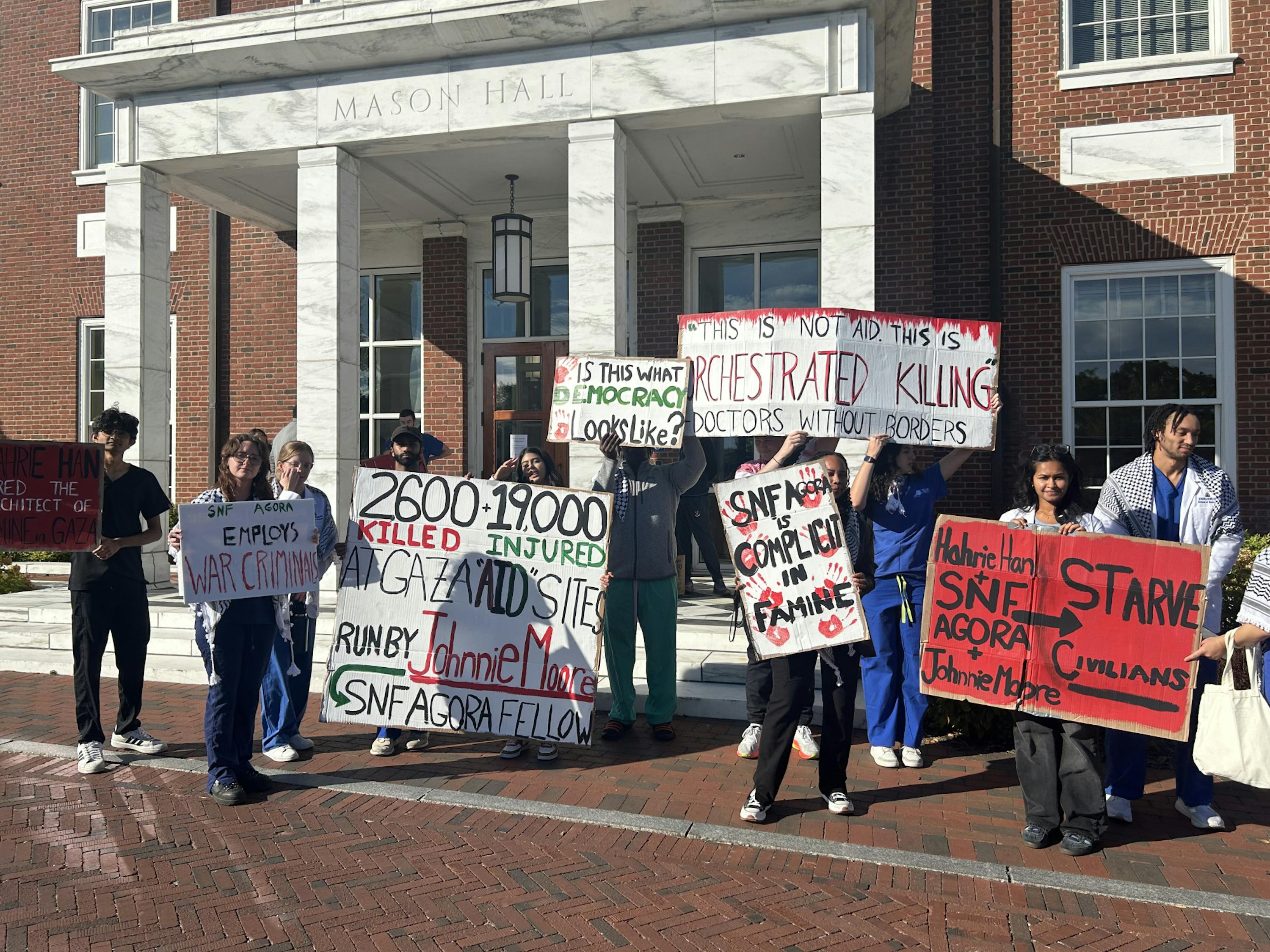
On Oct. 15, before Han attended a formal SGA meeting, about 20 medical students from the School of Medicine assembled and protested outside of the SNF Agora Democracy and Freedom Festival in Mason Hall, calling for Han to remove Moore’s fellowship.
COURTESY OF MYRA SAEED
Students from the School of Medicine demonstrated outside of an SNF Agora event against Moore’s fellowship.
In an interview with The News-Letter, a spokesperson outlined the rationale of the group’s protest, citing doctors’ accounts of gunshot casualties after GHF sites opened and UN-reported deaths in the thousands due to GHF’s collaboration with the Israeli Defense Forces.
“We don't think that Johnnie Moore should have any place or any money from Hopkins. We're here demanding that Hahrie Han take accountability for her actions and for the institute that is supposed to promote freedom and democracy, [and for her] to revoke that fellowship and stand behind her words,” the spokesperson said. “We should not be allowing war criminals and people who promote targeted and orchestrated killings of civilians. [This is not about] free speech, [it’s about] humanity.”
The medical students reported to The News-Letter that the Johns Hopkins Police Department (JHPD) began to take photos of students’ faces once they assembled outside. The students were not allowed to wear masks. In an interview with The News-Letter, a protest attendee elaborated on their experience with the JHPD.
“I just want to note that the presence of armed JHPD should never be the response to a free expression of our First Amendment rights,” a protest attendee stated. “For example, intimidation of free speech is something that scholars like Hahrie Han would know chills free speech. So the fact that there is a greater than one-to-one ratio of police to student protesters who are not disruptive, who are just expressing beliefs in not only a peaceful but a silent manner, [shows] what this university is afraid of, which is student expression, despite the fact that they profess otherwise.”
On Nov. 11, Han attended the weekly public SGA meeting, where student protestors demonstrated outside the room. During the meeting, Han stated she was unable to provide a comment on specific cases but noted that Moore has not been affiliated with the GHF for some time. When asked why she hadn’t responded to student emails advocating against Moore’s presence on campus, Han explained that the emails had been lost in her spam folder, and she had not seen them.
Outside the meeting, protestors convened in keffiyehs, handed out flyers calling for Moore’s fellowship to be revoked and held signs that read “Let us in” outside of the clear back wall. Once the meeting ended, the protest turned into a disturbance, which was shut down by SGA executives. Protestors accused SGA of censoring the meeting and Han of ignoring student voices.
In an interview with The News-Letter, junior Eli Lesher, an attendee of the event, shared his experience communicating with Han. Lesher reached out to Hahrie Han in the first week of September following his study abroad experience in Jordan, where he interviewed doctors who worked in Gaza. According to Lesher, he emailed Han six times to get a meeting scheduled in mid-November; however, after he clarified his opinion over email and asked a question in the SGA meeting, Han canceled the meeting.
“She said something along the lines of: I don't feel we need to discuss this further at this time. If I feel that a conversation with you will add value, I'll reach out,” Lesher stated. “Answering four questions at an SGA meeting was not like a good way to actually have any sense of what she believes or whether this is something that the university is seriously considering.”
Lesher added how Han’s refusal to discourse makes him question the institute’s values.
“'I’ve never seen a faculty member go to such lengths to avoid speaking with the student, especially because Professor Han's scholarship centers around dialogue across differences. And, from what I know, Professor Han hasn't really been responsive to any of the student concerns in any format that they've been delivered to her. It's making me really question if the Agora Institute is genuinely interested in dialogue,” Lesher stated.
Lesher interviewed 17 doctors from his research in Jordan who expanded on how the GHF’s distribution sites affected their work. He recalled how the doctors stated that many medical personnel were denied entry into Gaza only a few hours before they were supposed to enter. Medical officials who were allowed to enter faced severe restrictions on the food and supplies they could bring, which severely affected their on-site capabilities. Lesher shared a quote from a doctor, obtained for his research.
“It's not medicine that we're practicing there, it's patchwork. It was extremely heartbreaking, because even the physicians over there, one of them just started crying. He's like, my patients deserve better,” the doctor stated to Lesher. “This is not okay. These are premature babies that are born at no fault of their own, other than there is a war happening now, and a lot of the moms are stressed or bleeding and have complications, and we have no way of knowing what's going on. We had several babies die. I had four babies die in a matter of 24 hours at one point, because the infection was spreading — we didn’t have soap to wash our hands.”
Lesher focused on how the GHF does not reflect a humanitarian model due to its increased risk for mass casualty events during its operation. As such, Lesher supported and signed the petition, stating he aimed to avoid legitimizing Moore’s work in the GHF.
In an interview with The News-Letter, an anonymous undergraduate student involved with Speak Out Socialists further emphasized the fellowship’s role in justifying the GHF’s action.
“SNF Agora’s commitment to the sanctity of dialogue denies that reality often does not ‘end where another person’s body begins’ — that the GHF’s militarization of humanitarian aid under Johnnie Moore’s leadership resulted in the killings of over one thousand Palestinians and the starvation of countless more. Whether or not it is intentional, Agora’s steadfast refusal to re-evaluate his appointment services to legitimize his involvements beyond the institute,” the affiliate stated.
In an email to The News-Letter, the University, on behalf of the SNF Agora Institute, responded to the petition circulation and calls of student protestors against Moore. The spokesperson stated that SNF Agora fellows are selected through an application process where candidates submit a proposal for a fellowship project aiming to support democratic practices. Fellows for the 2025–26 year were chosen in March–April and were judged based on alignment with the SNF Agora mission of opening discourse on a range of issues.
The University spokesperson highlighted the goal of SNF Agora to encourage engagement with complex issues in the campus’s intellectual sphere.
“Consistent with JHU’s statements of principles on institutional restraint and academic freedom, neither the university nor the SNF Agora Institute comments on current events or external organizations; we instead encourage and foster dialogue, debate, and productive engagement with complex issues in the university community,” they wrote.
As of now, there is no resolution. Groups within the student body continue to protest, while SNF Agora has stated no intention to review Moore’s position as a fellow.