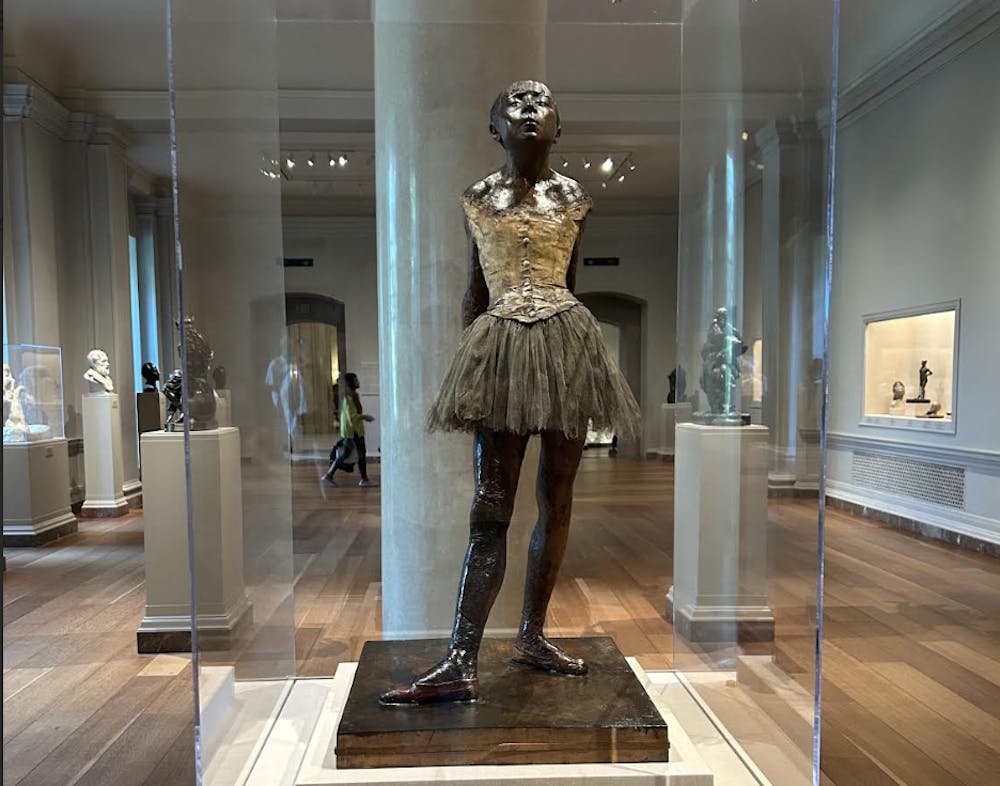
There’s a poem I keep thinking about: “Replica of the Thinker.” In it, a copy of Rodin’s famous statue sits at a museum, hunched over that familiar pose of “deep thought.” But he isn’t thinking. “His head is filled with iron and bronze,” the poet writes, “not neurons and God.” He looks like a thinker, but is he actually thinking?
I read this and feel an uncomfortable echo in myself.
There are mornings when I sit with my breakfast the same way the speaker imagines his father did years ago — with oatmeal, coffee, a newspaper and a blank stare. The poem suggests something I’ve been circling around in my own life: that we can move through the world looking like people who think, decide and shape our lives intentionally while actually living as replicas. Copies of parents, copies of expectations, copies of a life we haven’t had the chance to pause long enough to choose.
Real thinking is slow. It’s messy. It requires an inwardness that can feel intimidating. And yet we treat thinking like the default state of being present, as if it simply happens while we check our notifications or rush from our current task to our next priority. Thought becomes background noise, running behind everything else.
But what the poem gets at, which intrigued me, is the difference between appearing thoughtful and actually thinking. Between living life and performing life. Between being the original and becoming a photocopy of a photocopy.
Each version of a copy loses something.
The speaker in the poem imagines the replica trying to access profound ideas, like “patterns among celestial bodies” and “free will.” But his expression ends up “somewhere between agony and falling asleep.” It’s funny, but it also reminds us of the moments where we push ourselves to be insightful and creative yet actually end up mostly exhausted. When we strain for meaning with the same tense posture as Rodin’s Thinker, we hope some answer will finally arrive.
But maybe the problem isn’t that we aren’t thinking hard enough. Maybe it’s that we confuse the posture of thinking with the practice of thinking.
It seems that most of our lives are lived in the space between thought and non-thought. We drift into routines. We imitate the habits and expressions of the people who shaped us. We copy what seems to work. There’s comfort in that, sometimes even relief.
But there are moments when mindless living is not only allowed but necessary. The brain needs rest, of course. The heart needs stillness. There are moments when we need to pull back from the constant pressure to define or redesign our lives. Not every moment needs to be original.
But when copying becomes the default, when we move through life without asking why, our days start to flatten. We become like the replica: shaped by someone else’s mold, holding a pose that suggests depth but feels hollow.
The strange paradox is that thinking is what makes life meaningful, yet we often avoid it. Even I sometimes make myself busy and distract myself from my own thoughts. Genuine thought makes us confront who we are, what we want and our fears. It forces us to ask: am I living this life or repeating what I’ve seen? Am I choosing or copying?
If we stay in our minds too long, nothing ever changes. However, thinking too much may be problematic as well. Thinking alone makes us stuck in the bronze stillness of the statue, full of longing and potential, but unmoving.
So what does it mean to be an “original” in a world full of replicas?
Maybe originality isn’t about being different from everyone else. Maybe it’s just about being fully present in our own choices. Paying actual attention. Asking even the smallest questions. Slowing down enough to notice when we’re acting out of habit instead of intention.
Maybe life in the making is exactly that, in the making. It’s not perfected nor sculpted into permanence. It’s a gradual, ongoing process of choosing how much we think, how much we rest and how much we allow ourselves to become who we are.
The poem ends with the replica holding his pose as if some part of the world around him is about to make sense, almost. I feel that “almost” too. The near-answer.
I think that the point isn’t to force clarity but rather to stay awake to the possibility of it. To think when we can, to rest when we need and notice the difference between the two.
Kathryn Jung is a freshman from Silver Spring, MD, majoring in Biomedical Engineering. Her column reflects the process of creating and how the small things we make, notice and hold close bring meaning to everyday life.