I. Club volleyball
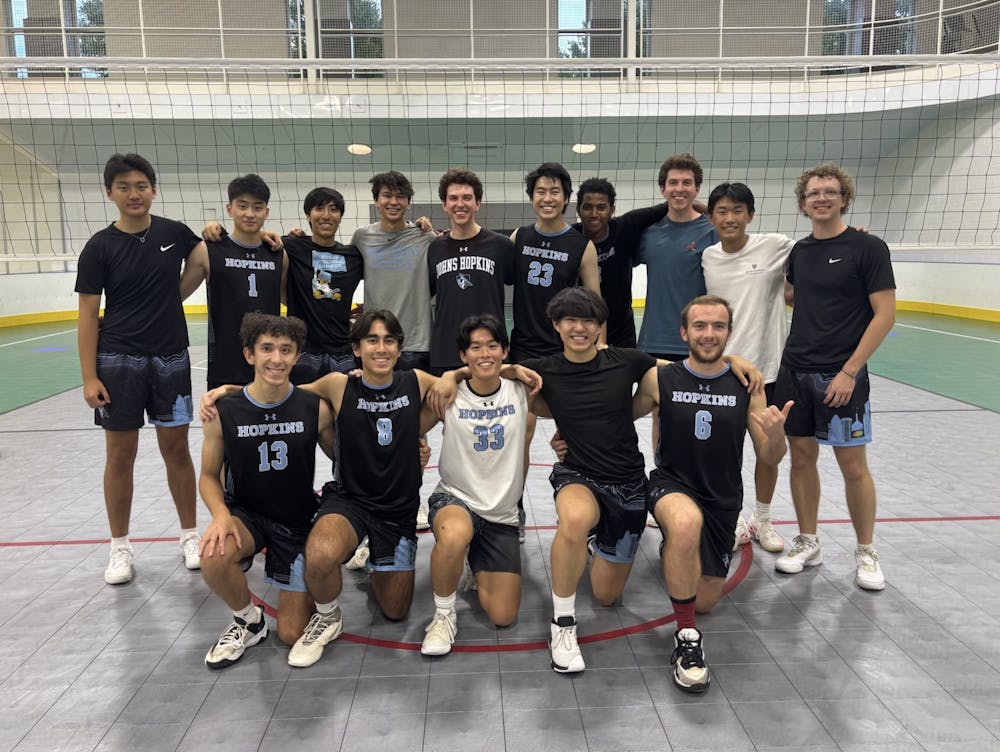
Winning the East Coast Collegiate Volleyball Association Championships for the first time in the history of the JHU Men’s Club Volleyball program was incredible. I can never forget the massive upset and the crowd lining the court, cheering as our team beat some of the best teams in the country to win it all.
But you know what might be better? The Raising Cane’s after. We didn’t even wait to shower. We drove straight there in full uniform, smelling like a musty, old volleyball gym, ordering enough chicken tenders to feed a whole army. This was not just a celebration, but a tradition. We did it after every tournament, win or lose. It was a break from thinking about lineups and staying in the tournament: just eating greasy (but tasty) chicken fingers and fries and making jokes.
My best friends came from this team. Three practices a week, tournaments almost every weekend. A lot of them were out of state, which meant road trips, plane rides and a lot of time spent together.
Even when my identical twin brother Justin and I turned down D1 offers, there are no regrets. Club volleyball at Hopkins was serious, giving me the opportunity to compete against the best teams in the country at the highest level while still having the flexibility to pursue the academic, research and clinical opportunities that brought me to Hopkins in the first place.
II. Teaching in PILOT
When I first joined PILOT as a student, I expected it to feel like a lot of other academic, tutor-like settings: quiet, a little tense and mostly focused on getting answers right.
It wasn’t.
I still remember being pulled into a name game at the start of a session — everyone scribbling their name on a piece of paper, tossing it into a Giant plastic bag for picking and then suddenly being responsible for remembering someone else’s new identity. It was chaotic and completely unrelated to calculus. But it worked. Within minutes, people who hadn’t said a word were laughing, calling things out and actually paying attention to each other. It made the rest of the session feel different, less like a place where you had to prove you understood everything and more like a space where everyone was learning and figuring things out as they went.
When I became a PILOT leader, I found myself coming back to that similar idea. I still start sessions with the name game, and it plays out almost the same every time: hesitation at first, then noise, then energy. And once that barrier is gone, everything else feels more approachable.
That’s what I’ve come to enjoy most about teaching. It’s not just explaining content but rather shaping the environment people learn in. When a session feels more open, people are so much more willing to try, to ask questions and to stay engaged even when things are confusing and difficult.
That interest carried into my role as a Teaching Assistant for Organic Chemistry I & II. In a different setting, with arguably higher stakes, the goal is still the same: help students understand material that can feel overwhelming and give them the space to work through it without shutting them down, often with some jokes and fun involved. Whether it’s answering questions outside of class or guiding problem-solving in discussion sections, I have found that the most effective moments are usually when a student is thinking out loud, unsure and willing to keep going anyway.
I am grateful for PILOT because it didn’t just help me understand calculus or organic chemistry — it showed me how much of a significant difference the right environment can make. Cultivating a fun, energetic and informative environment is something I have learned to bring into every teaching opportunity.
III. Leading with Blue Key
Blue Key Society is the Hopkins student admissions organization, where I became a tour guide for prospective and admitted students. No two tours are the same. If you’re anything like me, at some point you might have a guest suffer a medical emergency mid-tour, a parent interrogating you deeply about your Friday night plans or a fifth-grade elementary student asking what he should do now to get admitted into Hopkins in the future.
Beyond the chaos, it’s one of the most rewarding opportunities I’ve had at Hopkins. There’s a real enjoyment in talking to prospective students, answering their questions and giving them a genuine sense of what life here actually looks like. I love Hopkins, and being able to share my experiences — the academics, the incredible research, the clinical opportunities, the tight-knit community, including with the professors — (and hopefully help someone make one of the biggest decisions of their life) makes every tour worth it. And without even realizing it, you get really comfortable talking to people, handling curveball questions and scenarios, and thinking on your feet.
Brandon LeBlanc is a senior graduating with a degree in Molecular and Cellular Biology and Public Health Studies from San Diego, Calif.