“Aren’t we the song that we sing?” asks Reverend Shaw, the main antagonist of Footloose, whose authority the younger, freedom-loving characters rebel against over the course of a two-hour musical. What are the songs we’re singing? What kind of songs are the right songs to sing — and to be? On April 18, we, the News-Letter writers (Estelle Chen and Kaylee Nguyen), stepped in to find answers to these questions with the University’s very own Barnstormers’ production of Footloose!
A Footloose summary
Footloose, directed by Herbert Ross and written by Dean Pitchford, made its debut as a musical drama film in 1984. In 1988, the film was adapted into its musical form of the same name by Dean Pitchford, Walter Bobbie and Tom Snow. The show’s Broadway run lasted 12 years and was nominated for four Tony awards over its course. Although the Broadway musical incorporates new show tunes, it also includes hit songs like “Holding Out for a Hero” from the original film.
Similar to its screenplay, the narrative follows a young Ren McCormack. McCormack is a high school student who has moved from the metropolis of Chicago to the small midwestern town of Bomont. Here, he discovers that dancing is outlawed by the community’s preacher and he makes it his mission to rally together his friends and fight for the freedom to dance.
Both the 1984 film and stage musical are full of witty jokes and high-energy musical numbers that fuel the story’s central conflict. At its core, the story is defined by grief, happiness and acceptance.
Casting shout-outs
Stellar casting gave way to brilliant performances by the Barnstormers! Our special mentions include sophomore Finnigan Keane in the lead role of Ren. Ren is a smart kid — maybe too smart for his own good — and beneath all of his teenage disaffection is a genuine hope that a good, heroic speech can make a change.
Keane’s delivery was nothing short of spectacular. His loose charisma blended seamlessly with his shy awkwardness characteristic of the “new boy in town.” In all his clumsiness, Keane felt truly Ren, in a way that made you gasp, giggle and gawk. Even more moving was his take on the varying emotional beats throughout the production. Keane wielded silence like a saber, and when he begged Reverend Shaw for a chance, it was as if he was winning over us as well.
Aside from Keane, another one of our personal favorite performances was given by freshman Hannah Girges as Rusty. From her stellar vocal performance to brilliant acting and surprisingly consistent country accent, Girges demonstrates the pure desire to dance and to love, straining against society’s expectations. In a time where the world is used to “mean girl” archetypes (consider Heathers from last year’s production), Rusty, Urleen and Wendy Jo were a refreshingly happy trio. Rusty’s apparent “shallowness” was heartfelt, her jokes charming and her high school love with Willard endearing — they even have matching accents!
In sync with his counterpart, sophomore Mason Valentine was horrifyingly hilarious in his portrayal of Willard. The lovable “best-friend” was exactly that, and we found ourselves unexpectedly cheering harder for the secondary love story than the main one. Valentine’s debut show was nothing short of exceptional; his acting choices didn’t feel like choices, but like Willard himself — you could practically hear the audience silently begging him to muster up the courage to ask Rusty to dance.
Honorary mentions for superior casting choices include Prachi Pandit as Ariel, Philip Dai as Reverend Shaw, Arli Villa as Vi, Aayush Bhakey as Cowboy Bob and Audrey Kertscher as Ethel. With each line, the actors embraced the character’s dynamic development, and the world of Hopkins became Bomont.
Highlights and lowlights
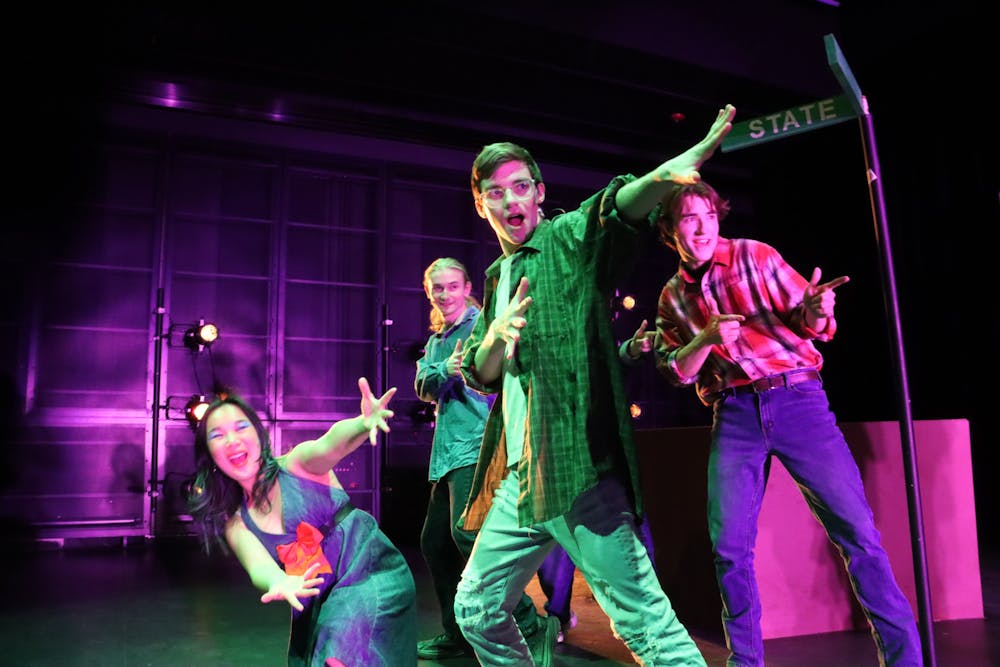
We found the show’s set design simplistically clever. The use of elevation in “Somebody’s Eyes” helped to cast Ren in a claustrophobic, inferior position, and we loved seeing the upper level transform from Ariel’s bedroom to Cowboy Bob’s stage. The props sold every setting change, and the blocking choices were particularly clever in making use of such a small area. The Bloomberg Student Center became the students’ high school and the “Burger Blast,” and we could practically feel the platform shake as Ariel and Ren watched the train pass by.
Additionally, other small technically admirable details included the comic signs during “Holding Out For a Hero” and the costume changes from the usual garb to formal outfits!
The cast and crew did a spectacular job working with their source material, and we commend the team’s hard work. In terms of improvements, the blocking of the opening sequence confused us. There were two signs, one that indicated the setting of “Chicago” and another that displayed “Bomont,” and the incorporation of the same cast for both the beginning and the rest of the musical made it seem like all of the characters were from the metropolis as well. Furthermore, we noted that some costuming choices (including the use of sneakers paired with Reverend Shaw’s priestly garb) took us out of the environment.
Final takeaways
Over the course of two incredibly entertaining acts, we followed Ren’s trials and tribulations: his fight against the tyranny of Reverent Shaw and his blossoming love for Ariel. If Orpheus has his lyre, then Ren has his two dancing feet. But Footloose is much more of a comedy than a tragedy, and Ren’s appeal to Reverend Shaw’s humanity succeeds without strings attached, unlike Orpheus’s song for Hades.
At the end of the day, we considered the musical's script itself to be a little lackluster. Indeed, a particularly negative review entitled “A Little Town Goes A Little Footloose” by Ben Brantley for the New York Times — published shortly after the musical’s Broadway debut on October 22nd, 1998 — criticizes it thus: “Any grit and spunk that belonged to ‘Footloose,’ the movie, which was silly but kind of satisfying, has been bleached and sanitized out of existence.” Can we really believe everything can be set right by the right song?
The cliche of musical theater is the idea that a character feels an emotion so deeply that they must put it into song. Song links with dance in their temporal immediacy: the aesthetic production of self-expression is every moment made afresh, and the dualism of voice and body is continuous and repeating. The attempt to fracture the relationship between song and dance sets the struggle for Footloose.
There is a sense in which this is a caricatured struggle — the musical is a little tongue-in-cheek about it too. We, students of an elite East Coast university, easily fall into the trap of caricatured conceptions of rural towns as backwards and religiously repressive.
Nonetheless, a ban on dancing feels like the logic of a fable. With a tight, bitter grip on the law and an absurd opposition to the simple joy of dancing, Shaw didn’t convince us with his sudden turn at the end of the Second Act. The perfectly wholesome ending reaches out to its audience to (not exactly politely) remind us that this musical was written with a telos to which all characters must bow. It is hard to think of dancing as radical when its banning is so easily resolved. If the stakes were never too high, and the songs we sang were never too radical, then who are we at the end of it all?
Yet the Hopkins Barnstormers’ Footloose managed to transcend some of its plot’s weaker points. This production gave us hope for the future of musical theater at Hopkins with the cast and crew’s overwhelming passion and love for theater (which is undeniable). Our song is a song of excitement: we look forward to seeing what the Barnstormers have next in store!