Lawrence Jackson, a Bloomberg Distinguished Professor in the department of English and history at Hopkins, created the Donald V. Bentley Memorial lecture in memory of his good friend who lost his life to gun violence. Jackson founded the Billie Holiday Center for Liberation Arts to “begin a regular process of sharing resources from the arts and sciences of the Homewood Campus with other portions of the city.” Each year, the center sponsors a free public lecture, and in celebration of her 200th birthday, the most recent lecture covered Frances Ellen Watkins Harper; the most prolific Black female writer of the 19th century and among the first African American women to be published in the United States.
On April 9th, the Baltimore Museum of Art hosted the sixth annual Donald V. Bentley Memorial Lecture: The Freedom Bell: An Evening with Frances Harper at the BMA. Tracey Beale, the director of public programs at the Baltimore Museum of Art, gave a brief introduction about the Billie Holiday Center for Liberation Arts and highlighted its collaboration with Hopkins and its memorial lectures. She also introduced Jackson, who set the tone for the lecture by opening with his poem, “The Flight of William Bowser.” William Bowser was a Maryland native who led a slave revolt shortly after the birth of Harper. The poem echoed the ideas of perseverance and revolution that Harper’s life embodied.
Historian Martha S. Jones, a professor at the SNF Agora Institution at Hopkins, gave a lecture detailing Harper’s life. She has evoked Harper in all of her works. She detailed the creation of the Johns Hopkins Hospital's orphan asylum and Harper’s eventual visitation that disrupted the pre-conceived, rigid notions of what Black orphaned girls were capable of, covered the breadth of Harper’s activism and work and analyzed how her speeches and poetry were effective in challenging the suffocating racism and sexism of the 19th century.
“By the 1850s, Harper was already established as an educator and published poet. In that decade, she also broke new ground; she joined the anti-slavery lecture circuit, a rarity for a Black woman, and she immediately earned notice,” said Jones. “One woman's magazine remarked how Harper tore down barriers. Mary Ann Shadd Cary, an American-Canadian anti-slavery activist who edited her own newspaper in the 1850s, described Harper's early speeches as fervent, eloquent and with almost superhuman force and power over the spellbound audience.”
Jones discussed how Harper’s successes, particularly through character and speech, manifested. Harper’s demeanor was critical to audience engagement.
“She adopted a ladylike comportment, even as her ideas were sharp edged and highly political,” said Jones. “Audiences admired her unassuming manner, graceful oratory, fervency, pathos and truthfulness. She delivered outbursts of eloquent indignation in a style of speaking, which was highly poetical, quite touching and effective. [...] Harper shared the podium with many of the era's best known anti-slavery speakers [...] men like H. Ward Douglas, Robert Purvis, Charles Remond, William Grant Still and William Howard Day — along with white women lecturers, such as Lucretia Mott and Josephine Griffin.”
Despite her professional triumphs, Harper faced many personal and fraught dangers during her travels.
Jones discussed a moment where Harper recalls a specific dangerous encounter.
“I have been insulted on several railroad cars. The other day, in attempting to ride in one of the city cars, after I had entered, the conductor came to me, and wanted me to go out on the platform [...] As a matter of course, I did not,” Harper said. “Some one interfered, and asked or requested that I might be permitted to sit in a corner. I did not move, but kept the same seat. When I was about to leave, he refused my money, and I threw it down on the car floor, and got out, after I had ridden as far as I wished.”
Then, Jones covered Harper’s far, thorough journey across the country.
Specifically, in detailing Harper’s journey, Jones moved from the men Harper shared the stage with and focused on her talent as a female speaker.
“She headlined commemorations and celebrations. She shared the bill and the podium with illustrious men, including H. Ford Douglass, Robert Purvis and Charles Remond,” said Jones. “Cary had remarked that Harper was the greatest female speaker ever. And in the post-war years, Harper proved her right. When she spoke before the American Equal Rights Association in 1866, she did not mince words about the rights of women [...] faced down figures no less formidable than Elizabeth Cady Stanton and Susan Anthony, and she was at her best, the only Black woman to speak in a gathering brimming with skilled orators.”
Most often quoted is her admonition: “They are all bound up together in one great bundle of humanity.” Jones elaborated on this quote.
“It was a fierce reframing of American politics that rejected differences of race and of sex. Harper did not dwell on property rights for the ballot,” said Jones. “Instead, her grievances emanated from the everyday indignities that Black women endured on the nation's trains and streetcars, being roughed up, ridiculed and refused service. All this, while white women passengers watched.”
According to Jones, she was one of America’s first truly intersectional feminists, someone whose analysis rejected racism, and sexism, along with differences of class and origin; “Harper's concerns only continued to broaden in the post-Civil War years, and she turned her attention to orphan children, those uniquely sheltered in care.”
“Theirs was a world shaped by slavery, anti-Black racism and, even among some Black leaders, skepticism about how far a young woman's aspirations should take her,” Jones remarked. “Harper's young life was troubled and also fortunate. She made the most of the active fortune we know while building upon a foundation that few young Black girls, even those born free, would never know before the Civil War.”
In her 1891 poem, “Out in the Cold,“ Harper reflects on justice.
Jones’ analysis of the poem incorporated Harper’s life.
“Harper knew herself to be more fortunate than most children left out in the dark and cold, and it is her humility that permits her to see herself in the face of the children who animate the poem,” said Jones. “The poem reflects the circumstances that Harper saw as she traveled through her time with women and girls, many former enslaved people among them.”
Jones’ lecture then returns to Hopkins, and how Harper and the institution shaped one another.
Harper, through her work and character, seemed to work as a counterexample to the rigid expectations set by the Hopkins orphan asylum.
“When Harper visited the girls in the Hopkins orphan asylum in 1895, she had a critical message. The girls there were trained to go into domestic service in the homes of Baltimore's elite. They would not be trained as educators or poets,” said Jones. “They would know too little about how a woman like Harper made for herself a private as well as a public life. The girls, instead, could expect to live lives of domestic service, expect to face women who might not honor their purity and men who sought to compromise it.”
Near the end of her lecture, Jones reflected on the nature of Hopkins as an institution.
In specific, she analyzed the institution’s influence on those like Harper, who were orphaned and expected to be subjugated.
“For those straining to remember the asylum and understand its meaning for the Hopkins of today,” said Jones, “Harper reminds us that in contrast, its rigid structures were not enough to hold her, and the possibilities of reform, back. The asylum began to shut its doors in 1914, but not before a new campus was built [...] It was the start of a new ambitious research institution that for generations trained young men of privilege, expecting that they would themselves someday not only make the world, but that they would head the elite homes that relied on the services of girls, such as those trained in the asylum. Hopkins was erecting halls that would launch white boys into limitless futures.”
Jones concludes the lecture by moving back to words from Harper.
She takes Harper’s most famous quote to bring together why every one of us should pay close attention to Harper and her life.
“To borrow Frances Harper's most openly quoted refrain, they were all the girls of the asylum and the boys of the university, but they were, like us, ‘all bound up together,“ said Jones at the end of her lecture.
After the lecture was over, African American spirituals in Harper’s honor were performed by Baltimore’s Jonathan Pettus Chorale, which includes many alumni of the celebrated Morgan State University Choir.
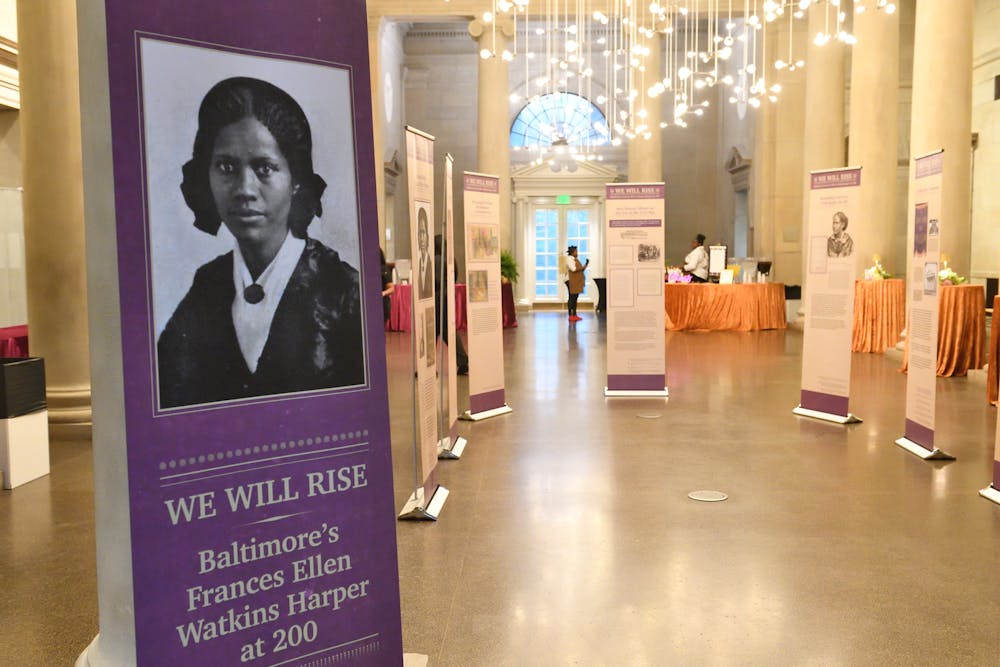
A post-performance reception was held that featured free food and drinks. Notably, this reception featured a pop-up exhibit designed by Dr. Raynetta Wiggins-Jackson. Jackson is the lead curator for Curating and Archiving Black Baltimore, an interdisciplinary position between the Billie Holiday Center for Liberation Arts and Johns Hopkins University’s Sheridan Libraries.
Currently, Special Collections in the Sheridan Libraries is hosting a Frances Harper exhibit until May 14th. The Brody Learning Commons Frances Harper exhibit is viewable from the windows of the Special Collections. This exhibit, called “We Rise,” displayed at the museum, features a map that will help Hopkins students understand how the institution itself is in spatial relation to Harper.
The Billie Holiday Center for the Liberation Arts was designed to foster restorative links between Johns Hopkins University and the historic African American communities of Baltimore, and this lecture about Harper was one of the several ways the Center invites participants to engage with significant historical events and its relations to Hopkins. The Center hosts other programs for students to attend. These events are all over Baltimore and outside of campus, actively encouraging students to grapple with the history around them.
Through art, particularly music and poetry, Harper’s revolutionary heritage has been preserved, but it also invites reflection on hope and resilience and a continued future for progressive growth.
Editor's Note, Apr. 15, 2026: This article was updated to correctly attribute several direct quotes by Jones from her lecture and correct several historical names mentioned. The News-Letter regrets this error.