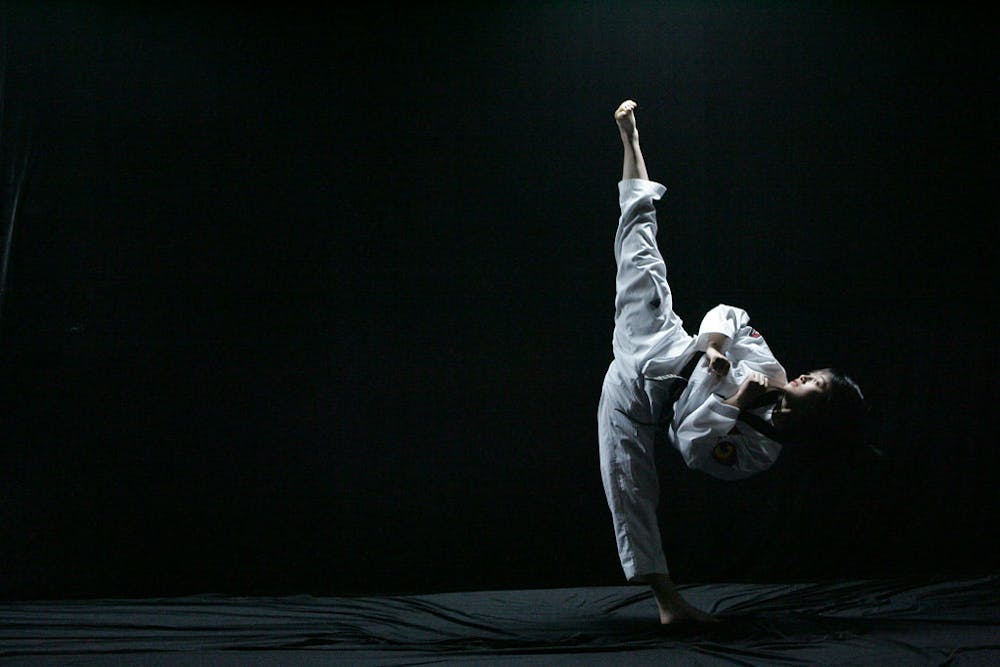
Broken up into three words, “Tae” for foot or to step on, “Kwon” for fight or fist, and “Do” for way or discipline, taekwondo is a traditional Korean martial art. Taekwondo has origins in Korea’s Three-Kingdom era, during which the Hwarang, or warriors of the Silla period, practiced Taekkyon, translating to “foot-hand.” It additionally draws from “Subak” or “Taekkyon,” describing the defense martial arts in the ancient kingdom of Koguryo practiced by the Sunbae. This was an elite warrior corps of this time period.
The two main components of the sport include sparring (kyorugi) and forms (poomsae). Sparring is a free-form fight utilizing dynamic techniques between two contestants wearing body gear with the goal of landing accurate, well-timed strikes on the opponent’s armor. Forms is a structured pattern of attacks and defense movements against imaginary opponents. Taekwondo additionally involves breaking boards or bricks, self-defense movements and other fundamental, disciplined training in movements and proper techniques.
The sport is built on five core tenets: Courtesy, Integrity, Perseverance, Self-Control and Indomitable Spirit. These shape an individual’s character, behavior and mentality, and are carried during and outside of training. The tenets are perceived as more than simply how to conduct oneself. Rather, they are about how to be transformed and actually live out these philosophies. One way this is enforced is through “Kyeongrye,” or bowing down. Bowing down is a practice of mutual respect, recognition, humility and discipline toward those of higher rank, opponents, training partners and even when entering or leaving the training mats or school. Other forms of Taekwondo etiquette include cleanliness, proper wear of the uniform (Dobok), keeping the training place (Dojang) tidy, polite addresses to higher-ranked instructors, strict adherence to punctuality and maintaining focused silence during training.
Training integrates Korean terminology, most commonly counting to 10, as well as other basic instructions. The most commonly used is “Ki-hap,” which is a shout or yell. Specifically, the “Ki” is a focus of the individual’s spiritual energy, while the “Hap” is produced by a powerful, vocal exhalation. A literal Korean translation is “to focus, or synthesize.” This practice, however, extends beyond the concentrated harnessing and demonstration of energy.
Taekwondo instructor Yoshi Ota describes it as “...the ultimate form of self representation,” with great potential to enhance strength, awareness and breathing. Ki-hap helps with fostering confidence, startling the opponent and bringing a harmonized balance between the mind and the body.
There is higher acuity formed in body control and resilience when utilizing this shout effectively. Ki-haps are commonly used during the termination of drills or sets, at specific points in forms, in self-defense and in sparring training. Different dojangs also promote various variations and lengths of this shout, such as “Ai-yah” or “Ah,” where the key practice throughout all forms is essentially starting from the diaphragm to generate needed power.
A major international organization affiliated with the sport is the International Taekwon-Do Organization (ITF). The ITF was founded in 1966 by General Choi Hong Hi, a leader of Korean resistance during Japan’s colonization of Korea and a founding member of the South Korean army. Not only is he credited with naming the sport, he also unified a breadth of civilian Martial Arts Kwans into disciplines we know today. As an active educator and ambassador of the sport, he has led demonstration teams worldwide and authored several books, including a 1972 textbook “Taekwon-Do: The Art of Self-Defence,” recognized as the “bible of Taekwon-Do.”
The ITF emphasizes discipline, practical applications and philosophies of life alongside physical, self-defense-oriented aspects. On the other hand, World Taekwondo (WT) is more sport-oriented and competition-based, mainly connected to Olympic-style taekwondo that is recognized by the International Olympic Committee. Participants wear electronic scoring gear that detects and responds to impacts via sensors. This style relies on agility, sharp reflexes, dynamic movement and high-impact kicking (since kicks score higher than punches). The spectrum of ITF hand techniques is broader than WT. Its forms additionally involve deeper stances, low kicks and self-defense, and ITF is thus known to be the more ‘traditional style’ of taekwondo.
USA Taekwondo is the National Governing Body specific to the United States Olympic Committee. This is not to be confused with the American Taekwondo Association (ATA), which is based in North America, holds its own tournaments for ATA members and includes a combination of techniques and curriculum. It was founded in 1969 by Eternal Grand Master Haeung Ung Lee, a student of General Choi. From his teachings, a new “modernized” style of the sport emerged, dubbed “Songahm Taekwondo.” This has become largely integrated into ATA-affiliated schools.
Lastly, taekwondo oversight broadly stems from Kukkiwon, the official World Taekwondo Headquarters and the sport’s governing body. Based in Seoul, South Korea, it is responsible for ranks and black belt certifications, standardized training methods and the sport’s global promotion and education.
Taekwondo is an official Olympic sport, with its demonstration debut fittingly in Korea’s capital at the 1988 Seoul Games. It then became a medal sport at the 2000 Sydney Games. Olympic taekwondo, managed by World Taekwondo, is only based on full-contact sparring. The other martial arts to be included in the upcoming 2028 Summer Olympics in Los Angeles include boxing, fencing, judo, karate and wrestling.
To this note, an important distinction is the difference between taekwondo and karate. Karate has its origins in Japanese Zen philosophy. Besides differences in organizational structures, competition formats and training regimens, there is a gap in techniques and physical expression involved. Karate leans into controlled hand techniques with slow, intentionally focused movements to achieve precision, optimized power and balance. Taekwondo is conversely known for its fluidity, dynamism and agility, incorporating force through rapid actions, mainly kicks.
All in all, taekwondo emphasizes training the mind alongside the body and finding unity within the self. The high level of preparation in confidence, leadership, mental focus and clarity, in addition to the physical benefits draws individuals of all ages and from all over the world. True strength through taekwondo is not just physical. It is enduring, disciplined and purposeful. It is a way of life.