March Madness is the annual high stakes, single elimination tournament in college basketball. There are four regions, also known as brackets, that teams are divided into based on location. The tournament has constant surprises every year. A big reason that people get so invested is due to these unexpected moments: the upsets, buzzer beaters and nail biters. However, this year’s women’s tournament demonstrated a new direction the college game is going in.
The 2026 NCAA Division I Women’s Basketball Tournament was filled with excitement, fueled by a newfound hype over women’s sports. Ever since the 2023 tournament where Caitlin Clark and Iowa faced Angel Reese and LSU in the national championship game, views have skyrocketed. At the time, Iowa was a no. 2 seed and LSU a no. 3 seed, meaning Iowa had at least 4 teams in the tournament that were ranked higher, while LSU had at least 8. The final two standing had one thing in common: they were the underdogs.
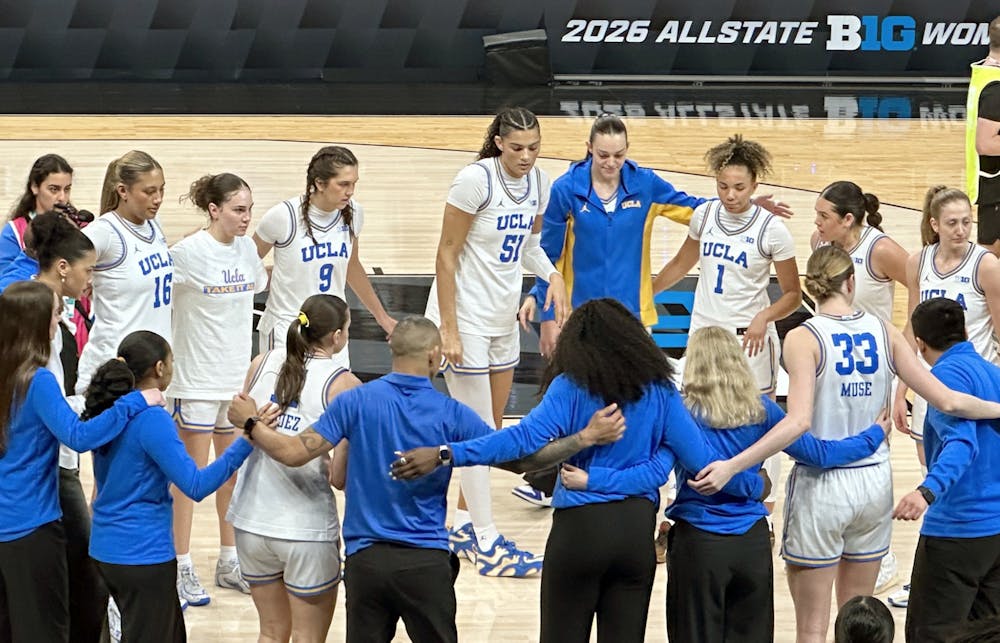
The 2026 tournament ended with a championship game of South Carolina vs UCLA. UCLA dominated, winning 79-51. Six foot seven UCLA senior Lauren Betts won Most Outstanding Player. She had a tournament average of 21 ppg, 9.8 rpg and field goal percentage of 68.8%.
There were many more stars who shined throughout the tournament. Notre Dame’s Hannah Hidalgo is as versatile as they come, averaging 25.3 ppg, 5.6 steals and 6.9 rebounds at only five foot six. Earlier in the season, she broke the DI record with a 44 point and 16 steal game, making her known as one of the best defenders in the game. UConn stars also rose to the top as players like Azzi Fudd and Sarah Strong both averaged around 19 points per game and were tremendously efficient shooters. Strong was named the National Player of the Year and Hidalgo was awarded Defensive Player of the Year.
There has been a recent shift in the game, punctuated by an expanding skill gap. There has always been a big difference in the capabilities between the 1st and 16th seeds, but not only has this become more evident, it has become apparent even within the first 3 seeds. Since the LSU vs. Iowa championship game, there has not been a 3rd seeded team present in the Final Four.
There also has been a massive emphasis on the new ‘it’ teams in the league. In the last two years, the same four teams (Texas, UConn, South Carolina and UCLA) have appeared in the Final Four. This has created much underwhelm within the tournament; people who were excited to see the underdogs come through faced constant disappointment. This year is being dubbed a chalk heavy year, which highlights the trend of higher seeds outscoring their opponents. 6 of the 32 first-round games were decided by single digits. Of the 29 other games, the winning team advanced by an average margin of 25 points. No. 1 South Carolina took the crown with its 69-point blow-by of Southern.
There are many reasons that teams like UConn, South Carolina and LSU have become superteams, some including incredible coaches and massive fanbases. Additionally, there are two new developments that have readjusted the way talent and skill are dispersed throughout the league: the commercial concept of name, image and likeness (NIL) and the transfer portal.
NIL is a way for players to make money from their own personal brand. Certain teams as a whole are more well known than others and have higher exposure, so players are now choosing teams that might maximize their future NIL income. Generally, these are teams that have more TV time, larger fan bases, are sports-centered and have more connections to deals. As a result, the best players will all cluster at the best schools in order to optimize their earnings. For example, LSU player, Flau'jae Johnson, is the nation's most valuable women's basketball player with a $1.5M NIL valuation. She is partnered with brands like Puma, JBL, Amazon, Meta and Samsung, and is also signed to Jay-Z's music label.
The transfer portal, introduced in 2018, allows students to transfer to a school they feel better accommodates their athletic needs. Prior to this, players would have to sit out a whole season at their new college and receive permission from their school to transfer (unless the coach that recruited them was leaving). Now, the transfer portal is unrestricted – any player can enter it as many times as they’d like. If a player transfers schools more than once, a waiver is required to allow them to play immediately; this was done for Louisville star Hailey Van Lith, who transferred from Louisville to LSU to TCU in the span of three years (and started for all 3 teams). This year there have been over 1300 women’s basketball players in the transfer portal, and teams, such as Tennessee, had 0 players on their roster at one point.
The portal definitely has many positives. For one, bench players don’t have to feel stuck; instead, they can go to a place that values their game and respects them as players. However, the negatives are evident as well. Notably, the best players are no longer dispersed throughout the division. Instead, they flock to the same elite teams at unprecedented levels. Notable transfers include Iowa State’s Audi Crooks, who shot 64.9% from the floor and averaged 25.8 points per game in the 2025-2026 season.
The NCAA DI Women's March Madness was more than just a tournament, it was a reflection of the evolution of women’s college basketball. What has been adored for its Cinderella story-like comebacks is now defined by influence, resources and money. If the tournament proved anything, it's that dominance may in fact be the new norm, rather than the exception, for the future of the women’s game.