The University has formally publicized its commitment to providing an accessible campus environment to students, faculty, staff and visitors with disabilities in compliance with the 1990 Americans with Disabilities Act (ADA). The ADA prohibits discrimination based on disability, instituting space and conduct guidelines for physical and mental disabilities.
Students who need to request accommodations for their disabilities work with the Student Disability Services (SDS) office. The process entails completing an online application, submitting appropriate medical documentation and scheduling a meeting with a staff member.
In an interview with The News-Letter, sophomore Kathryn Prather, majoring in Materials Science & Engineering and Economics, shared her experiences navigating accessibility resources. Prather has Postural Orthostatic Tachycardia Syndrome (POTS), which causes varied symptoms, such as dizziness, fatigue and rapid heart rate, upon standing up from lying down. As such, this year, Prather has relied more on wheelchairs and avoids staircases when possible. Prather first mentioned her experience with SDS and her impressions of their role as tailored to preventing lawsuits.
“[SDS’s] main job is to get the University to not get sued over accessibility. That is why it exists. So the way they approach student accessibility and their individual problems is interpreted through that lens,” Prather explained. “A lot of individual advisors in the office really do want to help you. It's just that their legal framework is ‘what will I do to not get the University sued?’”
As a freshman, Prather shared that the documentation she provided to SDS for accessibility services was in a different format than what was accepted. Only upon contacting a Hopkins doctor specializing in POTS was Prather able to get SDS resources.
“I come from a more rural area, and so there aren't that many primary care doctors, and they're very overworked. [SDS] wanted a really long questionnaire from my doctor about all my needs... which is great if you have a doctor that has the time or resources,” Prather said. “[After] I got into the [Hopkins POTS] clinic... [SDS] were really willing to work with me and give me my accommodations. [But] it took having a doctor that knew the correct language and had the resources, and it took me having the resources to get that doctor in order for my accommodations to be approved.”
SDS’s guidelines for physical disability forms fall under “all disabilities,” where paperwork is expected to encompass the history of the disability, functional limitations, expected progression and potential accommodations. The exact documentation form provided by SDS entails seven short response questions regarding these details.
Prather also explained that a lot of the burden falls on the student and professors with accommodation execution.
“I have some extended time on assignments if I have a flare... [SDS] wanted me to go through [with] all my professors this long document agreement thing, which just puts a ton of burden on me and my professors,” Prather stated. “[For exams,] you basically have to email all your professors, be like, ‘Hey, can you set up my exam to take it at SDS?’ And then most of your professors will be fine... [For] some professors who are on the older side, perhaps or not used to the systemm I’ve had to go back and forth [them], and if professors aren’t responsive over email, that’s a big problem.”
In terms of accessible resources, some students have noted how SDS’ website page of accommodations tends to focus more on intellectual disabilities than physical ones. Specifically, some students have pointed out that while non-stair routes exist, they are highly impractical for regular use. For example, a seemingly straightforward route between Remsen and Gilman Hall can take up to 10 minutes when taking the accessible route, including using the Remsen Hall elevator to get to the basement, going around Decker gardens through the tunnel between Gilman Hall, and entering to use the Gilman elevator.
“If it's possible to avoid stairs, it literally just takes me so much longer to get to my classes, sometimes, because I have to go all the way around,” Prather added. “They do have a shuttle service, like there's an on-demand ride thing you can get as an accommodation, which is helpful, but it takes forever. You can eventually find ways around campus, but it just is so time-intensive.”
In an email to The News-Letter, one campus tour guide, choosing to comment under the pseudonym “Pat,” shared how their accessible, non-stair route can take far longer than the typical route.
“It’s not harder to give the tour [with accessible accommodations]; it is a different route, though. And it definitely takes longer to get around campus. Of course, you can get anywhere stairless, but you just have to take longer detours.” Pat added, “There are some buildings where I still don’t know where the stairless route would be without having a super long detour.”
Specifically, Pat shared how some University ramps are unnecessarily long and difficult to locate, such as the Breezeway to Wyman Quad (which does not accessibly connect to Keyser Quad), Gilman Hall to Keyser Quad and Brody Learning Commons to Maryland Hall.
“I feel like most ramps are covered (like Shriver or Gilman) with bushes so it’s hard to find,” Pat noted.
Pat also noted the effects of the long routes on prospective students requiring physical accommodations, including frustration.
“Just seeing routes with stairs that are inaccessible but clearly faster and easier would diminish morale,” Pat wrote.
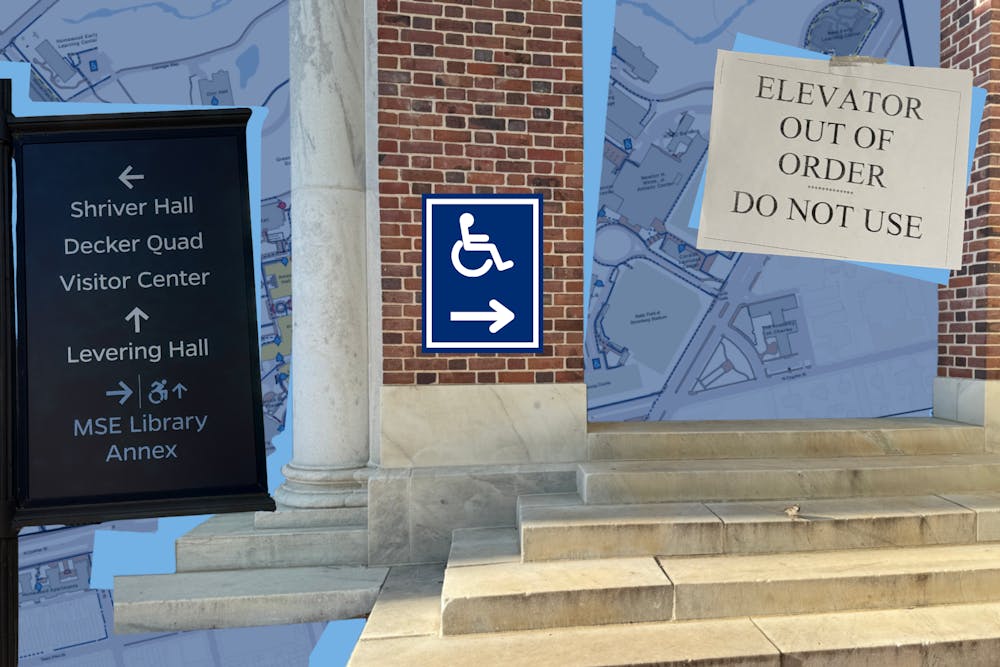
Prather, in particular, noted issues with the lack of signage and maintenance updates with elevators, such as the one in Krieger Hall. Prather also expressed that many elevators are old, which scares her from using them frequently.
“The Krieger elevator went down earlier this semester... A lot of elevators seem to go out of order randomly on campus, or they even get tested without notice... [The University] will have elevators just be down without really telling you why. I actually missed class once, because it was on the third floor of Krieger, and I came into the basement entrance, which has no stairs, because I was using my wheelchair that day, and the elevator wasn't working,” Prather shared.
Pat corroborated Prather’s claim, mentioning how the stair-less campus tour route sometimes relies on dysfunctional elevators. The Shaffer Hall elevator, for example, was also out of order for some time this semester.
“The stairless route is very reliant on the 2–3 elevators per building, some of which don’t work occasionally,“ Pat wrote.
SDS currently does not publicize its elevator outages; instead, students can request maintenance through a provided form and number. In an email to The News-Letter, the University encouraged students to report outages and provide feedback through the maintenance form and explained the protocols for marking dysfunctional elevators.
“Hopkins maintains its elevators in accordance with all applicable safety, building, and accessibility requirements. When an unplanned elevator issue occurs, our facilities team locks out the elevator and places an “Out of Service” sign,“ a University spokesperson wrote. “Elevator outages are prioritized for immediate response due to the impact on individuals who rely on elevators for access. The facilities team maintains an elevator service log to document inspections, maintenance activity, and operational status.”
SDS also promotes a quarterly-updated map with all accessible routes on their website; however, the map requires individuals to chart their own route and interpret the legend. Moreover, the University has released a Wayfinding app, which reflects updated paths on campus due to construction. According to a University spokesperson, the University had developed these resource with student input. On their website, the University outlines future plans for greater interaction.
“The university is researching mobile app capabilities that would provide an accessible experience for blind or nonvisual users, offer a more interactive experience, and be easier to update with changes,“ the University writes on the SDS website.
The University has highlighted the Bloomberg Student Center (BSC) as a building with an elevator and physical accessibility resources. However, Prather shared that some features are more varied in efficiency; for example, in Prather’s experience, the automatic doors haven’t worked consistently, and many locations are only accessible through stairs.
“The whole [BSC] is a giant staircase of a design,” she said. “There are tons of spaces that are just inaccessible, and that's fine if you want that kind of architecture, but it's very insulting when, also on the wall, you're talking about accessibility.”
With the BSC’s development, Prather shared how the garden area in front of the courtyard was now blocked off with shrubs; prior to the BSC’s construction, that was one of the only accessible routes to get on campus from North Charles Street. Other paths, including through the Baltimore Museum of Art sculpture gardens and the Beach, are not ADA-compliant due to their steep gradient. The Alumni Memorial Residence (AMR) II parking lot provided a path, but it has mostly been under construction this semester until two weeks ago.
As such, students requiring accessible routes to campus have mostly relied on the BSC with its ramp and elevators. If the BSC is closed, students who cannot use stairs would have no reliable access. Prather expressed that the University should make an accessible route on campus without relying on entering a building.
Throughout the construction projects on campus, Prather has shared that many paths have been blocked off without prior notice and some construction vehicles have parked in disabled spots.
“Behind Hodson, there's a bunch of disabled spots. It's sort of a comical number of disabled spots in a row, but I do park there, and they just had construction vehicles there — construction equipment taking up all six spots,” Prather said. “[And] it’s such a burden [to complain about this], I’m literally a disabled student trying to keep up with my coursework, like I don't have time to run around campus yelling at people.”
Notably, Prather’s physical accessibility needs vary from day to day. Prather criticized the system for lacking clarity towards uncommon and varied disabilities and medical issues.
“And so with such a wide range of disabilities, and [with] a more nebulous disability, then it's just so hard to define, and there aren't really systems in place to help you define it either. You really do just have to find it yourself and advocate for yourself,” Prather noted.
Prather expressed that the University should be more proactive in finding issues with physical accessibility. Prather recommended the Disabled Student Community Outreach (DiSCO) for students seeking guidance on navigating physical disabilities on campus.
“I think [the University should] invest more into actually finding the problems. Be more proactive as a university, versus waiting for students to have problems or for faculty to have problems [...],” Prather said. “[DiSCO is] a really good starting place for any disabled student who doesn't know what they're doing or if they're not even sure if they're disabled.”
In an email to The News-Letter, a University spokesperson reaffirmed the University’s stance to ensuring campus life stays accessible and expressed openness to ongoing feedback. For example, in recent years, the University has noted how they have updated building signage at accessible entrances, replaced eroded accessible pathways, evaluated building handrails, installed curb cuts and added interior wheelchair lifts in Shriver Hall. The University has also focused on accessibility for upcoming renovation of the Milton S. Eisenhower Library, including the lowering of the eastern entrance to remove stairs.
“Informed by student feedback, the library will feature a variety of seating options and adjustable-height tables, allowing individuals to choose what best suits their needs. New bookstacks will be appropriately spaced, with materials placed at easier-to-reach levels to support independent use. Movement throughout the building will also be improved through a comprehensive, ADA‑compliant signage system that incorporates clear visual and spatial cues for wayfinding.” A University spokesperson continued, “Hopkins understands that accessibility is essential to the full experience of campus life and works to ensure that everyone can move through our campus as smoothly, safely and efficiently as possible.”
In Fall 2024, the University established the “Hopkins Accessibility Working Group“ (HAWG), which seeks to maximize campus accessibility and amplify the voices of disabled campus members. According to a University spokesperson, HAWG has provided guidance on construction projects, held community forums (regarding signage and construction notices) and met with the Disability inclusion Advisory Committee, the Disability Employee Resource Group, Resident Advisors and DiSCO.
“These collaborations help the university identify opportunities to improve accessibility by responding to needs promptly and tracking progress over time. They also ensure partners share best practices for including people with disabilities. To reach out to the group to report a concern or advocate for increased accessibility, email HAWG@jh.edu,“ a University spokesperson wrote.