
After a very busy half-semester of rewatching all of Bridgerton and Emily in Paris while studying for my organic chemistry midterms (I am only half-kidding), I got to spend a glorious nine-and-a-half days frolicking around London and Paris with two of my best friends and my mom. I know, I am the luckiest girl in the world.
Going to Paris with my mom has been a dream of mine since my parents went for their ten-year anniversary of marriage when I was just six years old, and fifteen years later, I found myself at the site of all the photo album pictures of my mom and dad imitating famous statue poses and carrying around giant baguettes and looking cooler than I’ve ever seen them before (sorry guys, this was your peak).
Although I love a good museum, I’m very particular about which ones can keep my attention for an entire afternoon. For example, I could spend hours upon hours in New York City’s Museum of Natural History (honestly, hours in the gemstone room alone), but after running down the Guggenheim’s spiral structure once as a child, I haven’t wanted to go back. Musée d’Orsay in Paris, a favorite of my mom, is one I could return to again and again.
Though I was initially captivated by the old train station’s wide arched ceiling and intricately carved clock, my mom quickly pulled me towards the doors of our daily itinerary’s main event: a Renoir exhibit titled “Renoir and Love.” When she had initially told me that she was getting tickets for the exhibit, I imagined it to be some sort of Valentine’s Day special, paintings of couples staring, enamored, into each other’s eyes. While pieces like “Le Printemps” certainly allowed us to see romance through Renoir’s eyes, love, it turns out, is so much more than (admittedly beautiful) couples strolling lovestruck through gardens. Let’s flip through it together, shall we?
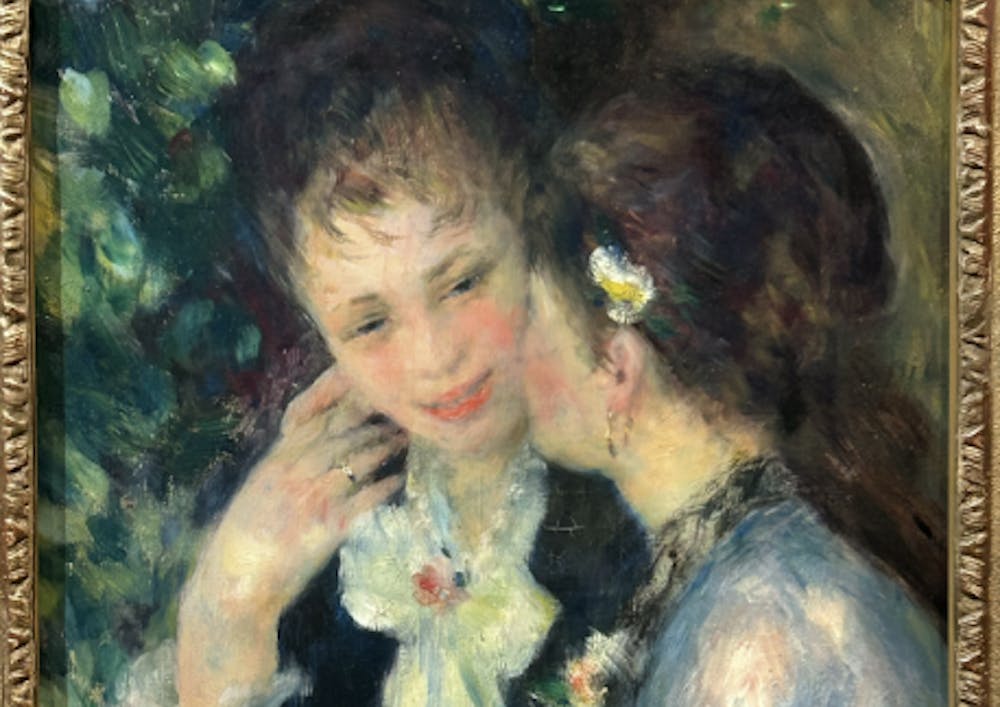
“Confidences” is a portrait of two young women sharing secrets: the body of one turned towards the ear of another, the listener with an expression of intent concentration and a hint of amusement as she takes it in. In “Confidences,” I see myself with any number of best friends. I stare at them, captivated, as they drop shocking gossip, profound realizations, an anecdote from their day. Just like Renoir’s subject, nothing exists outside of me when sharing these intimate moments, it just takes one “Guess what I heard…” to make the whole rest of the world melt away into oil paint.
“Children’s Afternoon Wargemont” shows us three young children occupied with various tasks in their living room. The oldest is sewing with the youngest holding a doll by her lap, while the apparent middle child is engrossed in a book, paying no mind to the other two. In “Children’s Afternoon,” I see myself with my two younger siblings. In a harmonious dynamic we call “parallel play,” each one of us is engaged in our own tasks while enjoying the company of the other. The middle child’s voracious reading reminds me of Ellis’ old childhood habit, while the youngest’s somewhat bored expression reminds me of baby Clara’s restless energy, easily bored by silence. There is no love like sitting in the quiet company of the people you know the best.
In a third and final favorite, “Mother and Child” depicts an aloof, fluffy-haired baby sitting on their mother’s lap. There is something here to remind everyone of their mothers and it is all in the expressions Renoir has painted. The baby looks off into the distance — maybe at a bird by the window, maybe at a painting on the wall — but the mother’s eyes are fixated on her child, gazing downward at them with a look that can only be described as love at first sight. How many moments of wonder and joy have we experienced under our mother’s loving gaze? As a first-time traveler to Paris, I am a baby, and everything is a shiny new object to stare at with fresh eyes. My mother has been here before, she is passing it down to her daughter. Whatever I am watching, she is watching me.
A Google search for “Paintings About Love” will yield almost exclusively images of couples (some of which are AI-generated, but that is a separate issue). Renoir reminds us that love, though sacred, is a limitless resource that shows up in our relationships with romantic partners, yes, but also in our relationships with parents, siblings and friends. Love is a secret whispered in the garden, it is a book you read while your sibling crafts, it is sitting with your mother while she radiates the sort of love you won’t see until it is painted and hung in a museum for all to bear witness to.
Hailey Finkelstein is a junior from Ardsley, N.Y. majoring in Medicine, Science and the Humanities. Her column shares miscellaneous prose on current issues, the collective Hopkins experience and growing up with a pen in hand.