This past spring break, I was lucky enough to travel to Hawaii with my lovely roommates, two of my favorite people. At the bag check line on our way out of The Big Island, standing beneath massive wooden ceiling fans that did next to nothing against the humid evening, one of my friends said to me, “I get it. I get what you’ve been trying to get me to do this whole time.” She said she’d brought her laptop to try and squeeze some work in, and every time she asked me when I’d do the same, I’d said some variation of wanting to forget it all and stay in the moment. Allegedly, I’d been trying to get her to be present — truth be told, I’d been giving my honest answer.
I’d spent much of the trip slowly trying to dip into the present, only really getting there toward the end. But this got me thinking about presence: whether it’s a conscious act or a state of being, whether you train into it or enter the moment only when you let everything else go. “We’re so present!” we’d joked, sweating into the tropical night, enjoying our last cool breezes before the hours of airplane air that awaited us. Then, as we inched forward toward the bag scanners, she said it was gone. She’d had a minute of presence before the upcoming flight and everything that waited beyond it crept back in.
Presence is such an elusive thing. It should be there under any circumstance, except we know that it isn’t. There are always stretches of time where we can’t recount what we did, much less what we were thinking. When you enter the hot sun, you feel it warm against your skin. The longer you stay there, or even the more times you enter, you notice this less. Give it an hour or a week or more and you’re tanned or burnt before you know it. Habituation is helpful because it means we don’t have to think about every little thing, but what happens with that freed mental space, I’d argue, falls back into habit. Rather than constantly taking in our surroundings, once we’ve absorbed enough to orient ourselves, we step back into our resting thoughts — these might be task-oriented or time-dependent, they might stretch into the past or future. What then becomes of the present?
My other roommate is taking a Jazz History class. Inspired by this, and as a result of us accompanying her to her mandatory live jazz nights out in Baltimore (oh, poor us!), I’ve started listening to jazz. I love Erroll Garner’s “Misty.” Coming off a streak of A$AP Rocky and Tyler the Creator, this slow, lilting piano felt wondrously sparse. I adored how some notes fell just barely into place, the way Garner let phrases hang suspended, as though in hesitation or in thought. Even though he must’ve run through this song dozens of times, each version keeps this feeling of path-finding. It dug into my brain like an ear worm. I noticed that whenever I listened to that space before a note fell, my mind would clear in anticipation. I’d feel my weight against a chair or my feet on the ground. I’d become suddenly embodied, experiencing the feeling of being a person within space.
I think, ironically, that I’ve been better at presence in the past. Growing up, I was acutely afraid of death and hyperfixated on playing an active role in molding myself into the person I wanted to become. In the interim, I think I’ve focused so hard on shaking this fear of dying that I forgot to also prepare myself for a life I wanted to live.
I’m past the ages that I thought I’d see and I’ve been wrestling my mind out of the idea that this is all some limbo of bought time. So I’ve been trying to sink into the present. I think I had it right as a child: the present moment is always as young as we’re going to be, and so, it is the best time to build out the life that we would choose to live. Sinking into the present lets us rewire these habits that have built out our lives, which becomes more important with the more life we’ve lived. Rather than coasting along, finding this slippery moment-by-moment feeling of being alive and human cuts through the heuristics — back into sense, into feeling and into living, actively and not by default. It’s ridiculous, but perhaps all the more worthwhile, that this is all so hard.
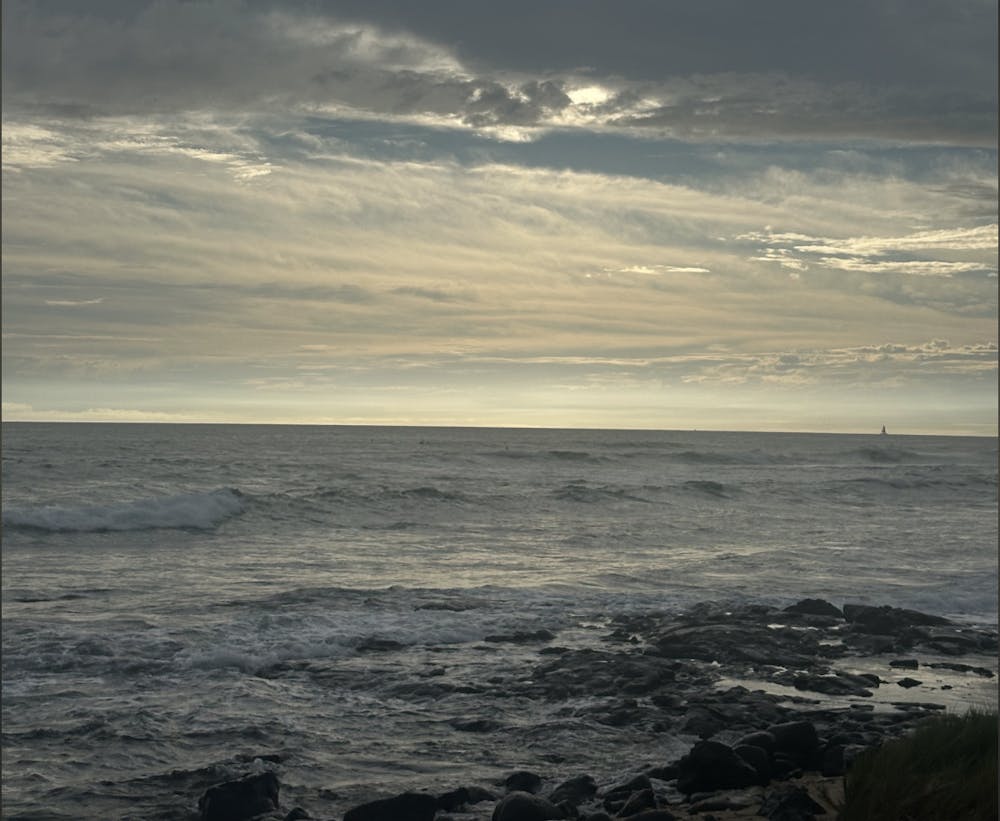
Some of my favorite moments from this past trip have been the times where I’ve felt the most embodied. Sitting on a picnic bench at the top of a scenic lookout point 2,000 feet above sea level, listening to the distant crash of waves and to cicadas waking, where there was nothing but breath and being. There, we were small, unlikely humans on top of a mountain, facing an increasingly blurred horizon of sky and ocean, and that was all we had to be. Down by fierce waves the next day, we studied crabs scuttling about volcanic rocks, listened for the thunderous rumble of particularly strong waves and watched them crash. And maybe that’s all there is to it: listening for our own waves, watching as they crash.
Kaitlin Tan is a senior from Manila, Philippines majoring in Writing Seminars and Cognitive Science. She is the Voices Editor for The News-Letter. In her column, she tries to parse through the everyday static for something to hold onto.