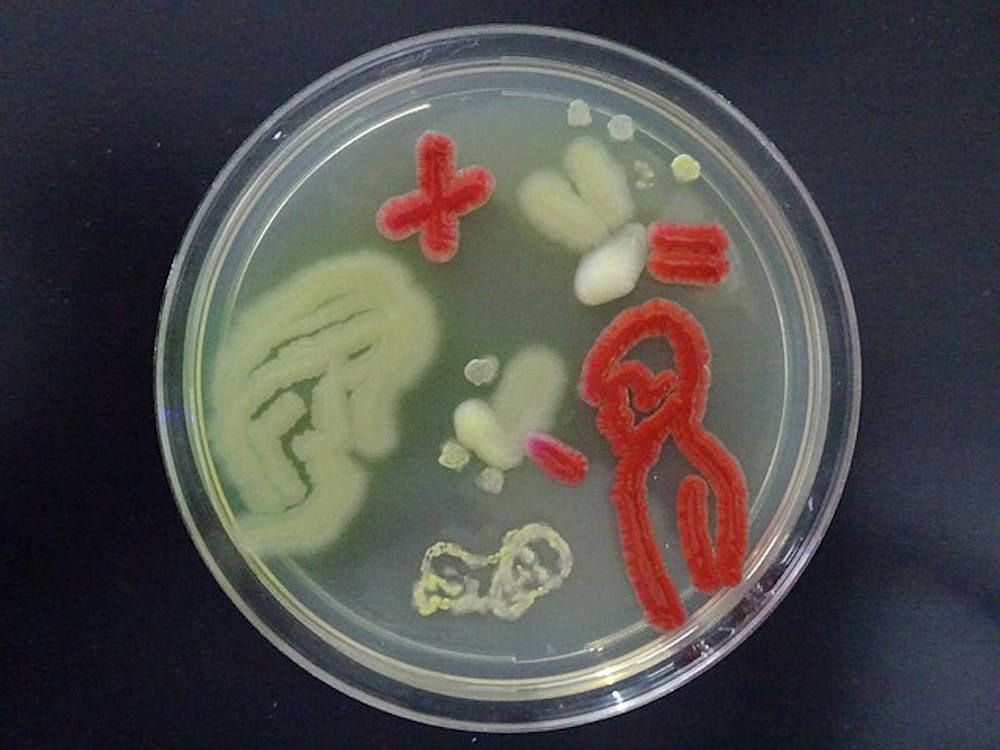
A fourth-year doctoral student in Chemical and Biomolecular Engineering at Hopkins, William Brakewood, is undertaking a new venture: the creation of a start-up, Microbiome Foundries, which designs bacteria to regulate surface microbiomes. Currently working in the Betenbaugh Lab, Brakewood’s research spans numerous topics of interest in microbiology.
His primary area of research is in the disinfection of hospital surfaces, where harmful pathogens carry the risk of infection for patients during their stay. Looking past traditional, potentially insufficient methods, Brakewood’s project seeks to design microbial strains that can be optimized for removing pathogens from these surfaces. Unlike chemical methods, this would be a more long-term solution with the bacterial strains remaining on the surface to persistently suppress pathogenic growth.
Brakewood’s research experience serves as a key source of ideas for his start-up venture, which focuses on the development of methods to control the microbiome across surfaces — not just hospital walls, but even interventions for skin or gut microbiota.
“With the hospital, the current microbiome on a surface might have a lot of harmful pathogens if you can reseed it with a beneficial microbe, then that might allow you to reduce the rate of people getting sick there. If you're doing this, for example, on your skin, a lot of body odor is actually caused by harmful microbes, right? If you can produce microbial interventions that permanently replace those microbes [with] something more beneficial, then that would be potentially useful,” Brakewood described.
While his research has its origins in working with microbial control in built environments, investigating this manner of generalized microbiome control is a long-term goal for Brakewood. Taking this forward through a start-up rather than sticking to an academic context was a deliberate choice by the researcher.
“The academic research cycle is very important. The way it tends to work is you'll come up with a really cool idea, you'll get some funds to explore that idea, maybe you find some big breakthrough and publish it. But at that point you tend to move on to the next thing,” Brakewood said. “You're basically leaving it in the hopes that someone else will come and look at this really great breakthrough and develop something with it. You don't have very many avenues in academic research to make that happen yourself.”
Rather than leaving his work for others to build on, Brakewood expressed a desire to actively continue developing these ideas further: working with regulatory agencies, commercializing his project and analyzing the demand for his breakthroughs to try and make a stronger impact.
Hopkins provided many resources for his venture. Having been interested in beginning a start-up since his arrival, Brakewood sought the support of the Pava Marie Lapere Center for Entrepreneurship.
“From there, I got into some of their accelerator programs that gives you a couple different things that I think are really essential in the early stages of doing a startup. The first thing is, they give you access to relatively early, non-dilutive funding. Through that, I've been able to set up a proper corporation, and now I have some startup lab space where I'm actually doing independent work for some of our first products,” Brakewood explained.
Brakewood especially highlighted the significance of the network he was able to tap into for his success.
“The nice thing about Hopkins is there's a lot of other people in the startup space, there's a lot of other people in the biotech space, and the challenge can just be knowing who to talk to,” Brakewood said. “We're at a pretty exciting point. We've gotten some money through winning the fuel accelerator. We set up our current lab, and recently, through the Pava Center's endorsement, we were able to win a grant from the Maryland State Government, Tedco’s Baltimore Innovation Initiative.”
When asked about his advice for other prospective start-up creators, Brakewood stressed the importance of identifying an untapped idea rather than chasing market trends.
“In general, people over index on those problems because they're the most visible. I think there's a lot of problems out there in the world that need solving. It's worth exploring those areas more, because, frankly, no one else is going to do it. In many ways, it’s a little bit easier to get people interested if you're working on something a little bit out there from a personal perspective. You'll be able to look back on yourself in five years and say, "‘Wow, this might not have happened at all (if I had not) done this,’” Brakewood reflected.
Microbiome Foundries has its early projects currently in the development pipeline, and aims to launch microbe-based products in the cleaning space by the end of the year. Moving forward, they aim to make a push into disinfectants for hospitals and pursue fundraising for research and expansion.