APRIL FOOLS’: This article was published as part of The News-Letter’s annual April Fools’ edition, an attempt at adding some humor to a newspaper that is normally very serious about its reporting. This is not true.
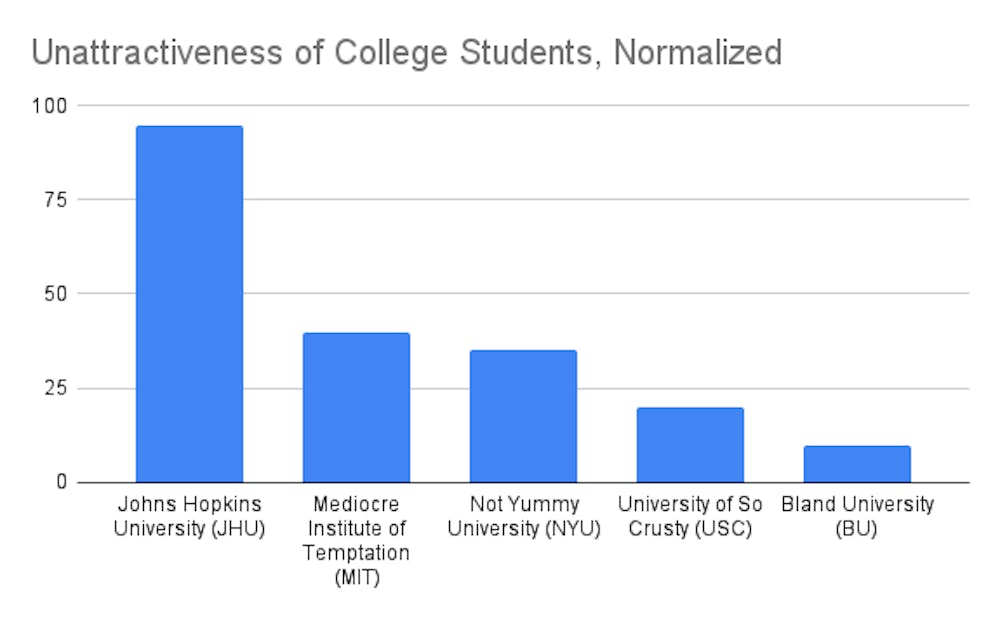
A groundbreaking longitudinal study recently published in Nature’s Journal of Misaligned Aesthetics has confirmed what local residents, visiting sports teams and the entire single population under the age of 25 has long suspected: Hopkins students are considered to have facial features considered less attractive than the national college average, landing stolidly in the 20th percentile. Comparable peer institutions have ranked considerably higher, with the Mediocre Institute of Temptation (MIT) in Cambridge, Massachusetts ranking in the 60th percentile and Bland University (BU) in the 90th percentile.
The study methodology involved interdisciplinary research by evolutionary biologists, psychologists specialized in adolescent psychology and anthropologists, with help from computer science researchers at the University to analyze the data. Dr. Anna Lysis, specialist in machine learning and facial recognition, spearheaded the efforts.
To ensure objective results, Lysis and her team utilized a custom-built neural network dubbed “SIGHT-SORE.” The AI was trained on a dataset of 500,000 images of the facial features of college students across the country who had submitted their images consensually, each of which was given scores of both objective and perceived attractiveness based on the interdisciplinary team described above.
The model identified 67 unique landmark points on each student’s face that were key differentiators between attraction levels. Hopkins undergraduates in particular exhibited two key features.
The first, identified by Lysis in an email to The News-Letter, is the “Organically Receding Hairline.” The distance between the eyebrows and the hairline was approximately 12% larger in upperclassmen compared to underclassmen. Results were further correlated to pre-medical upperclassmen and underclassmen at the University, and it was identified that this feature was especially prominent in Computer Science majors and students who had taken pre-medical prerequisite courses such as Organic Chemistry I, Organic Chemistry II and Biochemistry.
The second feature was all the more interesting because, according to Lysis, it originated from an error in the model. During initial verification, the model was also trained to ensure that it was accurately identifying human faces under the age of 25, so extraneous data points of individuals at older ages (ranging from 30–60 years old) were provided to ensure the model understood age-related differences. However, these images revealed a new phenomenon where premature aging in Hopkins students resulted in certain students being initially misclassified by the model as between the ages of 40 and 50. Students were also seen to carry a grayish tinge to their skin previously only observed in older individuals. Affectionately called “Library grey,” Lysis hypothesizes that this phenomenon is not a literal pigmentation of the hair or skin, but a unique spectral frequency emitted by students who have spent more than 72 consecutive hours in the basement levels of Brody Learning Commons.
These groundbreaking results have sent shockwaves through the University and even have helped neighborhoods. Local bars, long baffled by their own low occupancy on Friday nights, finally have a scientific scapegoat. However, Dr. Lysis insists that there is cause for hope, arguing that most adolescents care more about “what’s on the inside.”
“It’s really all about your potential — to make money, to glow up… we have to remember that beauty is subjective. Sure, [they] may have a receding hairline or concrete skin, but [their] CVs have never looked better. In the darkness of a lab, everyone’s a 10.”