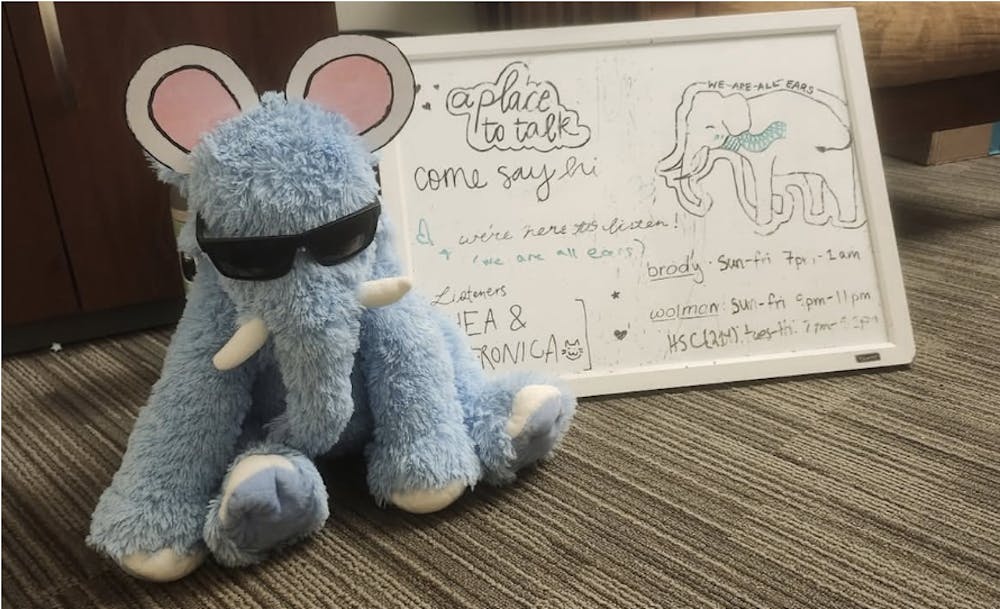

As a second-time trainer for A Place To Talk (APTT), I’ve found myself spending the last two weeks sharing lifelines for the third time. For those who aren’t familiar with the term, giving a “lifeline” refers to telling someone your entire life story, from beginning to end, and it is how we kick off every semester of APTT training: by sharing whatever feels important to us about our lives with the members of our small training group. I did it as a trainee during my sophomore year, as a trainer during my first semester as a junior, and now again for a second semester. Each time, I am awestruck at how powerful it feels to witness another person’s life experiences in totality, but this semester, it might have had its most profound impact on me. Over the course of three days, my group spent fourteen hours sharing lifelines.
When, at our second large group meeting, my co-trainer and I had to report to the other trainers that we hadn’t yet gotten through everyone’s lifeline, I was nervous about what falling behind would mean for my trainees. Not only did I want to make sure that we kept pace with the other training groups in terms of learning each listening skill, but I was also worried that they would begin to resent the training process for how unconventionally intense of a time commitment it had become. Although we normally stay pretty late for our first small group meeting due to the long-form nature of a lifeline, we rarely have to spill over into another session, much less four sessions. I was so incredibly proud of my group for committing the time and respect of fully participating in each of their group members' lifelines, but I also couldn’t help but feel guilty as I saw them working around midterms, illnesses and social commitments. If my group ever reads this, you guys are rockstars.
After a total of fourteen hours fully immersed in the lives of each one of the six of us, my co-trainer and I were thrilled to let our internal training director and faculty advisor know that we had finally finished getting through all of them. We said this with relief, as if lifelines were an enormous challenge that we had, over the course of fourteen hours, finally conquered. I was struck by our faculty advisor’s response.
Rather than shooting us a lighthearted quip about how long it took us, or congratulating us for finally finishing, she reflected that, “It’s really rare to be able to say you spent that much time on other people,” adding that, “There are very few people that [we] will be able to say [we] spent this kind of time on, that [we] know this much about.”
Whether or not her semantics were intentional, I realized I had never considered lifelines to be time spent on other people. I certainly considered it to be time spent with others, relishing the details they shared with the group, feeling honored that they felt comfortable sharing their stories with us, but I had never thought about witnessing a lifeline as a space where listening was an action directed onto someone more than simply a state of being.
I think I can speak for a lot of us when I say I spend so much time thinking about myself. I think about how much eye contact I make when I pass someone on the street. I think about my posture when I’m sitting in lecture. I think about whether the question I just asked my friend came across as rude. I think about my health, my stress, my grades, my hair. Living inside yourself like that can be exhausting, which is why so many remedies for anxiety involve meditation and being present, but APTT has taught me that the most powerful form of presence (for me at least), is spending time on other people.
Although dedicating that many hours on top of our already hectic schedules to lifelines felt stressful and hard to coordinate logistically, in practice, they were everything but stressful. Sitting on the chairs in my warmly-lit room, time seemed both to slow down and to race by as I sat totally immersed in each group member's lifeline. The ability to sit there spending time on my incredible trainees and co-trainer felt like such an immense privilege – to be on the receiving end of someone else's vulnerability and emotional openness is no small thing. When I say that witnessing a lifeline is the application of one force onto another, I mean that the speaker is putting forth the force of their storytelling, of their sharing, of their life out into the room and we, as listeners, are emanating an outward force of concentration, of active attention, of compassion for the effort it takes to bare your soul to near-strangers. To be the listener of a lifeline is not a passive act. To me, a lifeline does not feel like something you just hear, but something you receive, and the time we spent receiving lifelines was time we spent outside of ourselves.
As I received the lifelines of each speaker, I did not think about my health or my stress or my grades or my hair. In fact, I had no inner monologue, just a whole-body sense of honor to be able to listen to every piece of the life that I was allowed to witness. I have never before felt so present, and would spend fourteen more hours on those I care about again and again, completely forgetting myself as I soak up every last word.
Hailey Finkelstein is a junior from Ardsley, N.Y. majoring in Medicine, Science and the Humanities. Her column shares miscellaneous prose on current issues, the collective Hopkins experience and growing up with a pen in hand.