
I despise small talk. And it’s all over social media, too. When did it become necessary for “friends” I haven’t spoken to in years to flood my comments section with “gorgggg,” or “you’re so adorable” or “marry me pls.” I don’t really want to marry you, random stranger whose Instagram handle I barely recognize.
Was small talk really always so blasé? I sound cynical, but it’s not the length of these conversations that bothers me. It’s the lack of personalization. There’s something sickly about the sweetness of artificial platitudes, of the awkward smile and wave when you run into someone in the halls or on campus. Who decided that “Hi” and “How are you” must be responded to with “Fine”?
I am deeply introverted and I struggle with talking to new people. But most of my fear originates from my anxiety about the dreaded small talk. Even some of my closest friends default to humor as a shield during small talk because talking about how they’re really doing is too difficult.
But what if it wasn’t small talk, anymore? What if we spoke with our hearts open and earnestness to learn about each other? What if we avoided the desire to hide behind a silly little coping mechanism?
What if I were to respond to “How are you”s with “Having the worst day of my life, actually,” instead?
The most memorable encounters I’ve had aren’t resume swaps or bland commentary on the weather; they’re short and sweet but filled with meaning. It’s the girl I talked to during Orientation Week and bonded with about our brown parents and fears about college. It’s the person who texted me about how much they loved Gracie Abram’s newest album and how much it connected with them. It’s the very first set of DMs with the girl who became my roommate and best friend, where we talked about NIKI; it was the other incoming students who reached out to me three years ago and confessed their fears about graduating and their excitement for this new chapter. There was no “slay, queen!!!” in those moments, only raw, unpolished truths. It was just humans, coexisting with each other, short conversations dripping with vulnerability.
These interactions are what give me faith in our capacity to move away from predetermined conversations, from rehearsed dialogue. Small talk is a dead end — both me and you, reader, will be left standing there, waiting for our little back-and-forth to reach its intended end. But if you told me you were having the worst day of your life or told me about that terrible test you had, the end of the road disappears. There’s infinite conversation to be had, there’s relatability and empathy to share.
Of course, there’s probably some safety in the shallow end and there’s risk involved in being so open. I’m guilty of it, just as much as anyone else. Telling someone you’re not doing well is terrifying; letting someone into your own complicated life is almost like throwing a fishing line into piranha-infested waters. It’s crossed my mind that my introversion is a defense mechanism, a way to keep people at arm’s length so I can curate the parts of my personality that they actually see.
I want to end with a guide to what “big talk” looks like, for people who find themselves lost navigating past surface-level conversations.
- Don’t ask me a question I can answer in just one word. Not “How are you?” or “How was your weekend?” Ask me, “What was the best part of your week?” instead.
- Ask “why.” Why did your weekend suck? Why do you feel like your test didn’t go well? Why do you like boba so much?
- The most important rule: know when to shut up. Above all, sometimes the best small talk is no talk at all. Just sit with me in silence. We don’t need to talk all the time. Sometimes it’s enough to just sit together and be in the same room, doing your own thing.
The next time we run into each other, don't just compliment me and ask “how it’s going.” Tell me more about your weekend than whether it was good or bad. Rewrite our small talk script. And who knows? We might end up learning something about one another that brings us closer together.
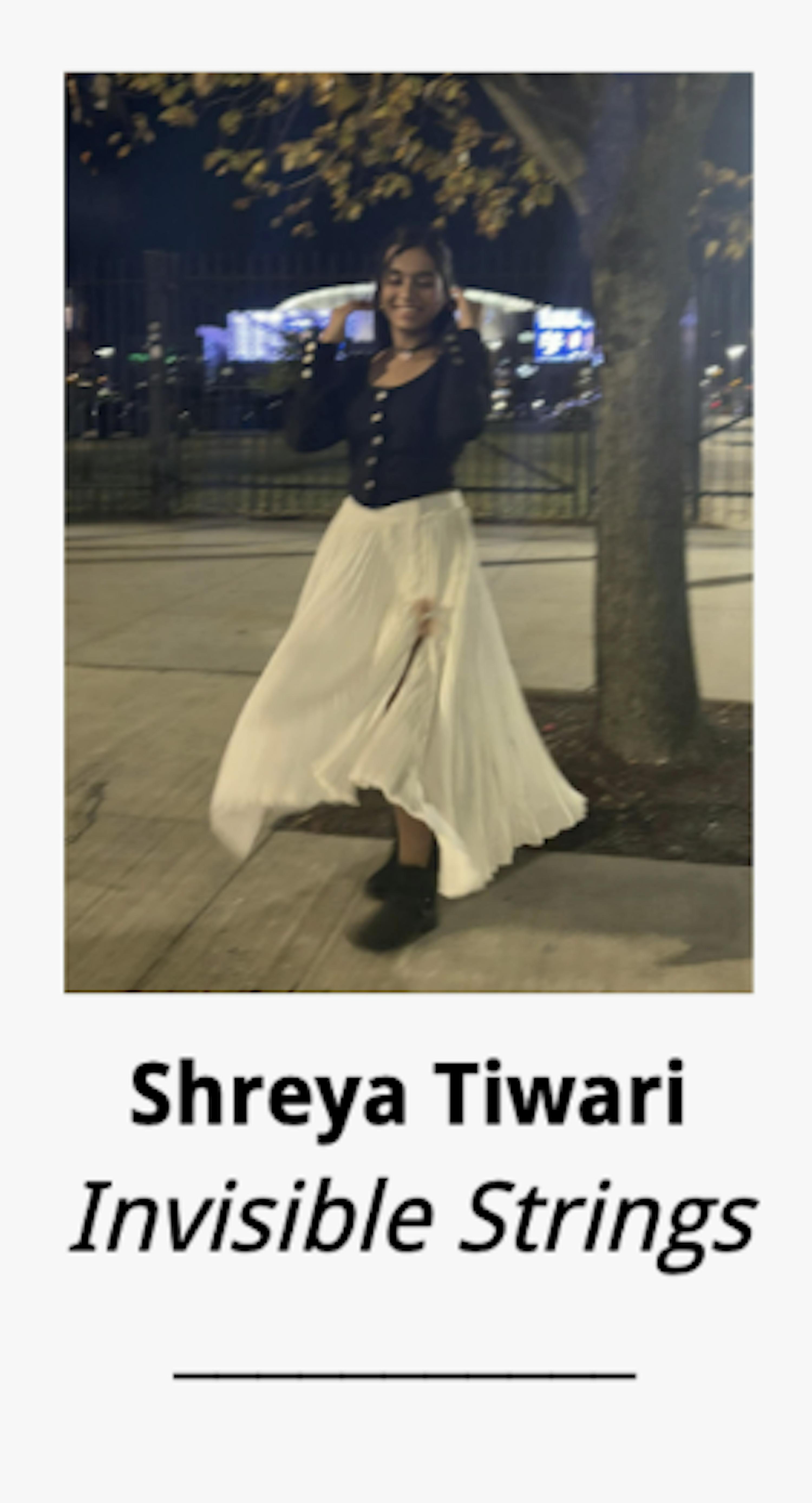
Shreya Tiwari is a junior from Austin, Texas, studying Biomedical Engineering. She is a Managing Editor for The News-Letter. Her column, "Invisible Strings," shares stories about all the people, places, and feelings to which she has “invisible strings,” intimate hidden connections that she hopes to reveal to readers with each piece.