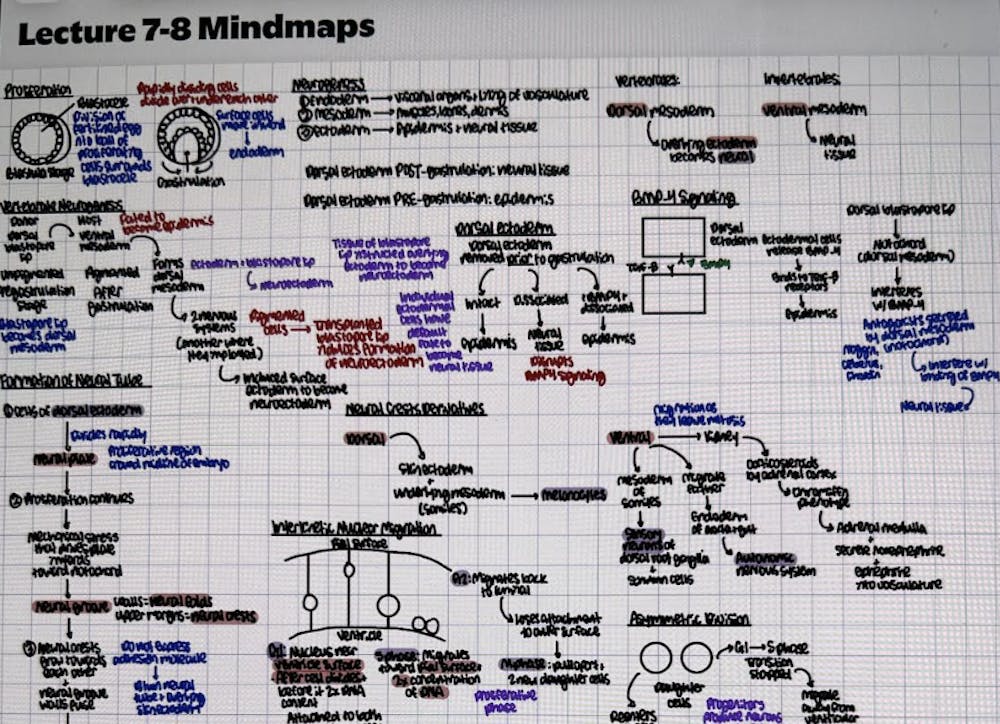

The Tuesday before the Neuroscience: Cellular and Systems I (Cells) exam, war officially begins. My body is constantly in fight or flight mode, running on too much caffeine. In every interaction with my friends, I love to complain about how cooked I am. My whiteboard is filled with scribbles of every molecular and signaling pathway and half-erased reminders that somehow make perfect sense only to me. My days blur into a loop of studying, contemplating my overall intelligence to be a neuroscience major. It might seem dramatic and a little exhausting, but by this point, I’m completely on autopilot. My phone is on grayscale. I’m hopping from the Annex to Gilman on my study crawls, barely noticing the world around me, consumed entirely by memorizing every single detail I’ve been taught. The days feel faster, the stakes feel much higher and every second is dedicated to active recall.
Every day, I dedicate all of my brain cells (no pun intended) to memorizing every single concept from the lecture slides. I read the lecture notes, eyebrows furrowing to memorize every single word at least twice to make sure I am not missing anything. I double check my Anki cards to make sure that every single piece of information mentioned in the course content is included. Every move I make is with a single-minded purpose, testing myself relentlessly and pushing every concept into memory until it basically becomes tattooed into my brain.
For all of freshman year, I’ve always had the intention of becoming a neuroscience major. However, after enduring Foundations of Brain, Behavior, and Cognition (FBBC), I had to face a significant learning curve. Despite being allowed a cheat sheet, I had to think of an entire way to think and adapt to fast-paced material. After struggling, adapting and pushing through the frustration that I wasn’t scoring as exceedingly high as my peers, I found myself questioning if I was even smart enough for the major. I would hear countless accounts on Cells on how it was basically FBBC on steroids and without a cheat sheet. There was a period that lasted a few months during freshman year where I was switching between multiple major combinations as I was sure that I wasn’t going to be a neuroscience major and that it was best to switch to an easier major for the premed route.
As it was time to officially declare a major, I ultimately decided to commit to what I originally came in as. Part of it was stubbornness, but most of it was something deeper. Even after the frustration, the late nights and the constant feeling that everyone around me understood the material faster than I did, I still couldn’t imagine studying anything else. The questions that originally drew me to neuroscience (e.g. how something as intangible as emotion can arise from electrical signals, how memory works, the beauty of neuroplasticity on how that changes us as a person) never really left my mind. Even when the coursework felt overwhelming, I truly did not believe I belonged in any other subject.
The night before a Cells exam never fails to remind me of how little I feel like I know. No matter how many hours I have spent reviewing, tracing pathways, being able to recall the text on the slides by just looking at the title, the moment I start working through the backtests and study questions, everything seems to fall apart. Questions that should feel straightforward suddenly look unfamiliar, and the answers end up being completely different from what I was thinking. Each mistake sends me back to the lecture slides’ speaker notes, highlighting a small detail I have missed.
By the time midnight passes, the realization that the exam is only hours away makes the panic set in a little more. I keep telling myself that I’ve spent days studying this material, but at that moment it’s hard not to focus on the many things I’m still getting wrong. The uncertainty feels heavier because I already know what it feels like to walk out of a Cells exam disappointed. Having scored lower than I hoped on the last one, this exam starts to feel like it carries more weight than it probably should.
Every mistake on a practice question suddenly feels like evidence that I haven’t done enough, that maybe I still don’t understand the material the way I’m supposed to. It becomes this familiar cycle: studying intensely for days, convincing myself that I finally understand the material, and then reaching the night before the exam and feeling like none of it has stuck. I’m sorry neuro gods! I promise I’ll lock in! I can totally get a perfect score if I study! If I just remember what this one slide said, I can gain back a good amount of points. Cells is just a grind after all.
By that point in the night when I hear birds starting to chirp, there’s not much left to do except trust the process that got me there. The whiteboard is full, my brain is overloaded with so much information and the exam is only a few hours away. I could cope by telling myself that I am worth so much more than a test score. I could come up with a hundred different explanations for why I still don’t feel one-hundred percent ready. All that’s left is to try to get a few hours of sleep for my memories to reconsolidate, and hope that when I sit in the exam room later that morning, my brain remembers more than it feels like right now and my abilities reflect so much more than my confidence.
Grace Wang is a sophomore from Tuscaloosa, Ala. majoring in Neuroscience. Her column chronicles life's unpredictable, beautiful mess — never neat, always honest and willing to show the chaos, contradictions and awkward truths we usually try to hide.