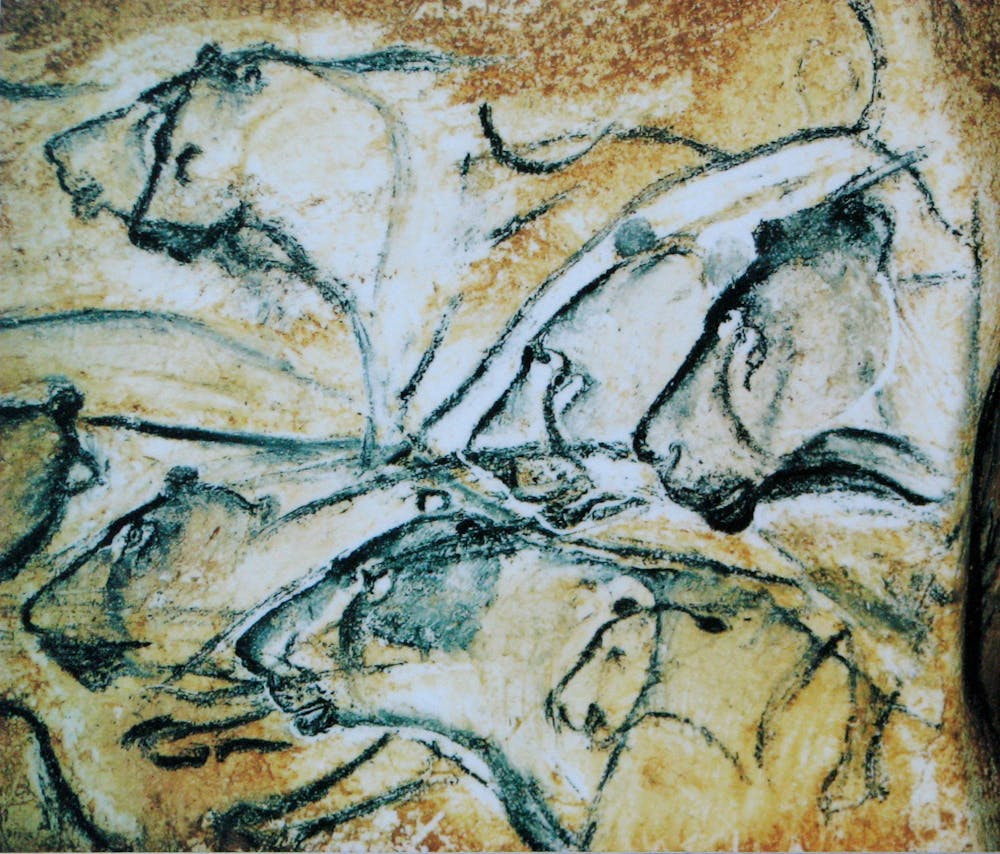
Looking back on art, we might as well start from the beginning. We know in France, in the dark wombs of mountains, there are caves filled with ancient paintings. The largest cave system, the Chauvet Cave, dates back to 32,000 years ago, and it was discovered by three cavers in 1994. It is since closed to the public; reopening the cave would grow fungi and deteriorate the cold, damp walls across which run bison and bears and horses. We know that there are prehistoric animals there — we have photos — but to keep them alive, we cannot look at them, nor be with them.
The Cro-Magnons — early European homo-sapiens — drew in the dark, save for torch light, with charcoal, red paint and engraving. With red paint in their fists, they’d open their hands against the wall, filling the cave with red dots of a pattern not exactly uniform, but not exactly wild. Something that hints, undeniably, of humanity.
On the stone walls, they coaxed out charcoal outlines of animals, still, moving, heads and bodies falling over each other in cascades, while the natural wall color filled in the rest: “the rock-face around them, which is lion-coloured, has become lion.” Studying the divots and ridges, they found natural forms and shadows for their outlines to carve out and awaken into animals. The cave was the art’s location, canvas and most primary medium.
According to Jean Clottes, a French prehistorian and archeologist, the Cro-Magnons painted on the cave to draw out its spirituality in ritual. Based on research into the cave floor, very few people ever entered the cave at a time. Clottes interprets this to mean that the Cro-Magnons likely did not see the cave as home, but rather that select, elite and specially trained shaman-painters engaged in spiritual practices within it. With their red hands, the Cro-Magnon would “summon the spirits out of the rock,” and with their outlines, they would “persuade [the animals inside the rock] to come to the rock's surface.” The earliest painters worked on and with the walls; drawing to draw out something invisible.
One of the few researchers invited to the limited openings of the Chauvet Cave, Clottes remarked: “these were hidden masterpieces that nobody had laid eyes on for thousands and thousands of years, and I was the first specialist to see them... I had tears in my eyes.” As if eyes altered what they looked at, as if the presence of a perceiver changed the perceived: the masterpieces were hidden, and virginal. The works, frozen in time, overwhelmed him.
What Clottes experienced was the aura of the Chauvet Caves. For German philosopher, art-theorist and cultural critic Walter Benjamin, aura, first coined in his seminal 1935 essay “The Work of Art in the Age of Mechanical Reproduction”, is the unique immediacy of a work of art: “its presence in time and space.” The work of art’s unique existence, its aura, fulfills a ritual function, imbuing it with sacred purpose and magic. This is the immediacy of the cave paintings to a looker like Clottes — holding some ancient secret so impossibly unknowable, yet appearing so sophisticated and modern artistic in technique; it carries the weight of millennia while preserving these sights as if time had stopped entirely — it overwhelms with the unbearable rush of the past, heavenly yet physical, sublime yet immediate.
Aura is, more or less, the medium of cultish fascination. To treasure the guitar pick of a favorite musician, to hold it in ones hand and think of their hand holding it just the same; the fact that the cult value lies in this particular piece of plastic and you could buy no other one from the store: that connection you feel to the idol is built, brick by brick, with aura. So too, standing within the Chauvet Cave, one would feel connected to the earliest humans.
But the average person, you and I, cannot experience the real caves in person. The entrance is sealed “behind a thick metal door.” French conservationists strictly monitor and regulate the temperature and airflow within the cave, learning their lesson from the disaster of the Lascaux Caves, another ancient Cro-Magnon cave system in France which opened to the public in 1948. During this time, “visitors by the thousands rushed in, destroying the fragile atmospheric equilibrium. A green slime of bacteria, fungi and algae formed on the walls; white-crystal deposits coated the frescoes.”
The public swarmed into the sacred cave like a disease. Restoration and preservation efforts to cleanse the walls of the Lascaux caves continue since its closure in 1963. Scientists have since learned that to open the Chauvet Cave to the public would be to more or less destroy it, and it was closed very soon after discovery. Instead, we have a replica: the Caverne du Pont d’Arc, a facsimile opened in 2015 scaling down the original 8,000 square meter area to 3,000. We protect the past from the present’s infestation, but the past does not emerge wholly unscathed and unchanged with the creation of the facsimile. For Benjamin, the act of reproduction involves the destruction of aura, for the creation of a double, a copy, shrinks the authority of the original’s immediate uniqueness: “the quality of its presence is always depreciated.”
Thus, Smithsonian Magazine writer Joshua Hammer feared a facsimile would reduce the miracle of Chauvet to a Disneyland or Madame Tussaud-style theme park — “a tawdry, commercialized experience.” Luckily, the faithfulness of the replication surprised him: “The paintings were copied using the austere palette of Paleolithic artists, traced on surfaces that reproduced, bump for bump, groove for groove, the limestone canvas used by ancient painters.” The perfect copy.
But, the desire to see the cave is the desire to feel the unique connection to where ancient prehistory tread — not the desire to feel astounded at the power of our ability to replicate “bump for bump, groove for groove.” Hammer defends the replication as far from a “tawdry, commercialized experience,” but his experience is nonetheless not the pure Chauvet cave, not cave as cave and nothing else, and therefore, the sights lose some of their original, spiritual magic. What dazzles is how perfectly plastic, mortar and metal replicate stone walls and stalactites. In the facsimile, the shocking beauty of ancient work is necessarily diluted with the shocking proximity to the original.
Of course, the replica widens the reach of the cave while safely preserving the original. Its creation, as well as online circulated images of the cave, are no doubt better than not seeing anything of it at all. The cave’s contents are democratized: there is a gain here. But, we must also acknowledge that there is a loss. The unique magic, made in the darkness, will bask in its darkness forever. It is not for our poisonous eyes. Looking back at the Chauvet Caves involves a false, limited look. How can we live knowing that there is this treasure beneath this fresh green earth, so near to us, knowable only under the condition that we can never know it in its most pure form; that it is destroyed should we see it? The present inherits the past, but never purely, never all.