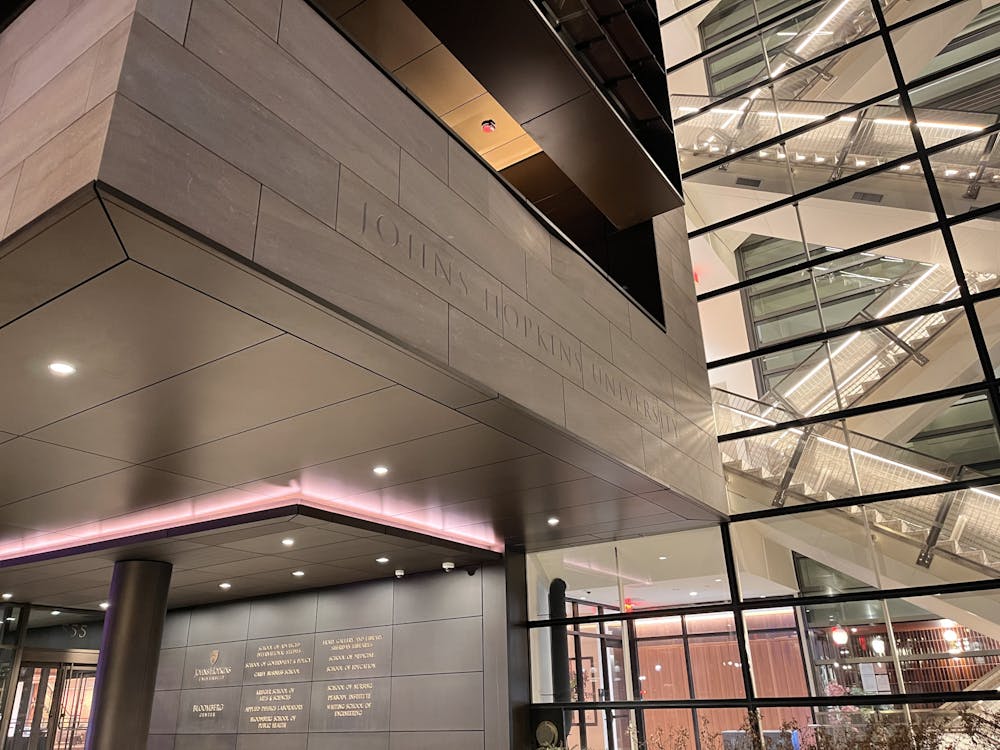
Scholars of international law, natural resources professionals and Indigenous advocates gathered on the evening of Tuesday, Feb. 24, 2026, at Johns Hopkins’ Bloomberg Center in Washington, D.C., for an evening of conversation on the implications and ramifications of the green transition worldwide. The green transition is defined as the currently in-progress global technological shift aimed at mitigating and preventing the effects of climate change through technologies such as renewable energy, sustainable infrastructure and clean transportation. Although continuing the green transition is widely accepted as necessary for the health of humankind, the International Law Society’s “Green at What Cost? Human Rights and the Energy Transition” explored the often-overlooked effects of technological development, even when ostensibly sustainable, on worldwide Indigenous communities.
The event was moderated by School of Advanced International Studies Adjunct Professor Nina Gardner and featured three guest speakers. Emily Greenspan, the co-lead for the Natural Resource Justice Global Program at Oxfam America, opened the event by introducing issues facing communities in resource-rich areas and how these issues can come to a head in light of increased global resource needs.
“[The] World Bank estimated […] we need to quadruple mineral construction by 2050 which is really scary for those of us who've been following mining. We know that minerals like lithium, cobalt, graphite, copper […] are going to be in huge demand for solar panels, wind turbines, etce […the minerals are] going to entail a number of really problematic [human rights] impacts, unless significant change happens across the sector,” Greenspan explained.
One of Greenspan’s key focuses was the idea of free, prior and informed consent (FPIC), which guarantees that communities engaging in deals should be given accurate, holistic and frequently updated information on said deals to prevent unethical business practices.
The next guest to present was Kate Finn, Founder and Executive Director of the Tallgrass Institute and a member of the Osage Nation. Finn highlighted the critical importance of self-determination, or “the right for Indigenous peoples to freely determine their political status and freely pursue their economic, social and cultural priorities” as Finn elaborated.
Further, Finn also drew focus to the fact that human rights, the green transition and business sensibilities aren’t a zero-sum game; rather, they can work in tandem.
“I think that really what we need is to continue at a measured pace with accountability to human rights, and in that way, we can solve for climate change together in a way that creates a better planet for all of us. And the thing is, we [...] know how to do that, and that is respect for free, prior and informed consent, respect for Indigenous people and building [...] human rights into business operations,” Finn explained.
The final guest to speak was Maria Lettini, who is CEO of the US Sustainable Investment Forum. Lettini discussed the economic imperative businesses have to commit to an equitable green transition, but also the economic benefits such a transition provides for firms with stake in clean technologies.
Lettini stressed that social responsibility and green technologies are a key consideration in a business’ investments and that business owners and investors in the U.S. Sustainable Investment Forum strategically utilized their positions to advocate for business- and climate-positive management decisions.
The night finished with a question-and-answer section, in which Lettini, Finn and Greenspan discussed the current state of FPIC policies, examples of when and whether Indigenous decisions were actually respected in practice and how their organizations were working to ensure an equitable green transition is reached from each of their unique perspectives as stakeholders. Gardner capped the night with a relevant reference to Indigenous author Edson Krenak’s work.
“The Earth is not just a storehouse of resources; it is life itself asking us to restore balance. Rushing to extract more minerals without reducing consumption or showing true respect for our rights is not only reckless — it is unjust and unfair,” Gardner said, quoting Krenak.
Discussion-based education is certainly not new to Gardner, and SAIS panels are no exception. In an email to The News-Letter, Gardner discussed some of the past panels she had moderated.
“I recall [a panel] on human rights issues with respect to the Qatar World Cup with the head of the International Labor Organization office in D.C., a [World Cup] sponsor representative and a representative from the U.S. State Department[‘s Bureau] of Democracy, Human Rights, and Labor [...] and another [panel] around the Dakota Access Pipeline with a number of representatives from Indigenous tribes and investors to discuss the risks of Energy Transfer Partners (the company) and various banks [...] not having done adequate human rights due diligence before financing the project,” Gardner elaborated.
This approach to learning is something that Gardner espouses in her work at Hopkins, as well. Gardner’s classes at Hopkins aim to tie the field of international law into a number of modern and emerging issues.
“All these issues are at the cross section of international law in a relatively new field of business and human rights. My course ‘Corporate Sustainability, Business and Human Rights’ takes a multidisciplinary approach to the various issues we cover — from extractives and the green transition [...] to other labor/human rights issues in supply chains, like apparel, [agriculture], as well as human rights challenges related to tech and AI,” Gardner said.
Gardner’s work is contextualized within a world that is facing drastically new issues in light of continued technological development, social injustice and environmental degradation. Gardner hopes that the interdisciplinary approaches she teaches will prepare students for this increasingly complex world, stressing that these issues must be viewed from a vast number of different perspectives.
“I hope for students to understand that they cannot live or work in a silo, that everything is interrelated [...] one cannot study or discuss the imperative for our shift to renewables without understanding the grave human rights risks this entails — for communities, especially Indigenous ones, but not only — but also for companies and investors if this green transition is not done in a rights-respecting way,” Gardner emphasized.