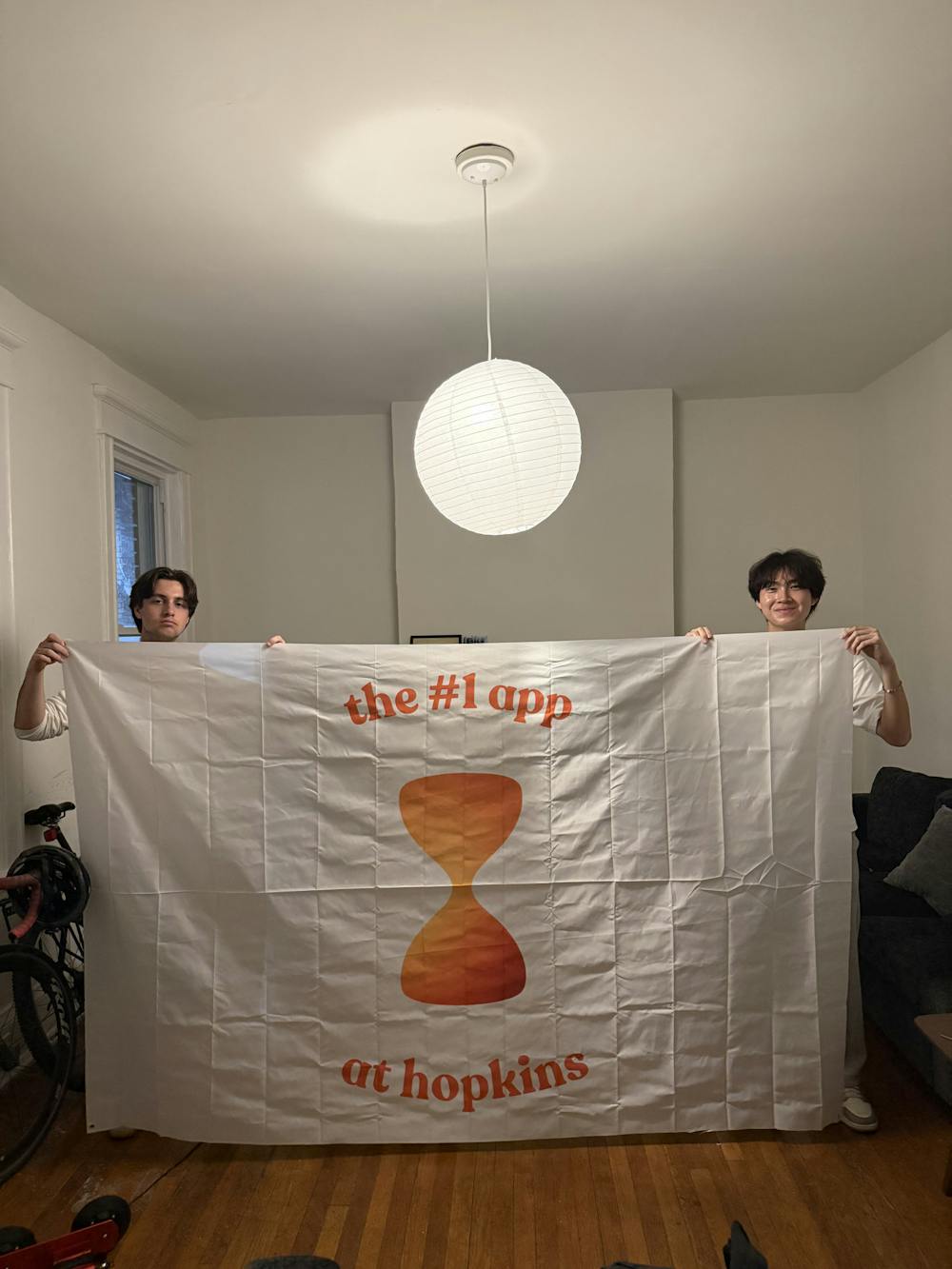
Dayli’s social media pages have been filling Hopkins students’ feeds for the better part of the semester. On Thursday, April 9, The News-Letter sat down with the team behind the platform, juniors Arthur Park and Barna Marczali, Dayli’s chief executive officer and chief operating officer, respectively, to discuss the app and their future goals.
What is Dayli? How can it be used?
From a purely functional standpoint, Dayli users are notified by the app at a random time each day, similar to the social media platform BeReal. However, instead of taking a photo, Dayli users start a one-minute phone call with one of their friends on the app. In signing up, users are prompted to share their contact list with Dayli and connect with friends by suggesting contacts that are already users on the app. Additionally, both parties to the call have a one-time option to add another minute to the call, resulting in a total possible length of three minutes. Users are also not locked into a 60-second call and can hang up at any time.
Park says that Dayli, at its core, is an easier way to help its users maintain friendships, especially with people users may not be able to see very often.
“We see Dayli as being the easiest way for you to keep in contact with people who you might not be able to see every single day. It mainly came from us being international students.” said Park. “Sometimes you just forget to keep in touch with the people who matter, and we wanted to build a solution to that exact problem.”
How does Dayli help facilitate social connection for its users?
Park highlighted an epidemic of loneliness, at least among Generations Z and Alpha, and offered social media as a potential cause.
“A large part of this is because you see modern day social media, Goliaths, like Instagram Tiktok. They're all like, really moving towards short form entertainment, and their main goal is to keep you stuck on the screen and for as long as possible,” offered Park.
He framed Dayli as a solution to this growing problem. By encouraging its users to connect with a friend for at least one minute a day, Park thinks Dayli offers an alternative to social media and all of its strings attached.
“‘We kind of wanted to be the antithesis to that exact issue, because all of that time that you're spending scrolling on [Instagram] Reels, it's time that you could have been spending with a real friend, with an actual person that you care about, with a family member. So the solution that we provide is very, very simple. You can't really scroll on our application. It's one call a day, and it's just for 60 seconds. It's really that simple,” said Park.
In terms of analytics, Park said that Dayli has grown to 500 users since the launch of its platform this semester and experienced a weekly growth rate of over 100% in addition to a user retention rate around 45%.
How have your social media campaigns helped in gaining new users for the app?
Dayli has been maintaining an active presence on social media and according to Park, the team behind Dayli believes that this is an important tool to spread awareness about the platform.
“Obviously we're meeting people where they're already at. They're on social media. They want to scroll into things. They want to see what's happening on campus and whatnot,” said Park.
Park thinks that this is just one step in the process of developing a user base. Many of their videos do not necessarily aim to convince watchers to download their app but simply try to establish a presence on social media.
“You need to have that first layer of awareness before you're really able to hit them with the reason why they should be using this application. Nobody likes to be sold things on the very first try. They want to first understand the emotion that you're trying to provide, the mission that you have. The fact that everyone knows about you makes that conversion process later down the line a lot easier,” said Park.
How has Dayli expanded into the event-planning space?
Dayli branched out into the event-planning space with an event co-hosted by the Beta fraternity on Saturday, April 11.
According to Marczali, Dayli’s events work similar to their social media presence, in that they aim to build up an on-campus presence.
“I think some of the things we've known in the past were smaller things, like hosting small challenges for short videos where people could call their friends up and play a little game to win a prize, or handing out free pizza during midterms to help out students and making it a little like fun thing for everyone,” said Marczali.
Marczali mentioned that Dayli’s biggest event so far would be the party with Beta (the interview was conducted before the event took place), but the team also has plans to expand and host more events, both larger and on the smaller side.
“We're planning a lot of year-end get-togethers that we're sponsoring in smaller or bigger student clubs and organizations, as well as maybe a couple other parties,” said Marczali. “Another thing we're thinking we have planned is a partnership with one of the one of the restaurants and boba shops on St Paul. So that's another thing that we're very excited about.”
How has Dayli changed over the course of its founding?
Early snapshots of Dayli’s website call the platform an “AI-powered scheduling assistant,” but the function of the app has changed drastically.
According to Marczali, the original idea behind Dayli was to create an AI tool that makes scheduling time with your friends easier.
Marczali said “The initial thought was ‘Hey, let's build something around planning or scheduling, because that seems to be something people struggle with.’”
However, Dayli has since evolved, most notably in its shift away from artificial intelligence.
“We actually are trying to go against the whole AI trend, because it just seems like completely unnecessary hype,” said Marczali. “We don't have any AI built into the app.”
Additionally Marczali remarked that during the launch of the app’s first concept, people were not as receptive to the planning features as the team thought they would be. Instead of using the existing scheduling features, many users would instead solely use the app to try to initiate new plans.
“While building the initial version of what Dayli was, we realized that the users didn't use it for what we thought they would use it for. They had the whole planning functionality and a lot of cool features that made planning very easy and very fast between friends or even friend groups. But what we saw is, instead of using it regularly for planning, people would just go on daily to try and initiate,” said Marczali.
Do you have any comments about the wider startup culture at Hopkins?
In light of a piece published by The News-Letter about What2Do, another Hopkins startup, Marczali made some brief comments hopeful about the future of the two platforms.
“Some of those people [at What2Do] are not only my friends, but also my fraternity brothers. So there really is nothing in between us, and hopefully we can even do some collaborations in the future.”