A little over two months ago, I turned twenty. Candles with beaming numbers had flared at me as their glossy pools of wax spilled over from the seismic shake of cake-bearing arms. I watched my mother’s eyes flicker closed as her voice took on the familiar cadence of a birthday tune.
Twenty is a decidedly consequential number by convention. It marks two decades of time on earth, which means that by now, I must have collected a lot of important things that offer me instructions on how to live, and that these things must make me more differentiated, more intelligent and more sensible. Unsurprisingly, a change in age lends me incentive to reflect on my lifetime’s material, where one thing comes to mind most clearly and easily.
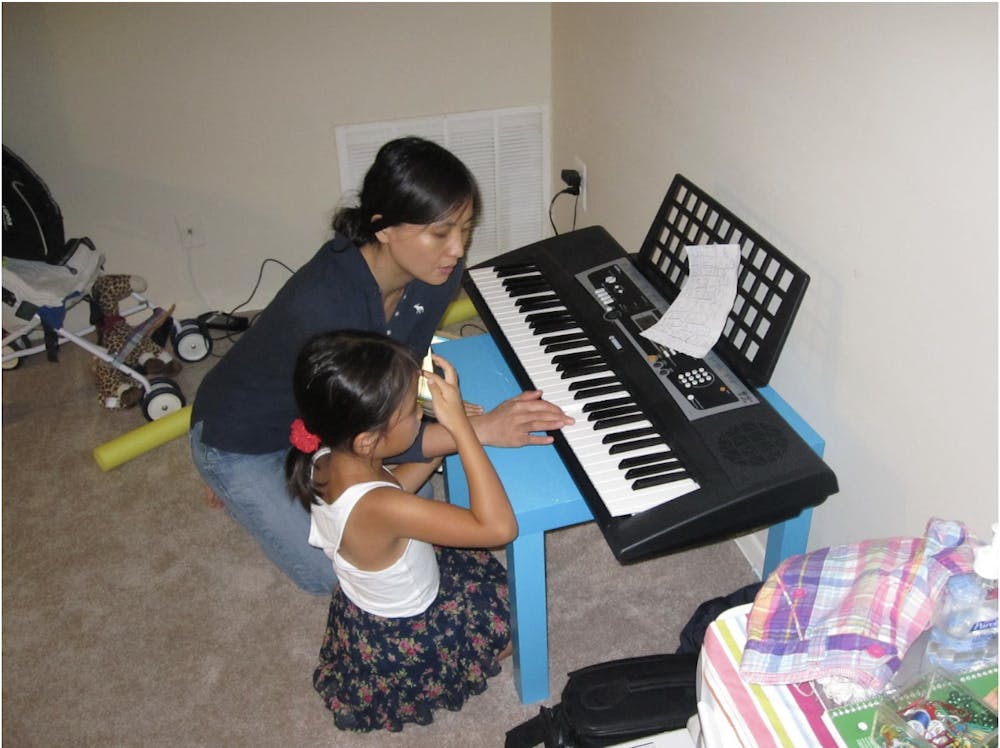
I started piano in kindergarten after tagging along with my close friend to her weekly lessons, where we excitedly left with scratch-n’-sniff stickers pressed on the backs of our palms. My only prior experience had been experimenting with the plastic digital keyboard my family had purchased a few years ago and placed in a particular corner of the bedroom, where it rested on a cerulean blue IKEA table. I hadn’t learned how to sight read music yet and found entertainment in recreating the sequences of sound I absorbed from daily life, ranging from select pop songs of the late 2010s that cycled through local radios, to a nameless melody my father liked to hum lowly in the evenings using solfège: do, do re mi, mi re do, do la so.
I remember playing the rest of that motif with my taut index finger over and over, until the notes spun like a wheel, whirring in my head as I drifted to sleep.
After formally picking up lessons from the same studio my friend frequented, my parents relinquished our Yamaha keyboard, with its beloved DJ setting and extensive demo library, to upgrade to an upright. I quickly found myself dedicating large portions of my afternoons towards practice, scouring the Suzuki book volumes for something impressive to learn, until I had finished all the intermediate material my teacher could provide and wanted a new challenge. This launched me into a vivid but short-lived period of piano competition participation where I performed the same Chopin waltzes I had studied for months on end.
“What do you think Valse de l’adieu means?” My teacher asked when I had blindly pointed to Opus 69 in A major on the repertoire list. She must have wanted me to be certain in my decision.
I learned that it translated to “Farewell Waltz”, and that Chopin had dedicated the final years of his life composing it in memory of his first but ultimately estranged lover. My teacher brushed a finger lightly over his monotone, cross-hatched portrait in her methods book, where I could faintly make out the whites of his eyes.
“I want you to think of that when you make your sound.”
And I had nodded, a little too young to grasp the heavier sentiment of a permanent goodbye, so I squeezed my eyes shut as I played, thinking, farewell, farewell, farewell.
I played piano for nearly the entirety of my childhood, and despite not being unique in this effort, its steady presence throughout many sensitive years of adolescence has made it the most forgiving figure in my life. I never pursued it to the highest level or entered a conservatory to intensify the rigor of my practice. Instead, I returned to it when I became curious, again, of what the mechanical motion of my wrists and finger pads could produce: the surge of rhythm and glissando, the low pull of melancholy or dashing lift of spirited Mazurkas. Or the resonance of a final note held captive under a fermata until I have sat in it long enough, releasing the damper pedal with a soft clunk.
There are no definitive ways to say farewell and have that mean the last.
Turning twenty isn’t necessarily too different from turning nineteen, but it terrifies me that I am always surprised by my limited foothold over time. That even though the composition of my parents' faces hasn’t changed at all — their eyes, lips, nose, ears — if I look closely, I can see the ways their features have yielded from weather, from the abrasions of expressing their energy and animation. And that even with all my musical muscle memory, I haven’t touched my piano for at least a season, my upright sitting at home, anchoring its corner like a lone monument.
When I feel worried that I am beginning to lose my touch with the things I have long loved, I think of a short excerpt from Mary Oliver’s collection of essays in Upstream. Wandering a river and having strayed from her family, she finds that being lost can coincide with arrival: “So maybe it was the right way after all…The beech leaves were just slipping their copper coats; pale green and quivering they arrived into the year. My heart opened, and opened again. The water pushed against my effort, then its glassy permission to step ahead touched my ankles. The sense of going toward the source.”
I wonder about that source. Where does it originate, and point for me to go? It must be in a place I cannot easily find, but I trust that it is there, with all loved things settled deep beneath the bedrock.
Crystal Wang is a sophomore from Baltimore, Md., studying Molecular and Cellular Biology.