
There’s a sort of ineffable magic in my hometown.
Not that it’s remarkably different from any other New England suburb, or unique in any way that truly matters. Watching familiar cityscapes rise in the distance before vanishing behind me, I sat quietly on the five-hour train ride which illuminated millions of complex, interconnected lives. Arriving home for winter break, I expected my surroundings to have changed as much as I had. While its superficial appearances remained the same, there was something different about how I saw my town.
Landmarks that had previously appeared commonplace were alive with meaning. Walking with previous iterations of myself, I strode along the path, looking out towards the water, past the wooden bench where I first told a girl I loved her and through the town square that would soon become lined with local businesses competing in the quaint but cliché yearly soup-er bowl every February. I glanced at the one-person barber shop I stopped visiting when I was twelve, and continued towards the library where I spent hours hunched over a desk, studying for the SAT in the middle of the summer. Finishing the loop, I passed the real-estate office with its flashing house signs, and saw at the ghost of myself a few weeks earlier, sitting in a car and laughing about the bizarre listing of a New Zealand mansion in a small Connecticut storefront window. To anyone else, the subsequent walk along the ocean might be a pleasant sunset view. For me, the path from my house to the beach was where I first felt at peace putting my phone down, breathing and looking up.
Madison, Conn., will forever be imbued with that kind of magic you can only really know as a kid. I have walked these same paths before, and I will again. But it won’t quite be the same. Every visit, I come back different. I try to recreate the thoughts of the kid who felt lost, or in love, or hopeless, each time I come back. Yet he isn’t me, and I am no longer him. The only thing that ties us together is the town we grew up in.
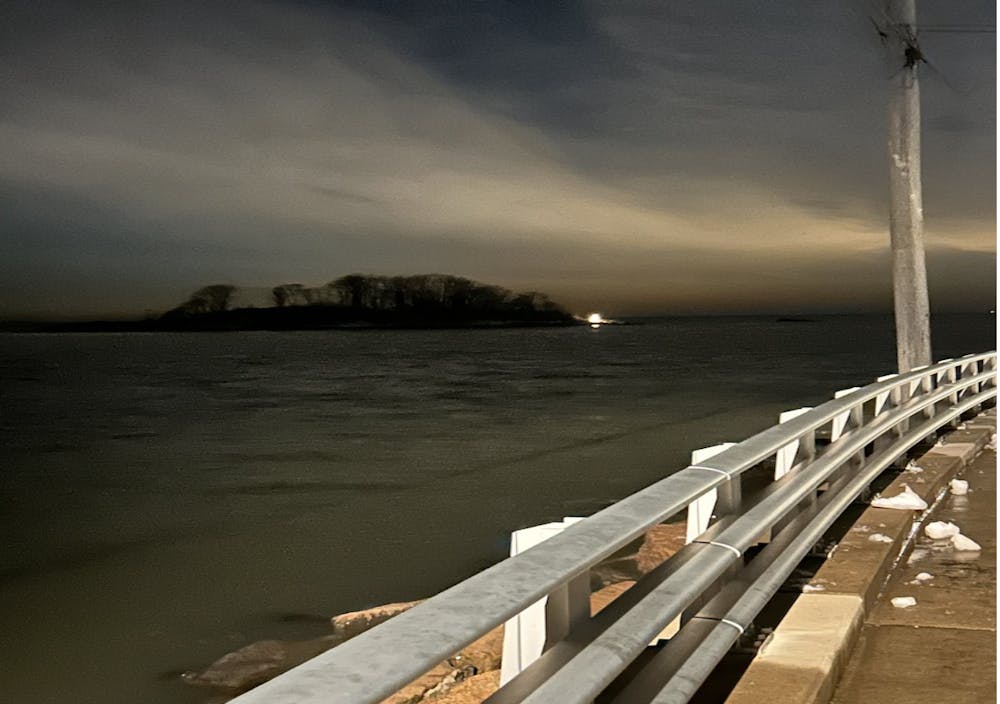
From early December to mid-March, a single Christmas tree remains lit each night. On a small, uninhabited island, across the Long Island Sound, its glow illuminates the water, the reflection visible from my window. I don’t think I will ever know how it got there, or how it stays lit, but it never ceases to remind me of the beauty of my home. When I get back from working, running or the busywork activities that fill my days during break, I try to take it all in: the tree, the starry night reflected in the water and the beauty in the mundane. That’s magic.
In his book Boy’s Life, Robert McCammon writes, “Life itself does its best to take that memory of magic away from us. You don’t know it’s happening until one day you feel you’ve lost something but you’re not sure what it is.”
In my hometown, the magic is still alive, at least for now. The capacity to love and experience beauty is only limited by observation. The more time taken to notice the wonder within each peripheral detail, the greater our ability will be to keep the magic we were born with. Maybe that’s how we can keep our sense of childlike joy from being taken. Through all of the stress of education and the burden of responsibility, it remains incumbent upon us to maintain some semblance of the awe we are born with. Magic only disappears without belief. It leaves us only when we fail to recognize the beauty of our homes, our loved ones or a singular tree shining a beacon of light across the water.
Bryce Leiberman is a freshman from Madison, Conn. studying Political Science and Philosophy. His column records a search for authenticity exploring the past, present and restless work of becoming oneself.