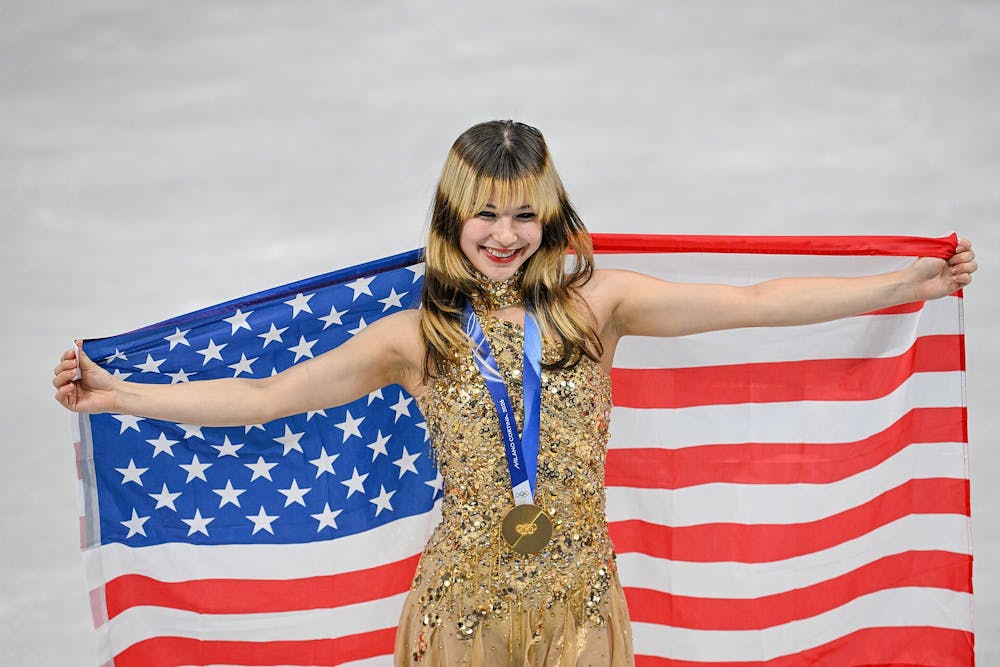
When American Alysa Liu stepped onto the ice in Milan for her Singles Free Skating Olympic routine, the arena went quiet. Five minutes before, teammate Isabeau Levito had fallen on her first jump. Two days earlier, favored American skater Amber Glenn dropped a required triple loop during her short program, placing her in 13th. Six days before, men's skating savant Ilia Malinin had suffered a shocking defeat after falling twice. Four years prior, Alysa retired from professional skating. 24 years before Alysa's music, 'MacArthur Park', began playing, Sarah Hughes became just the seventh American to win gold in the event's history. 30 minutes after Alysa stepped off the ice, she became the eighth.
Figure skating is a cold, unforgiving sport prone to high drama. With narrow margins and bright light, skaters’ stars rise high and disappear fast. Legendary Russian coach, Eteri Tutberidze, is known for her rigid philosophy that female skaters reach their technical peak at around age 14 or 15. Her tutelage has seen the past 11 years of international women's skating dominated by teenagers forced to be on all powder nutrition, abstain from water during competition and being forced to take medication delaying puberty.
In 2019, Alysa Liu was truly a product of this environment. She was a prodigy, the first women's skater in the world to land any quad jump, then perform a quad and triple axel in one program. At 13, she was the youngest ever U.S. women’s national champion. Alysa was under immense pressure from the training required to be a world-class skater. She drilled constantly on and off the ice to maintain the muscle structure, balance, poise and everything required to be the best in the world on not any given day but every day. Then, just like so many before her, at the Olympics she was beaten by two Tutberidze school skaters.
The competitive skating environment is highly polarized between exhilarating victories and crushing defeats. Skaters dedicate hours to perfecting and performing just two routines. They are constantly pushing the limits of both the sport and their bodies, all with the backdrop of a ticking clock before their ankles, knees or mental health give out. This Whiplash-esque pursuit of excellence then results in either ecstasy as dreams are accomplished or soul crushing defeat when they see their hard work go up in smoke. There’s beauty in this struggle, but skating has also become an environment where performance is superseded by results.
This struggle has been the case long before Americans stopped winning and is a valid pursuit for someone with the agency to make their own decisions. However, in recent years, things have taken a more malevolent turn. The movement to gain a competitive edge by preparing 13- and 14-year-old Olympians is a gross abuse of power over children. This is a multifaceted issue that extends beyond the obvious immorality of risking lives with unsafe prescriptions, but also through the exploitation of training kids to base their value off a score they are given rather than their own achievement.
In 2022, 16-year-old Alysa Liu became a victim of this toxic world. She expressed her frustration with the skating world and stepped away from the sport. Alysa had begun skating at age five and had become burnt out with the world of cameras, interviews, near constant training and expectations. She left the rink in pursuit of a normal life. Quitting professional skating is not uncommon. Alysa’s retirement was high-profile, but she put herself first and chose to reject the pursuit of medals in favor of discovering a new source for the joy she once received from skating. The story of what came next is rather famous by now. Alysa spent two years off the ice, trekked to Everest Basecamp, got into UCLA, then rediscovered her love for skating on her own terms.
There’s a pronounced cruel paradox in skating. As teenagers, female skaters are in their physical primes; and yet, no child at that age should be forced through the corollary mental strain that comes with competing at the highest level. Alysa lost her quads in those two years, and she may never have their recipe again. However, by reconnecting with skating on her own terms, she was able to become the first American to win the Women’s Skating Singles in over 20 years.
Alysa’s unconventional song choice and vibrant personality are on full display both on and off the ice. Her joy goes much deeper than a medal or podium. Though her path is unconventional, it is also truly one of hope. Her win is a rejection of a caustic philosophy all too prevalent in modern skating. Her comeback is hopefully a larger watershed moment of athlete agency; she joins Simone Biles in competing on nobody else’s terms. In a sport that has long demanded teenagers burn bright and burn out, Alysa Liu proved that skating unapologetically for the sake of personal excellence and no one else’s opinion is something worthy of true joy.