From Friday, Jan. 30 to Sunday, Feb. 1 the Barnstormers performed Stupid F##king Bird, written by Aaron Posner as a modern and satirical adaptation of Anton Chekhov's The Seagull, originally published in 1896.
The play featured an intimate cast of seven characters, each being reproductions or slightly changed versions of the original cast of The Seagull. Although it adopted a modern perspective, the plot remained similar to the source material. I found it fascinating how many ideas from the late 19th century still ring true with audiences today — the search for novel forms of art, disillusionment, bottomless ambition and adoration of stories about complicated love triangles.
When I asked the director of the play in an email, Leah Woodward, a sophomore majoring in Public Health and Anthropology, what drew them to choosing Stupid F##king Bird as a production, they shared a similar feeling.
“I heard about this play from other Barnstormers when we were brainstorming potential options to submit for I-Show,” Woodward wrote. “My high school did a production of The Seagull, so I was familiar with the source material, and I really liked the way the story was adapted to address modern-day issues — I feel like I share some of the sentiments about the world that the characters express, and assumed others would feel seen or heard as well.”
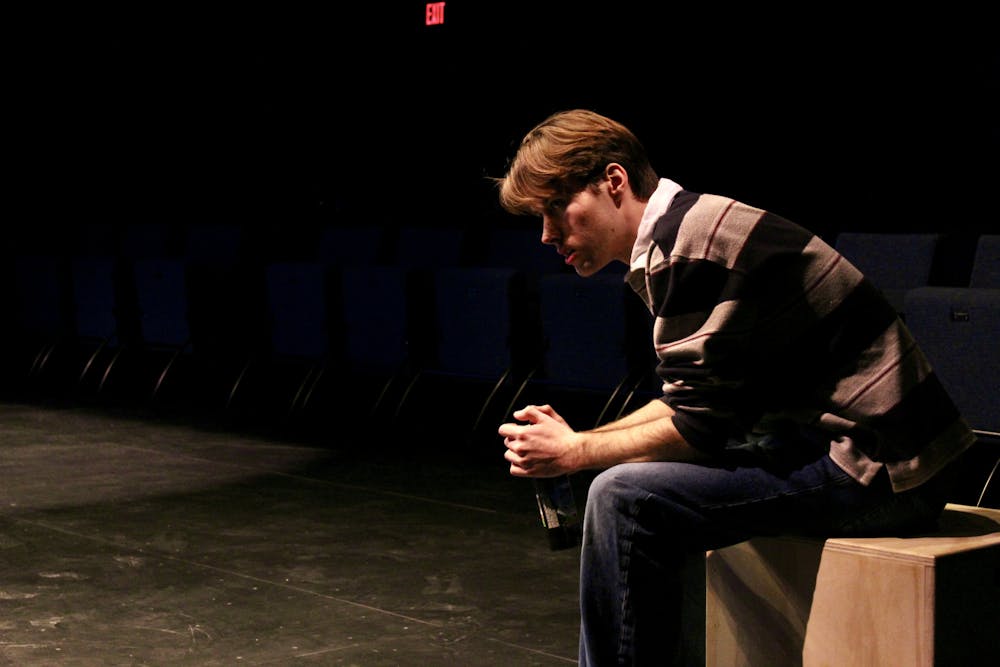
The play, performed in the Bloomberg Student Center theater, was positioned in a blackbox style, which was instrumental in telling the story. The set was humble, featuring a stage, one wall of a house, the occasional dining table appearance and a wonderful seagull that humorously “flew away” midway through the show.
Woodward also talked about the narration of important moments of the play in her email, which were intertwined with the physical set-up of the theater. She detailed her thought process behind how the characters interacted with the set in her interview.
“The stage directions in the play call for a pretty minimalistic and versatile set, so I wanted to experiment with the stage setup to keep things interesting,” Woodward answered. “I took advantage of the flexibility of the BSC theater to form a thrust stage, in order to create a more immersive worldview for the audience. I tried to think about the characters as real people when mapping their interactions with the set — having conversations around a table, or sitting and listening to another character rant. I elevated many important moments up onto the platform to improve sightlines and draw attention to the characters involved, which was also helped by lighting.”
The theater’s setup also played an integral part in audience interaction throughout the production. Some of the most memorable moments in the play were breaks in the fourth wall, ranging from subtle references to the fact that this story about a play was, indeed, a play to Conrad literally turning to the audience and asking for advice on what he should do to get his girlfriend, Nina, to love him again.
The audience came up with many helpful answers, my favorite being: “Like her Instagram story.” The execution of this bit was fantastic, and Conrad remained in character as he reacted to every response.
When asked about their preparation for this moment, Woodward talked about whether her team had expected responses or reactions to audience participation, and about the challenges of preparing for a performance with an unknown variable from the audience.
“Preparing for this moment definitely was interesting!” they said. “We often had whoever was in the room fill in for the audience, whether that was me, our producer, our technical director or other actors. We ran out of ideas pretty fast and tried to have a new person interact with that moment each day, but I knew that an audience would have a completely different feel... The audience produced funnier and more creative and realistic answers than we had generated in rehearsal, but Jackson handled them smoothly and was able to make the scene “work” each performance.”
Although moments like these had me, along with nearly all of the audience, in giggles, solemn and shocking moments allowed the play’s message to shine through. Woodward says one of these more serious sequences was her favorite in the production.
“My favorite scene is Scene 22 — Late Night Quartet,” Woodward said. “This is the scene at the end of Act 2 where Con, Nina, Dev and Mash express their frustrations with their love lives — I feel like it really gives the audience insight into the characters’ emotional states, and I love the reaction that Sorn has at the end of the scene. It was also the scene that took the longest to block, and we had so many iterations before we came to the final staging, and I love the way it turned out with the final lighting design!”
Act 2 featured the uncomfortably tense unfolding of Nina and Trigori’s relationship, but it freed me from that discomfort with a time skip in which we learned that Mash had finally acquiesced to Dev’s love, and the pair got married (aww). We also learned that Nina’s career as an actress had progressed slowly, and that Trigorin had gotten back with Conrad’s mother, Emma, after Nina’s first-born child sadly died at only a few months old.
Between Conrad’s uncle Sorn, who had been a calm presence throughout the play, crashing out at his birthday party and Nina finally visiting Conrad so they could reconnect and think about panicked, delirious metaphors about seagulls, the second half of the play did not press the brakes on the emotion. When things finally seemed to slow down during Mash's recount of what happened after the events of the play, Conrad came back with a gun to his head, saying that this is where his character would shoot himself and to “stop the f***ing play.” And so, the lights dimmed, and another successful production of Stupid F##king Bird by the Barnstormers concluded.
When asked what the biggest challenge they faced while directing the play was, Woodward referenced the timeline.
“We didn't have all of our actors together in one room until the start of the third week of rehearsals!” Woodward answered. “We also faced challenges with the snow — we missed a few rehearsal days and fell behind with the lights and set when the University was closed, which caused some stress because it was tech week! We had a line run over Zoom one day and did our best to make the most of the rehearsals we had left, and our tech teams were able to put the finishing touches on their respective elements on time! I am so grateful that everyone was so committed to this production and put so much effort and time, especially in the last week, into putting on the best show possible!”