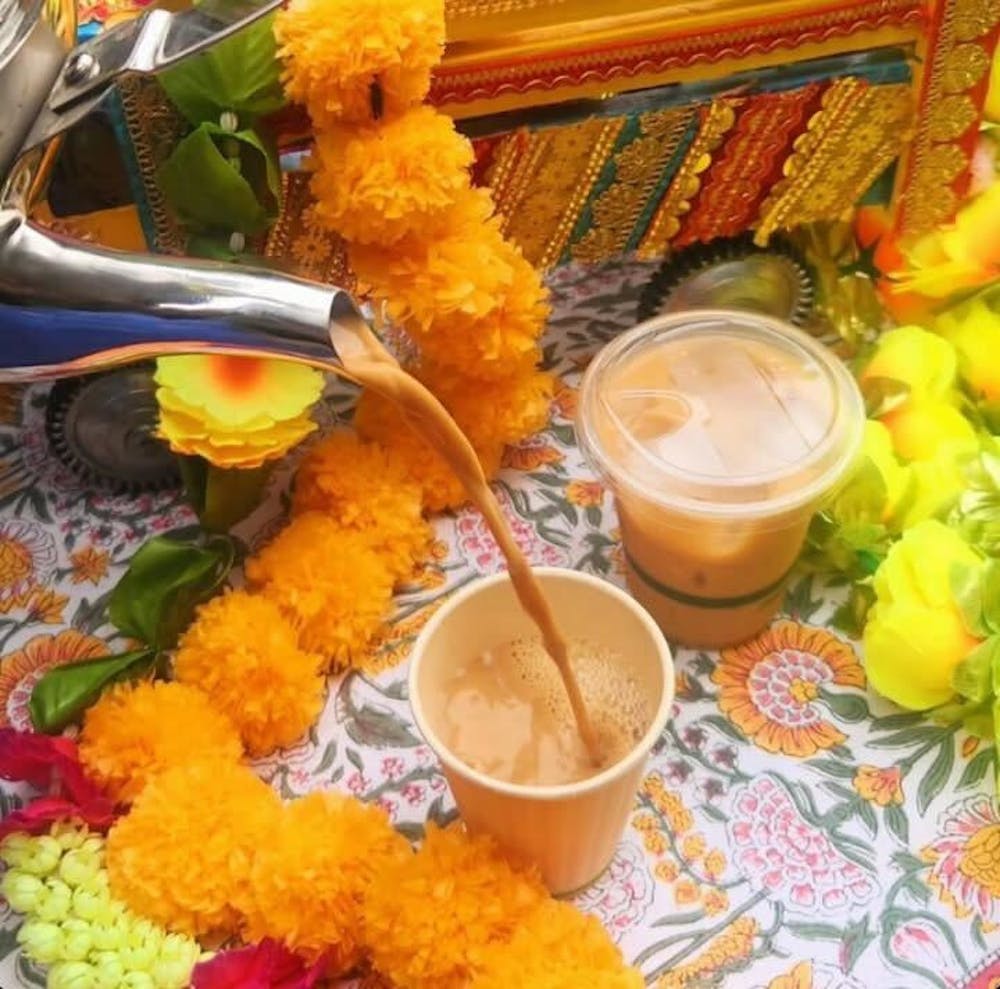
Born from Prateek’s nostalgia for roadside chai in India and Kayla’s creative eye, Chachu’s Chai brings fresh spices, seasonal flavors and heartfelt community energy to Baltimore. Between rainy pop-ups, sliding-scale pricing and countless batches of lavender chai, the duo has built something far bigger than a drink. They tell their story in an interview with The News-Letter.
N-L: Before we get started, could you introduce yourselves and share what you did before starting Chachu's Chai?
Prateek: I was born and raised in India. I came to the States for grad school about nine years ago at UMD College Park, and I came to Baltimore in 2017. Professionally, I work as a bridge engineer for a firm in the downtown Baltimore area.
Kayla: I actually grew up in the Baltimore area — been here my whole life. I started out getting a fine arts degree, then I pivoted and realized that plants were kind of my medium, so I got into horticulture and went to grad school for landscape architecture.
N-L: How did Chachu's Chai get started?
Prateek: After spending time together in India, which was Kayla's first trip to India for our wedding, Kayla got to try an authentic chai, which is very different from what you get here in the cafes. In India, there are vendors called chai tapri, and all they sell is just chai on the roadsides. I had always missed fresh, authentic chai, so when Kayla also saw and had that experience in India, the both of us were really missing that here in Baltimore.
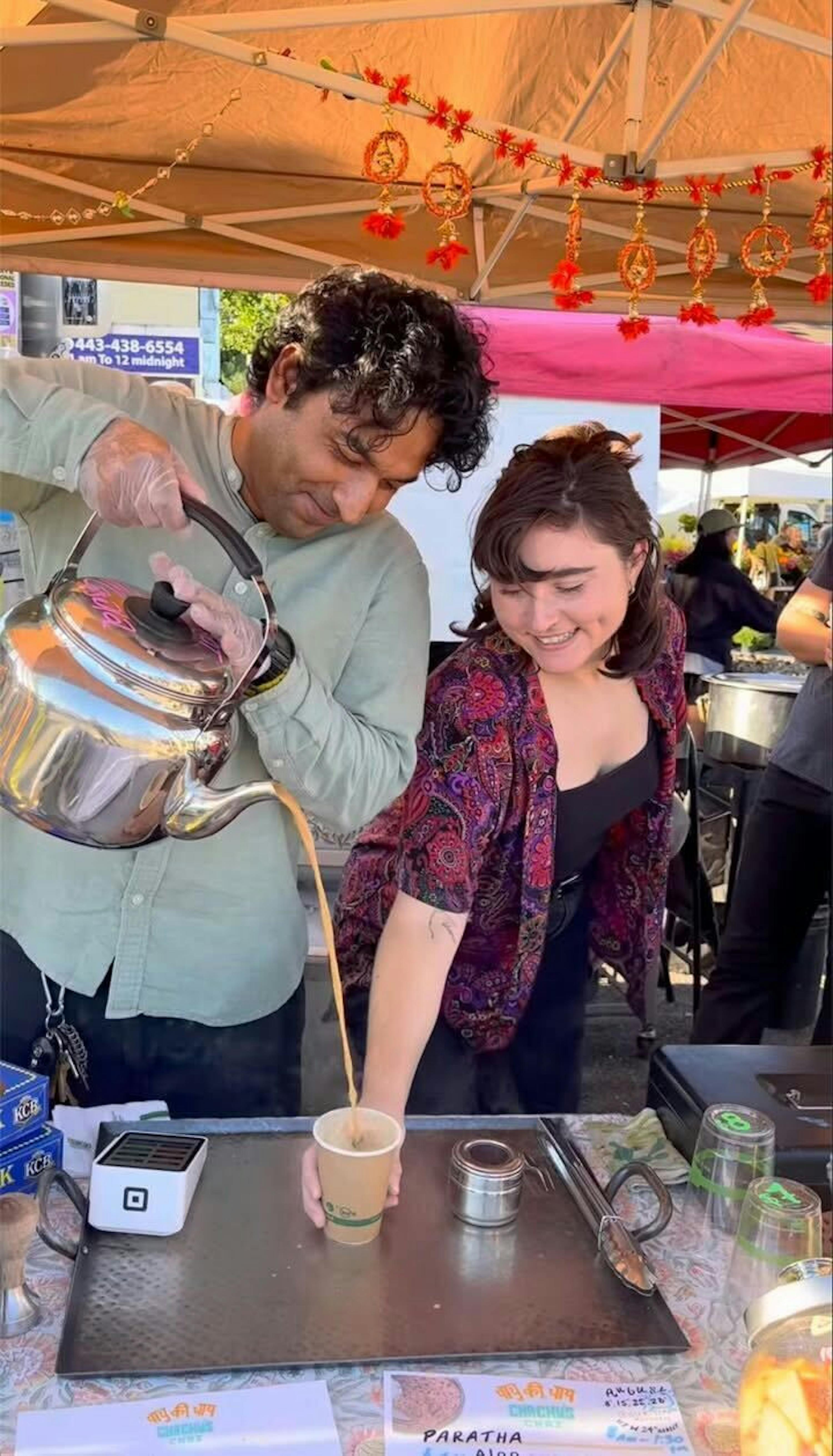
Kayla: And Prateek is really modest. He didn't mention that, actually, the first time I had authentic chai, he made it. As soon as I tried it, I was like, “Wow, I've never had anything like this before.”
N-L: What makes a good authentic chai?
Prateek: I think the main difference is that it's made from fresh spices instead of a concentrate or a tea bag, as they use in most cafes. When people think of chai, I think there are some ingredients, like cinnamon and cloves, that seem to be very popular, but it’s very Americanized.
Kayla: It's also a different process. At cafes, they’ll steam the milk, add the concentrate or the tea bag. But, as Prateek was mentioning, we have the fresh ground spices and fresh ginger — that all gets boiled together with milk and water and sugar for all kinds of mixing and mingling. That's where a lot of the flavor comes from!
N-L: That makes sense. I've been to your Farmer's Market pop-up and I noticed you have seasonal flavors. I think it was rose and lavender the last time I was there. Could you speak a little to how you craft these specialty items on your menu?
Kayla: Actually, it's funny that you mention that because we kind of went back and forth a lot — should we have any sort of unique flavor that you wouldn't find at a typical Indian chai tapri?
Prateek: Kayla's very artistic and crafty and creative, and that shows in our menu too. Any interesting, cool flavors that you see are most likely Kayla’s ideas.
Kayla: That's where the true fusion of me and Prateek's creativity with the chai happens.
Prateek: We’ll come up with an idea of a flavor that makes most sense for a given season. And then we will practice, make lots of sample batches and experiment. We actually came up with this point-based system where we would lock a recipe if it was like a 10 on 10, consistently. It was just a lot of improvising and tweaking the proportions of different ingredients.
N-L: That lavender is definitely a 10 out of 10. What are some flavors that didn't make the cut?
Kayla: Just this past fall, we were experimenting with a golden milk chai. We were really excited about that concept, but we just couldn't get it to a tenner.
Prateek: I was very skeptical of dirty chai at first. I'm a coffee lover myself and when I tried chai with an espresso, I was a huge fan immediately, and so we sell dirty chai as well.
N-L: Where does the name “Chachu's Chai” come from?
Prateek: That's a good question. We went back and forth with our business name, and then we landed on Chachu's Chai. Chachu in Hindi and Urdu means “uncle from your brother's side.” The formal word is Chacha, which is your uncle, but the endearing term that nephews use is Chachu. I have a seven-year-old nephew who calls me Chachu. So, we thought the word Chachu and Chai go well together. It's fun to say and it's catchy. And then, we became Chachu’s Chai.
N-L: That's so sweet. You’ve touched a bit on working jobs aside from Chachu's Chai. What’s this whole process been like for you all, building this business from the ground up?
Kayla: That's a big question because there's been different iterations of Chachu's Chai over these two years. It began with us working full-time jobs during the week, then we started to do the market every other weekend, we found success and an audience and began doing the market every weekend. We quickly realized that doing the market every weekend with the full-time job would be difficult — so we had to make the choice, do we go all in with Chachu’s Chai? Do we go back to part-time?
We went all in with Chachu’s Chai, and we started to do the 32nd Street Market every weekend. We began setting up near the Baltimore Museum of Art during the weekdays. It began at the end of summer, but it quickly became very rainy and freezing cold. There was a lot of construction in the area, and we realized that it's difficult to just sell chai on a sidewalk and be out in the elements and feel physically healthy doing that every day.
We set up from the ground up with the tent and with all the equipment. We don't have a cart or anything. So, we had to kind of juggle back. Right now, we're working during the week and doing markets on the weekends again.
N-L: You mentioned a point of decision where you had to figure out whether or not you were going to go all in on Chachu’s Chai. Do you remember what informed that choice?
Prateek: I think we were consistently seeing growth and higher sales at the Farmer’s Market. That gave us really good confidence. A lot of our customers at the markets were students from [Hopkins]. And chai is very popular in India, it's very popular near college campuses.
But I think it was also one of those things where, if we never tried, we would have never found out the potential of our business and built that customer base. It was a risky decision, but we had to test its potential.
N-L: As you’ve noticed, so many Hopkins students loved your stands at both the Baltimore Museum of Art (BMA) and the Farmer's Market. Could you speak a little to what it's been like working within the Charles Village community?
Kayla: We have just really had such a wonderful time working with Hopkins students. We did a bunch of different fundraisers with different student groups, and that really felt rewarding, like we were able to play a part in building a little bit of community. That was a really great thing that we were able to do while we were near the BMA.
We just now feel even more connected in the community where you can walk around and it's like, “Oh, hey, see you on Saturday!” Or hey, there's that little kid that we saw grow from a newborn to two years old who's now walking that we met through the Farmer's Market or being at the BMA stand. The Charles Village community and the broader Waverly community and Baltimore City in general has been so supportive and so wonderful. It's just really heartwarming.
For masala and lemongrass, we have the sliding scale and people will say, “I'm gonna pick the higher price. That way, the next person who can't, they can.” It really gives you a picture. What you realize is that actually everybody just wants to help out their neighbors when they're picking their price. It's really everybody having a hand in and giving the gift of chai and supporting each other.
Prateek: Some of our customers have actually become our helpers at the Farmers Market stand because they just love our product and business so much.
Kayla: We've made so many friends from doing this, so that's been really wonderful.
N-L: That's so great to hear. What was the inspiration behind the sliding scale system?
Kayla: I would say that I don't really align with capitalism per se. Prateek and I don't have the exact same views, but I think we're aligned to the point where we want people to be able to afford it. We know what it feels like to not be able to afford a simple pick-me-up in your day. We really want to give people the opportunity to give themselves a treat without breaking their bank. And then in India, the chai is…
Prateek: Yeah, the chai is very affordable and there is a common sentiment of just sharing food, even if it's for free — be it at the stand or at the market, too. If someone didn't have enough money or no money, we've never not served them chai.
Kayla: It kind of comes back to how we want to take care of everybody who is coming and patronizing our business. The sliding scale gives people that opportunity. In turn, we've been taken care of by the community.
N-L: That's an incredible system you guys have in place. What's one piece of advice you'd give to the students reading?
Kayla: If there's something that you feel deep in your heart that you would like to see, just go for it and do it in a way where you can play it safe at first. For us, putting our toes in the water was the Farmer's Market.
Prateek: We found solutions the more we wanted to minimize the risk and be creative. I think the key thing is to just get out there, but take baby steps and start small.
Kayla: Also, I think one thing that does ring true in me and Prateek is don't let your education and background hold you back from your vision or idea of what you want to bring into the world. Because you can be limited in that way. Prateek is an engineer. I'm an illustrator, animator, horticulturalist, landscape designer — like, all this stuff. We're still that. It's still true, but we're also now entrepreneur Chai slingers. So, don't let your background hold you back from doing something else.