The nature of our financially independent newspaper is to record all types of University activity, including student-led advocacy, neighborhood rallies and the administration’s responses to it all.
In a setting where the student body rotates every four years, many movements and student-led initiatives naturally lose momentum. Only half of the current undergraduates were present for the 2024–25 Student Government Association’s open letter to President Ronald J. Daniels and administrators, which called for a 5% tuition reduction due to student challenges from ongoing construction. The News-Letter is the only media source that has covered this resolution. None likely remember the 2019 Garland Hall sit-ins against the University’s implementation of the Johns Hopkins Police Department (JHPD), a private police force. The University’s public records about the sit-in mostly, if not only, contain the administrators’ responses. Construction and the JHPD’s legitimacy still affect students and the neighboring communities to this day, yet the cyclical nature of student discontent remains hidden without proper preservation.
Let us make this clear: The News-Letter does not hope to be the only record for the University. Hopkins already has employees who take on the public-facing, breaking news role to cover innovations and changes on a 24-hour basis. However, editors of The News-Letter make sure that past and current student voices do not get lost and create a platform for workers, affiliates and neighboring Baltimore residents. The News-Letter adds alternate perspectives to the events discussed by other news sources, or we serve as the only source for ones that don’t.
Lack of knowledge of important precedents in student advocacy can easily lead to its dilution. Conversely, previous students voicing their opinions encourages the environment of free expression, which the University administration deemed “a foundational value of our university and central to the Johns Hopkins experience” just as of last week in a broadcast email. The News-Letter preserves memories, allowing students in the present to engage with the University like how the generations of the students before have.
Other archival sources, of course, exist. However, internal University administrative records remain inaccessible until 25 years after their creation, including the “work product” of any administrative office or committee under the University. While administrative materials intended for public sharing can be accessed at the time of archival transfer, such as publications, recordings of public events and press releases, these documents alone do not tell a story. They simply show the information an institution wants its community to know at a given time.
This limits a key aspect of a comprehensive record: its ability to speak to present realities. Reading an internal document highlighting the truth behind University actions decades later likely will not carry the same nuance it does now, especially as relevance shifts alongside social, cultural and historical contexts among different student populations. And relying on University broadcasts to piece together an institution’s history misses the conversations, thoughts and potential actions specific to that moment’s unfolding — especially those that challenge the institution. The News-Letter precisely serves to capture these developments, providing a continuous, more realistic narrative to better understand why certain outcomes and perspectives may have arisen.
To visualize this role, we can examine physical accessibility on Homewood Campus. On the one hand, when searching physical accessibility and “Johns Hopkins University” online, the only University-posted voice that appears is from the Student Disability Services website, affirming to foster “accessible and equitable” student experiences. The website also features annual reports and data, but this page solely includes the percentage of students receiving disability services in a given year.
The News-Letter, on the other hand, has served as an active forum and facilitator of the accessibility movement. Many Opinions and Voices articles have actively highlighted the lack of disability discourse on campus, such as a 2021 op-ed titled “Disability isn’t taken seriously at Hopkins.” The author states that she has “never once... seen a visibly disabled student in a classroom at Hopkins, not even in a photo.” Even further back in time to 2008, students shared their concerns over the slow progress of implementing accessible features on campus. The News-Letter allows voices like these to be recognized, and while that isn’t the sole catalyst for change, having such concerns in writing acts as a propagator of discussion and an eternal reminder. Most recently, The Editorial Board advocated for a physically accessible campus in a piece published on April 20 of this year, following an investigation of how accessible routes prove highly impractical even today.
Another current example of The News-Letter’s archival role is the ongoing reporting of the construction of the Data Science and AI Institute (DSAI), announced in 2023. The News-Letter has posted articles alluding to this multi-year project every year since, with references to University real estate acquisition (2024), its impact on the residential community (2025) and, most recently, a deeper dive into the construction project’s destructive influence on local residents (2026). Anyone reading now, or in 25 years, can directly see how the community’s attitudes towards DSAI have evolved since its announcement and construction, along with the increasing capabilities of AI compared to two years ago. However, when examining University-produced records, readers only see the mission behind the project, an overarching project timeline and promises made during its construction.
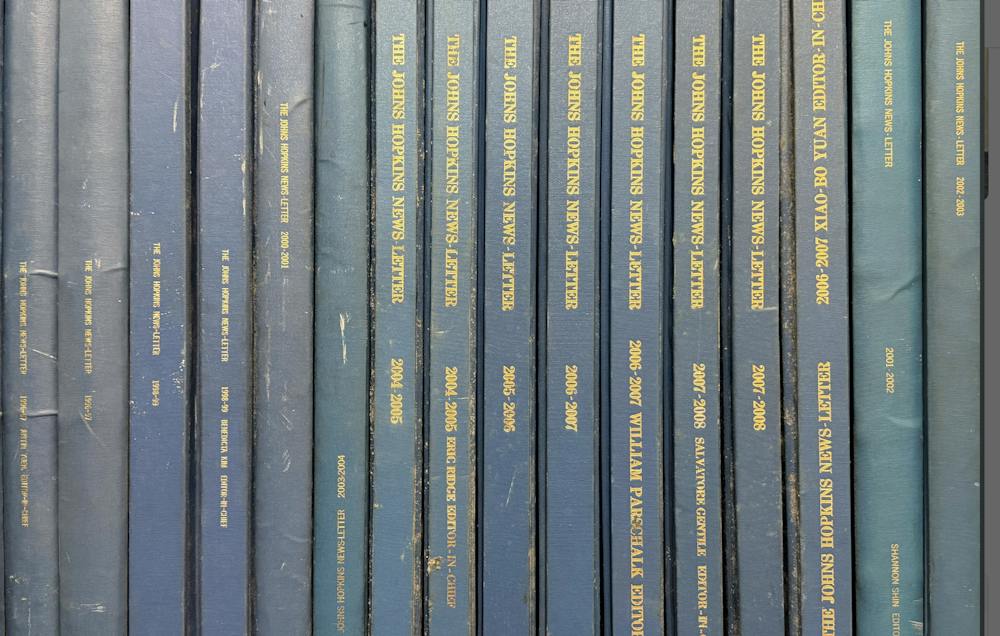
As you can see, this article has been embedded with links. We hoped you clicked on some of them; a lot of them come from The News-Letter. This isn’t to say that they all come from us — the editors of the 2026–27 Editorial Board — but rather that this has been a collective effort from the past generations of editors, dating all the way back to 1896. For over a century, students followed up on interviewees, whether over email, telephone or in person, to depict a more holistic story. We recognize that the default state of a university’s student community does not necessarily include a student newspaper. The News-Letter only exists because of the shared responsibility of countless writers to write the University’s history, year after year.
Equally important to our role of preserving the historical record is our commitment to eliminating censorship. A comprehensive picture of a movement or a story can only exist if our contributors can write without fear of retaliation from others or the University. We are immensely proud of our financial independence from Hopkins, and we will actively work to minimize barriers for students to write for us — freely and honestly.
To all Hopkins students: Write for us. You don’t need any other qualifications than being a student. If you are someone who wants to contribute to telling history, reach out. The News-Letter exists for you and continues to exist because of you.