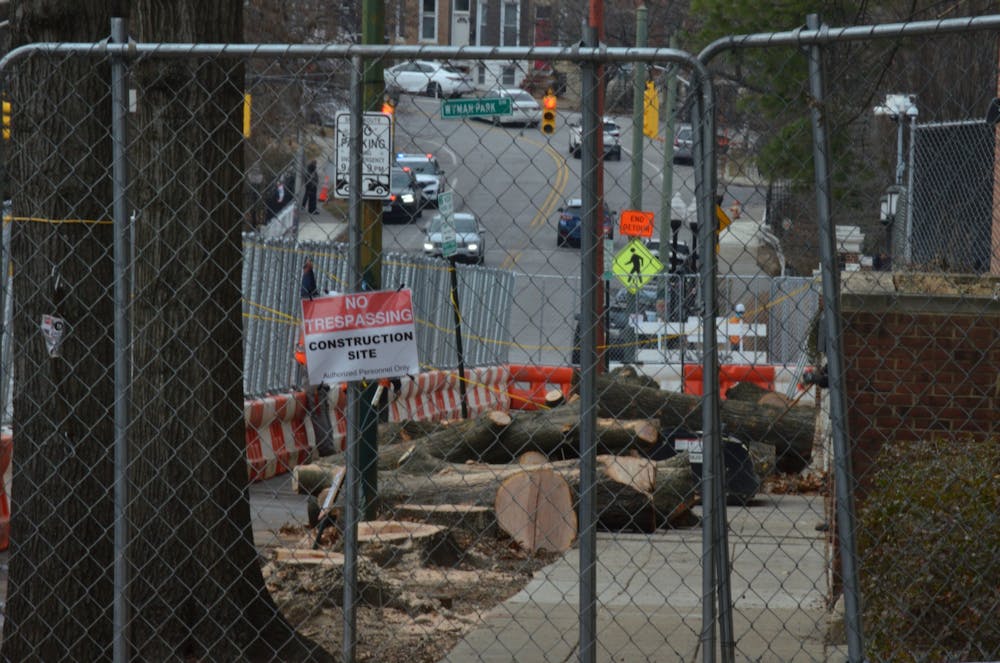
The University has begun construction of the Data Science and Artificial Intelligence Institute (DSAI) by cutting down trees on Remington Avenue in early January 2026. Construction has closed Wyman Park Drive to drivers and soon will to pedestrians in summer 2026. The project is scheduled to conclude in 2029.
The News-Letter covered plans for the DSAI in October; however, advocacy among community members against its placement continued since construction began. Four residents from Remington and neighboring areas have shared concerns over the DSAI’s blueprint, construction and environmental effects — all serving to hinder community trust in the University and in Baltimore City.
Blueprint
The DSAI will be located at the intersection of Wyman Park Drive and Remington Avenue. The DSAI will be part of the Whiting School of Engineering (WSE), and the University has affirmed that the building will be used for education and research. On the project’s website, the University states that DSAI is not a data center and will require no more electricity than a typical academic building. The current dimensions of the building are 465,000 square feet, reduced from 690,000 square feet upon community negotiation with the removal of the underground parking lot. The largest building on Homewood campus is the Bloomberg Center for Physics and Astronomy at 238,000 square feet, with its large size attributed to telescopes and observatories.
The University has rationalized the building size by stating that existing buildings are too small for cross-disciplinary research teams, lacking long-span spaces for flexibility and mechanical systems required for comprehensive AI research; floor plans for the DSAI have been attached on a community meeting powerpoint.
Specifically, in an email to The News-Letter, a University spokesperson expanded on the use of the DSAI, stating that its intended use was designed for student and research spaces.
“The DSAI team is currently located in temporary space at Mt. Washington. Once complete, the two academic buildings currently under construction on the Homewood campus will provide a home for the new faculty as well as students and staff with purpose‑built laboratories, classrooms, and meeting spaces for teaching, research and collaboration.” The University spokesperson continued, “Through shared seminars, adjacent labs, and common gathering spaces, the environment will naturally encourage researchers and students to learn from one another and spark new ideas.”
The University compared itself to its peer universities with large research buildings, such as Princeton’s School of Engineering and Applied Science (665,700 square feet), Northwestern’s Simpson Querrey Biomedical Research Center (625,000 square feet) and Harvard’s Science and Engineering Complex (544,000 square feet). Likewise to the University’s reasons for the size of the DSAI, these complexes also boast enhanced opportunities to connect disciplines and works in one setting. In Baltimore, the University of Maryland, Baltimore’s Health Sciences Research Facility III is 435,000 square feet. The locations of these large buildings are also close to the main institutional campus.
However, many residents shared dismay over the scope of the DSAI in proximity to Stony Run Park, the neighboring green space and the residential block in Remington. For example, Melissa Falen, retired professor and athletics coach from Notre Dame of Maryland University and Remington resident shared her perspective in an interview with The News-Letter.
“I was disappointed to hear [City Council President] Zeke Cohen after we all spoke, and then his summation was how Baltimore needs to be on the cutting edge of AI, which, okay, fine, but that's not what we were expressing concern about... It was that [the DSAI] doesn't belong in this neighborhood because it's an inappropriate size, and Hopkins has options... There was no explanation as to why [another location] wasn't chosen,” Falen added.
Moreover, Falen attended 14 out of 15 community meetings with the University. Falen shared her experience with compromising on the DSAI’s height, initially designed to be 120 feet high.
“When you live in a two story row home, [a building of that height] would make us feel like ants. We were going to have a vote, and they canceled that at the last minute. I think they didn't want to have a no vote, but I don't know. Through that process, I remember getting kind of flustered because [of] the way things were presented to us. It was definitely a marketing job. So it was like, ‘Here's how beautiful this 120 foot high building is going to look, and if we can't do that, then we're going to do this,’ [even though] ... it looked [worse] than the other,” Falen stated.
The University has rationalized the location due to its proximity to WSE’s facilities, underdevelopment relative to the rest of Homewood campus, space to handle research facilities and parking, and opportunity to improve connection and investment in Remington. In this presentation, the University also highlighted the location’s ability to create accessibility for Remington residents in the broader Homewood campus and provide forest landscape to the building. Other considered locations included University Parkway, Dell House and the ROTC Building; however, these locations were hindered by size, prior use and city policies. Interviewed residents shared how they were not given a thorough analysis on how officials chose the DSAI’s site relative to other places.
Hillary Gonzalez, founder of the Sacred Parks & Waterways nonprofit, an advocacy group for environmental concerns, also shared her perspective in an interview with The News-Letter. Specifically, Gonzalez referred back to the effects of the construction of the Stavros Niarchos Foundation (SNF) Agora Institute on Remington, where construction (including the cutting down of trees) increased the amount of impermeable-to-water surface. With heavy rain, the runoff of polluted water from construction sites easily returns into Stony Run Creek and flows into the Chesapeake Bay. Residents have already begun noticing this runoff since the beginning of the DSAI’s construction.
“Almost every single time it rains now, we're already seeing major flooding events going down to Remington. You can see the water is flowing from the construction directly into Stony Creek,” Gonzalez said. “So if we've already seen 14 major flooding events, all reported with Blue Water Baltimore and also with the Maryland Department of the Environment, how much worse is it going to be when they've gotten rid of the trees? ... That’s what I want people to understand. It’s not just the Remington trees. It’s not just the Wyman Park Drive trees. It’s the entire watershed of Stony Run.”
In 2015, neighbors called Hopkins to control runoff near Remington; in response, the University planted elm tree saplings in shallow areas. However, these efforts largely failed and polluted runoff continues amid construction of SNF Agora and the DSAI. Residents have publicized these runoffs in newspaper articles and on Instagram.
Environmental Effects
During construction, the University will remove 66 trees (including 9 on Remington Avenue and 21 on Wyman Park Drive) and plant 262. The University publicized that it will upgrade city-owned infrastructure for free to increase the capacity of public stormwater management systems to reduce runoff, install 30 new streetlights and sidewalks, and plant over 300 trees (including 57 on city property along Remington Avenue, Wyman Park Drive and 31st Street). The cut-down trees on Remington Avenue were mature, more than 50 years old Red Oak trees; the replacements will be 25-feet tall, 10- to 15-year-old trees.
Ted Eccleston, a former public school teacher who now works from home, has lived in the neighborhood since 2020 and joined advocacy talks in 2023. In an interview with The News-Letter, Eccleston shared his thoughts about the University’s promises to replace mature trees with new trees.
“I think the promises that they're making about planting new trees are hollow and lousy because no new tree, even a 15-year-old semi-mature tree, can replace a 50-year-old tree that's been growing its root system for decades, and every arborist knows that. And when I talked to the city’s forestry department, they were telling me that they fought to protect those trees but that the building is so big that they're going to need three massive cranes [and] that ... they need a construction entrance. It seems like [the University’s] concessions are just things that they can put out there to appease the public,” Eccleston stated.
Studies have shown that older trees have expanded capacities for absorbing carbon from the atmosphere. While the University has employed ornithologist Susan Elbin to design bird-safe exteriors, they have not publicized intentions to employ arborists to monitor newly planted trees. The executive director of the Community Law Center, Amy Petkovsek, has stated that the University’s promises lack the force of law.
Gonzalez added to Eccleston’s concerns, stating that a lot of resources are required to bring a tree to maturity.
“It takes decades for new trees to establish themselves, and that doesn't matter if you're removing an older tree and you're putting in a new tree that's 20 years old. Root systems for trees take a very long time to establish. There's also the amount of resources that goes into ensuring that a tree that's planted reaches maturity and that the root systems actually develop.” Gonzalez continued, “In order for a tree that's planted to offset its carbon emissions and be beneficial to the environment, ... it takes about 20 to 25 years, so the [50-year-old] trees that we had in the neighborhood ... were already giving back. “
Adding on to environmental concerns, residents also expressed concerns on the amount of energy and electricity used at the DSAI due to extensive computational resources. Many residents did not find out the exact power requirements until December 2025, as described by Eccleston. Publicly, the University has instead stated that the watts per square foot used will be similar to other research buildings on campus.
“We only found out at the last Board of Estimates meeting in December what the power requirements for this building are going to be. [The University said DSAI is] only 20 watts per square foot, but if you do the math, on an almost 500,000 square foot building, you get 10 megawatts, which is what a mid-sized data center would be using,” Eccleston shared.
Falen also shared concerns on the effects of the DSAI’s work on local utility bills in Remington; nationwide, data centers have already increased electricity bills in residential areas.
“I don't know how [the University is] going to generate the necessary power. I mean, it's an issue in the state in general from data centers... What kind of draw is that going to be on the grid? It’s not like Hopkins is putting up solar panels to generate their own electricity,” Falen commented.
There will be a new electrical substation on Hopkins property that will intend to do duct work (managing piping) on residential streets, but specific confirmations of watts of power for the whole project have not been disclosed despite questions.
Residents have also highlighted how construction will occur 20 feet from the edge of the forest conservation easement and 50 feet from Stony Run Park. While the University has stated that it will maintain sediment control over construction, a recent 2026 report released by environmental consultant company Steward Green showcased the poor health of Stony Run Park. 25% of the park has no native species, while 92% of all plots had invasive species. The forest also lacks a midstory layer, meaning that once the plants finish their current lifecycle, none will replace them. There are also erosion issues downstream Stony Creek, which frequently cause vegetation and trees to topple over. These issues have resulted from a lack of native species, severe storm events and the construction of roads, parking lots and rooftops.
Gonzalez has highlighted how the critical location requires nurturing of the park instead of potentially disruptive construction, noting the University’s past neglect of caring for the park’s environment.
“Baltimore Weed Warriors will come out occasionally, and they'll have big events in the park where they'll teach people [how to safely remove invasive plants], and there will be big cleanup efforts in the park on the community side. In the six years that I've been living here, I have never once seen any effort made towards getting rid of the invasives on the Hopkins side of the park,” Gonzalez stated. “It has been really upsetting to feel — this park that you love so much and that you've been trying really hard to take care of by yourself, the institution that's supposed to be its actual stewards have actively been harming it.”
Residents also emphasized the spiritual importance of Stony Run Park for their lives, with Gonzalez mentioning her love of bird-watching and Eccleston recalling a resident sharing the true meaning of a local greenspace in a community meeting on construction.
“We started crying because [the resident] said, ‘[Stony Run Park] is my refuge; this is my safe space. This is where I go when the chaos of the world, the chaos of where we are as a nation, is too much for me to bear, that I need to just go to that green space to heal.’ And that's not fluff. That's genuine soul level healing... When that person got up and spoke and cried, all of us felt that emotion,” Eccleston stated.
Eccleston himself described how he frequents the park with his four-year-old daughter, making the area a space to decompress and connect with others.
“I've been going to Stony Run for four years now, and it's been a place of comfort. It's been a place of play. I have a four year old daughter who likes to go down and splash around and throw rocks and look for birds. I meet people that are birding down there. I meet people walking their dogs. I've met somebody who is trying to build a mountain biking trail through the park that connects to other mountain biking trails in the northern part of the city, and it's a really beautiful green space that, frankly, is not really being taken care of by Hopkins on their side,” Eccleston said. “I don't think they've done anything to contribute to the health of the park.”
Eccleston continued to note how ongoing construction will negatively affect the park and the residents’ experiences. He questioned why the building was chosen for this location despite community concerns.
“Of course, I don't want to see [DSAI in Wyman Park] because in the park, it's so beautiful, and nobody wants to hear cranes and jack hammers. But regardless, it just doesn't feel like the right place for the building. That's been my question all along, and we don't think we've gotten a really appropriate answer. Why [is] this building [here]?” Eccleston commented.
Construction
Construction begins at 7 a.m., Monday through Saturday. However, Falen stated that, at times, beeping from machines and trucks start as early as 4:30 a.m. Gonzalez shared her personal experiences working at home amid the noise.
“[For] those of us who have home offices, the construction noise is so loud... For me personally, I've had to increase my dog's anxiety pills because he is so stressed out by the construction noise,” Gonzalez shared.
Beyond the effects of noise disruption, residents have also shared the loss of parking spots near their homes. According to the University, as promised to residents in the early stages of the DSAI planning, construction workers and subcontractors are required to park at Eastern High School. However, construction workers have taken many parking locations without permits — an observation attested by both Gonzalez and Falen.
“I hate to talk about parking when it seems so trivial, but, for example, on 31st Street, there are a lot of elderly people who really need to be able to park on their street, and as soon as anyone moves their car. If they go have to go to work in the morning, construction crew members are taking their spots. And [a separate parking lot for construction workers] was something promised to us. Day one, we saw them,” Gonzalez stated. “I took photos of 21 vehicles on one side of 31st Street. None of them had Area 7 parking permits.”
Falen added, “Hopkins has its own police force, and not once did they ever send one of their officers here to just tell the workers they shouldn't park here. But the night that [Gonzalez] organized a little vigil for the neighbors to say goodbye to the trees, ... [where there were] no more than 15 or 20 neighbors, there were six police cars.”
Falen also shared how residents were made aware of a tow-away zone beginning Jan. 8, 2026 to Dec. 29, 2028 in their usual parking spots three days prior. While residents received parking passes in the South Garage and other places on San Martin Drive, the spots are 2–3 blocks away from their homes.
“It's not great when you're bringing home heavy stuff and groceries to go two and a half blocks. But beyond that, like, why didn't you bring that up ahead of time?” Falen mentioned.
Dylan Maddox, a real-estate agent and Remington resident since 2001, also shared her experiences with parking loss, arguing that the University has not taken account of the broader consequences of expansion on Remington.
“Every single thing that Hopkins has done has inconvenienced a resident because they didn't look at the larger picture. Because the community at large is not a part of their big picture. Their big picture is how they grow their institution and how they bring more money to the institution, right?” Maddox continued, “So ultimately, to come home at any point in my day and not have a place to park my car, and to have to walk a great distance to just come home to my house for a break, that is a big inconvenience when you're doing it every single day.”
Maddox also shared how she has seen increased amounts of waste from the construction pouring into residential areas, including bottles of urine, lottery tickets and other forms of trash. Maddox, as well as Gonzalez, corroborated on cameras near the site, which peer into residents’ homes as well.
“And having cameras pointed directly into a neighbor's house. All those things — they’re uncomfortable. It's like a George Orwell dystopian universe where we feel like we're not comfortable living in our own homes.”
Falen also shared concerns on the length of the construction’s project, remembering how SNF Agora’s construction went beyond the time publicized. Both Falen and Maddox expressed worries on property value diminishing over time due to the construction’s proximity, thereby leaving them with limited options on distancing themselves from the work. Maddox emphasized that the University’s actions have portrayed the institution as a poor neighbor.
“So ultimately, I can't say that I'm surprised by any of the actions. I think it becomes overwhelmingly unfortunate when it, you know, affects your day to day life. Of course, we've had the Agora building construction over the past ... eight years? ... It feels like being under constant, disruptive activity from an institution ... [that is] not neighborly,” Maddox said.
Institutional/City Trust
The University has framed the DSAI as an opportunity not just for Hopkins, but for the wider Baltimore area. Estimates in January 2026 reveal that the DSAI project will create 4,490 jobs during the construction phases, with the entire project generating $505 million in net economic impact in Baltimore and $800 million across Maryland. Upon inquiry, a University spokesperson informed The News-Letter that this number was determined by a third-party expert using an “industry standard approach.”
However, in September, Gonzalez mentioned how a Hopkins representative first promised 11,000 jobs from the DSAI’s implementation. In December, Hopkins representatives changed this number, announcing 4,500 new jobs solely in construction. Gonzalez recalled how Lee Coyle, the senior director of Planning and Architecture at Hopkins, shared that construction workers staying in Baltimore City would make the city more prosperous; however, Gonzalez disagrees with this sentiment and the University’s wider promises of economic development.
“Most of the license plates that we see on our block for the construction crew — Virginia, Pennsylvania, Massachusetts, New York — they're not sticking around. They're taking a job, and then they're moving on to the next one.” Gonzalez added, “When the building — if the building — is finally completed, it's only going to employ 80 full-time faculty members. I don't see how this is an economic boom for the city at all. It does not positively impact Baltimore's working class... It’s going to be a good project for Hopkins, but it's not a good project for Baltimore City.“
On the University’s end of communication, it has launched a website, featuring biweekly updates on construction for the project, and it has announced intentions to minimize impacts on Hopkins neighbors. The University has met with the community at least 15 times over the past two years, incorporating public feedback into the plan.
“Johns Hopkins is committed to being a good neighbor and responsive to the community for the duration of this project. Throughout the design phase of the project, the university met with the community more than 15 times and made meaningful changes to incorporate feedback from neighbors, as detailed on our project website. This website also provides updates to the campus community and neighbors, and our team has met and will continue to meet with neighborhood groups and leaders to answer questions and address concerns,” a Hopkins spokesperson wrote. “We’ve set up an online portal for neighbors to submit questions or raise issues, and our team responds quickly and works with the city to make sure that we are meeting our commitments.”
However, many residents have reported more disparities between the University’s word and its actions since the DSAI’s inception. For example, Eccleston explained the changing narrative around cutting down Remington trees, diminishing residents’ trust in the institution.
“I think that the University likes to think that [community meetings are] what community engagement looks like, but the community feels like they've been surprised. At every turn, they've been told something and then something else happened.” Eccleston added, “[Regarding] the public trees that were cut down on Remington Avenue, the first public meeting was Hopkins saying… ‘We'll do the best we can to protect the public trees.’ After a year, it changed [to], ‘We're not gonna be able to protect those trees, but we'll do the best we can to limit the damage.’ ... They become less open and transparent, and I've become less trusting of anything that they say.”
Falen corroborated this point, adding to a list of promises not kept by the University administration.
“Coyle said that [the University] is not going to take down the oak trees in the city, but he said some of the roots could be damaged, and that he couldn’t promise that they wouldn’t be lost. They also told us, at one point, the construction entrance would be far away from our residential street, [but] both of those things were not true at the end of the day, which is disturbing,” Falen said.
Recently, on Jan. 7, according to Eccleston, construction workers also cut down the trees on Remington Avenue without publicizing the permit at least five days prior to removal, as required by Baltimore City law.
“I’m still trying through a Public Information Act request to find out what permit they were given to cut those trees down, but they didn't notify the public five days before. City forestry has told me that they approved [the cutting down of trees on Remington Avenue]. I just don't know where it is written,” Eccleston stated.
In terms of compromising on location and size, Maddox explained how the University’s agreements aligned mostly with its own vision, instead of being altered through community engagement. For example, as stated by Eccleston and Gonzalez as well, residents have complained about how the building still covers the same above-ground area in the exact same location, despite community outrage.
“I think [the University] thinks of compromise as like [they are] compromising what [they] want in order to do something else because the neighborhood didn't give [them] what [they] wanted... [for] them to move forward. So I don't think the compromise is to the neighborhood. I think the compromise is to the internal workings of Hopkins,” Maddox argued. “I think it's a strategic and a tactical use of words in order to minimize really what has been going on... Ultimately, they're using [their compromises] as a mask to cover up the reasons of why we are upset.”
Residents also report a low understanding of the projects to occur at the DSAI, and more importantly, the DSAI’s funding and sponsoring sources. Currently, an estimate of the cost of DSAI and its source of funding has not been publicized, despite public pressure. To The News-Letter, a University spokesperson provided an example of AI research intended to occur at the DSAI.
“Our faculty pursue research on the broader impacts of AI and train systems to behave and support human well-being without disrupting critical societal structures. For example, the research of Gillian K. Hadfield, a Bloomberg Distinguished Professor of AI Alignment and Governance, includes the responsible development and governance of AI tools. The Institute also hosts various events and convenings to bring together stakeholders from academia, health, and government around these issues,” a University spokesperson wrote.
Eccleston highlighted that the University’s vague devotion to public health and broad AI issues, amid resident advocacy against the building’s construction, heightened his suspicion.
Falen also questioned the University’s commitment to its neighbors, highlighting past instances with University expansion in East Baltimore.
“[The DSAI construction] does make you wonder if Hopkins wouldn't just like to get this block because it's just our row of houses between [its campus] and the park. They pushed [a lot of families out] as an institution around the hospital, so it makes you suspicious,” Falen expressed.
At the Dec. 17 Board of Estimates meeting, residents shared with The News-Letter that there was a memorandum of understanding regarding the cutting down of elm trees on Wyman Park Drive. 18 Baltimore City officials voted for the memorandum, while residents wrote 65 letters of disapproval and presented a petition against construction with more than 2,000 signatures.
“Nobody wrote any letters of support for the project, except for the lawyers representing Hopkins. Nobody spoke positively about this project, except for the Hopkins representatives. And then they showed the slides that they had already approved [the memorandum], I thought, ‘This is how city government works. Before the meeting happens, before the public testimony, before the letters are read, the PowerPoint was built with the slide that stated approval,’” Eccleston stated.
Gonzalez shared how these letters focused less on AI and more about the damages resulting from construction, as seen in SNF Agora Institute’s construction.
The Board of Estimates meeting also approved a developer’s agreement that will give the University rights to build in the public right-of-way. This agreement was voted by Cohen, Comptroller Bill Henry, Public Works Director Matthew Garbark and City Solicitor Ebony Thompson. Mayor Brandon Scott abstained, while Councilwoman Odette Ramos advocated against the agreement and the larger DSAI project. Residents have largely attributed Ramos as their only voice in city government.
Notably, supporters of the agreement — Cohen and Scott — received donations from Hopkins officers and attorneys two weeks after the Board of Estimates meeting. Cohen received $766 from Jennifer Mielke (Director of Baltimore City Government & Community Affairs) and Maria Tildon (Vice President of State and Local Affairs) and Scott received $1,500 from Tildon, $1,500 from Kevin Sowers (President of Johns Hopkins Health System), $500 from Camille Johnston (Vice President of Communications) and $500 from Mielke. Maddox expressed concerns about the role of funding influential city officials regarding the DSAI project.
“The city gives them leeway because there's so much money in everyone's pocket coming from them that the taxpayers and the citizens and the residents of these specific areas don't have any say... And the second we question it, and we don't just go along with it, it becomes like this strangely abusive, manipulative relationship, where [the University] tries to make [residents] believe one thing when they're going to be doing another. It's just so bizarre, and it really makes you spiral,” Maddox said.
Future Steps
Residents will continue their advocacy against the DSAI’s construction near Remington. Currently, the Sacred Parks & Waterways organization is set to host a town hall meeting on Thursday, Feb. 12, 7–9 PM at the Greenmount School to further discuss current experiences and future steps. The meeting is open to all individuals. While construction continues, residents, like Eccleston, push for more transparency and respect from officials.
“There's a lot going on all over in this city, nationally and globally... This issue sort of feels like… it's just a building. It's small, and no one's getting hurt... But I want our city to work for people. I want public officials to be public officials, not politicians. I want institutions to respect the community in a genuine way. And if we don't do that, then what do we have?” Eccleston reflected.