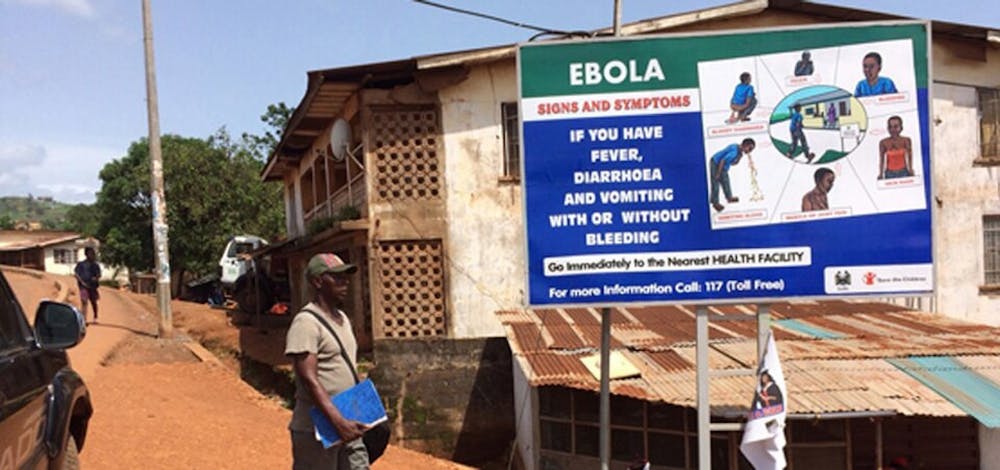
On May 17, 2026 the outbreak of Ebola in Central Africa was officially labeled by the World Health Organization as a matter of international concern. Instances of Ebola outbreaks have long been some of the greatest challenges for the public health field. First identified in 1976, Ebola disease has periodically spread, affecting several parts of the world and especially African countries. The disease, thought to originate from an unconfirmed animal, has been caused by multiple viral strains. The mechanism of transmission is through direct contact with the bodily fluids of an infected person, living or dead, or through contaminated objects. An individual is only considered contagious once they begin to express symptoms.
The current outbreak, considered the 17th in the Democratic Republic of the Congo (DRC), is caused by the Bundibugyo strain. It has been identified as highly contagious, with fatality rates estimated at over 30% of infected cases. While the DRC — for which the WHO has labeled the situation as “very high risk” — is considered the main site of the outbreak, bordering countries remain on high alert, with a brief series of cases in Uganda. The situation remains monitored by countries around the globe, including Europe, where the European Centre for Disease Prevention and Control encourages active monitoring and awareness of the potential risk.
Previous notable outbreaks of the Bundibugyo strain had occurred in 2007 and 2012, but the 2026 outbreak has been named the fastest-growing outbreak of Ebola as per recorded statistics. No vaccine specific to the current strain has yet been made public, leading to other stopgap measures such as the use of prior vaccines in the hopes of conferring additional protection. The situation continues to develop rapidly, with thousands of deaths and infections noted despite potential underreporting.
The News-Letter interviewed Andrew Pekosz, a professor of Molecular Microbiology and Immunology at Hopkins, to learn more about the specific details surrounding the response to this outbreak. Regarding challenges with developing a vaccine, Pekosz highlighted some nuances with regard to the Bundibugyo strain.
“[The virus] hasn't infected humans very frequently. So from a research standpoint, we're really, really carefully trying to monitor the sequence of the viruses from patients to see if there are any changes happening that might make the virus better at infecting humans. We've seen this kind of adaption with COVID-19 and SARS-CoV-2 when it enters the population... so, right now, this Ebola virus outbreak is in the middle of one of those,” Pekosz said.
Difficulties in monitoring the virus across thousands of cases and with discrepancies in reporting make the situation non-ideal, and further concerns were noted by Pekosz as impacting the possible implementation of solutions.
“We know how to make Ebola vaccines, but we kind of have to start from scratch and make new ones specific for this strain, and that's taking a lot of time... to be honest, there are problems that absolutely can be addressed, and we knew about these problems. We just really [don’t] have the money in place to be able to drive forward some of these things” Pekosz added
Previous major Ebola crises have included the 2014–2016 outbreak in West Africa, which led to the deaths of 11,325 people, and the 2018–2020 outbreak in the DRC. As a result of the recurring threat posed by the disease, several protocols and methods have been used across the years. To gain further insights into these practices, The News-Letter interviewed Chiara Altare, an associate research professor in the Department of International Health at the School of Public Health and faculty member at the Center for Humanitarian Health.
While Altare is not involved in the response to the current outbreak, she previously worked with the WHO on the 2018–2020 Ebola outbreak. Altare served on the monitoring and evaluation teams, which established clear parameters for the WHO across the board. Regarding her efforts during the previous outbreak, Altare highlighted the creation of thematic pillars around which the complex response to an epidemic could be organized.
“The first pillar is always coordination... You have the two key actors coordinating this outbreak response that are Africa CDC and the WHO [AFRO], but [there is also the] country level, where the Ministry of Health is the key actor in charge of the response...” Altare continued, “Then you have a variety of pillars that look at clinical management..., you have a big component which is the surveillance and contact tracing..., there is a pillar on laboratory capacity... and then you have the overall continuity of care, which is also something that is often forgotten.”
Altare further discussed some key differences between the 2018–2020 and the current outbreaks. One key difference she mentioned was the lack of a confirmed vaccine, whereas the vaccine and ring vaccination methods conducted in the previous outbreaks were essential.
“There have been two other outbreaks [of the Bundibugyo virus] in the past, so technically we could have been prepared. We were not for a variety of reasons... so it will require even more resources for contact tracing and surveillance...” Altare added.
Altare went on to highlight another emerging risk in the situation.
“Most of the new cases are actually not coming from contacts, which means we don't know what the sources [are]... This means that we have not understood yet exactly how the pandemic, how this epidemic is spreading, and that's very dangerous.”
Current response systems have been working to mitigate the negative impacts under these circumstances. One such measure in place is the use of biocontainment units. Found around the globe, these specialized units seek to prevent the spread of high-risk diseases when treating infected patients. The Hopkins Biocontainment Unit (BCU) is one such example, having previously played a key role in the response to the COVID-19 pandemic.
The News-Letter interviewed Carrie Billman, the director of education and training and lead infection preventionist for the Hopkins Biocontainment Unit, to gain further insight into these systems. Billman highlighted the exact nature of the BCU’s role during outbreaks.
“We have citizens coming [back] all the time from having traveled to [high-risk] countries, whether they were visiting family or they were part of aid organizations that are helping with the outbreak. Obviously those types of people are screened when they come back into the country, but you are potentially able to [become infected] up to 21 days after being exposed to any version of Ebola, so we have to be ready at a moment's notice for anyone who has returned and perhaps had high-risk behaviors while they were in those areas to be able to care for those patients,” Billman stated.
Due to the international nature of the current outbreak, Billman went on to highlight the global cooperation involved.
“[There are] high level isolation units all over the world, and so we are constantly in contact with our partners in crime in other countries — in Europe, in South America, in parts of Africa to not only make sure that we are all exchanging best practices, but really kind of any lessons learned for caring for these patients that could be coming from abroad...” Billman continued, “Thankfully, there are things like Zoom and Teams that help us a lot, so that we can really make sure that those lines of communication are open.”
Despite the current spotlight on the Ebola crisis, Billman further emphasized the importance of remaining aware of other outbreaks around the globe and of broader preparatory measures.
“When you hear about outbreaks, they're interesting, and people should pay attention because there's always something going on. It is not just from Africa. There's Crimean-Congo hemorrhagic fever that's usually over in the Middle East and in other parts of the world... Ebola is definitely what helped bring this national system together and develop our biocontainment units, but we like to think that we are prepared for Ebola and beyond.”
Though such measures might be in place, geopolitical and region-specific factors also play a role in disease management. During her interview with The News-Letter, Altare went on to highlight this point.
“It's not only the outbreak. It's 30-plus, 40-plus years of conflict and repeated humanitarian emergencies, repeated phases of complete disinterest of the international community, more recent funding cuts... It's actually very difficult to describe how challenging everything is — not only to respond, but for the people living there, and to understand what they are going through.”
Pekosz also spotlighted similar struggles beyond the basic science issue of developing a new vaccine.
“We're having a hard time getting to people to get them the tests and getting good turnaround time so that people hear those results quickly... The situation in terms of the local region that this is happening in is bringing on additional challenges because of the political strife that's going on in those areas, and the lack of ability to get objective WHO-mediated healthcare into those areas as well. So, even if we could have an Ebola vaccine that's specific to this strain today, it would still be a real challenge to get that rolled out into the population in a very timely manner.”
As of September 2026, the situation remains exceedingly complex and continually updating. An appropriate containment approach merits careful and consistent monitoring by all parties involved in the response to best mitigate the impact of the disease’s spread.