Ronald J. Daniels is the President of Johns Hopkins University. On May 8, President Daniels spoke with The News-Letter in an exclusive interview discussing the University’s 150th anniversary, campus construction, federal funding cuts, global conflicts and more.
The News-Letter: Our first question relates to the 150th anniversary of Johns Hopkins. We wanted to ask: what does this milestone personally mean to you, and do you see it as the beginning of a new era for the university's long term legacy?
Ronald J. Daniels: That's a great question. So I would say, first and foremost, an anniversary as momentous as 100th and 50th is just, by definition, a time of stocktaking. And so for me, it's been really important to just stand back and [ask], what are the achievements of the university? What are you most proud of, and how does that shape the future of the university? And I guess, what's really striking, and we've been signaling this in a number of the 100 and 50th anniversary events, is really seeing this as a place of first. This is a place that had the daring, the imagination, the courage to do things differently, both from the very inception of the university as America's first great research university, to all the other firsts that we've had over the years. You can think about the various inventions and breakthroughs we've had, but even going to the core: the way [we] first embraced the seminar as a way of organizing education and research activity in the same setting. [...] I think what's really wonderful is to see the way in which that willingness to resist the urge for any complacency. To continue to dream and to be daring and to embark on firsts – for me, that's the ongoing legacy.
The fact that we have stood up this major initiative that fuses data science and artificial intelligence (AI) [regarding the Data Science and AI Institute (DSAI)] [...] at an extraordinary scale, but very much with the view that it's centered in the Whiting School and radiates out to the rest of the university – that's a first. Today, in fact, the Dean of Engineering sent me an update that Stanford just decided to merge data science and AI and create an institute [based] very much on this model. So that's a recent first that, again, will set a standard and expectation for others. The Agora Institute was the first major institute that really was focused on the challenges and vulnerabilities of modern democracy [...] in a national and international frame. And so when we established that, that was a new model, but since that time, there's been a number of new models that have been developed that have other models at peer institutions that have followed that lead. [...] I could go on and on, but I think for me, what I'm most encouraged by is that there's just a constitutional inability of this university to coast. It's constantly looking at itself, critically, [alongside] looking at the world with a sense: how can we be more relevant and willing to embark on those endeavors?
N-L: Our next question is about the campus itself. Since 2024, the campus has undergone significant campus construction, including the library renovation and the new Bloomberg Student Center. So how did the university determine which buildings to create and renovate and the timing of each project?
RD: As you know, quite apart from those projects, there's a lot of cranes in the air right now across all of our campuses. First and foremost that it's all about the people. So that is to say, over the last number of years, and particularly as long as I've been here, [we’re] always thinking about the core academic mission of the university and that invariably means a focus on the people, the students, the faculty [and] the staff who are here at the institution. And so if you even look at what we have sought to raise funds for where we thought to make our own investments from reallocating funds, it's things like financial aid. Basically, over the last several years, we've raised literally billions of dollars in both undergraduate and graduate financial aid, and that's really, again, meant to increase access that's focused on the student experience and trying to reduce the barriers to entry and full participation for students, either at the undergraduate or graduate professional level when they're here. Similarly, we've really sought very deliberately, through a number of different vehicles, to increase the number of endowed chairs at the university, which provides support to individual schools departments to ensure that their faculty are properly supported. In turn, that brings research and education benefits from having those people there, and we've raised over 300 plus chairs over the last several years in terms of new chairs at the university. So it starts with the sense [that] your focus is on the people. And invariably, though, as the university is expanding, and as you look at the needs of the people, your students and faculty and staff capital projects are called out. So for instance, you ask how this happens? You know, typically it's a case that, in the case of a major capital project, you're hearing from an individual school. [For example], we've got these real challenges in terms of recruiting faculty and students to those basic sciences in the School of Medicine, because our labs are so run down and antiquated, and for decades we haven't been able to modernize them. And so [we’re] hearing from the Dean and from the faculty [that they] need more lab space, and [they] need modern lab space, and if you want to recruit faculty and graduate students, professional students, [...] we've got to do something about that. So that becomes the school, the school's chief priority, and in turn, that shapes what I'm looking to do in terms of providing the capital to support that project. [...] Aspiration comes from direction from the schools and from the faculty and students and staff in those divisions who are saying, we need this.
Once you get all these priorities, again driven by academic mission, often again related to how you support your faculty, students and staff, then it really becomes a question of, how do you design those projects? And making sure that there [are] multiple opportunities, for all of the affected stakeholders to feed into the design process, to express their needs that should be reflected in design, and again, creating a strong consensus around how the projects are involved. [...] Finally, at the end of all of this [...] planning, consultation, design work, then you got to find the funding. We've been really lucky in having incredible philanthropic support for a lot of these projects. Among many of them, has been the unprecedented support that we've received from Mike Bloomberg and Bloomberg Philanthropies and so it's just this really fortunate position that we've been in to be able to tap into the reservoir of interest needs on the part of the community, and then being able to develop the projects that we know are scratching the itches that are most meaningful to different constituencies across the campus.
N-L: We wanted to note that a lot of these projects reflect a more modern architectural direction that differs from the University's traditional Federalist style. Does this architecture reflect a new vision for the university's role in academia and development?
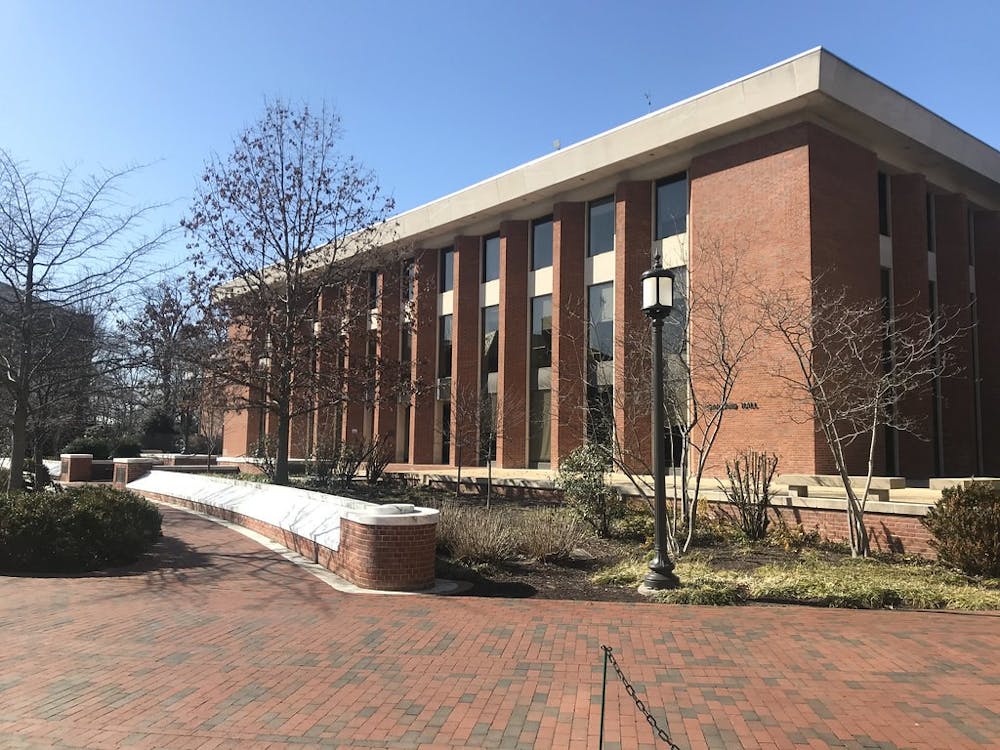
RD: [...] When you're on the core campus, [...] for instance [...] Malone and Hackerman Hall, [or] on the key quads, we've really adhered very closely to the Federalists motifs and how we've thought about the campus we're looking at. There's another new housing project, student residence, that will be done on the other side of Charles Street, between 32nd and 31st, and there again, because it's student residential space, we wanted to be able to be in alignment with what we've done at Scott Bates Commons. [...] Once you go outside of that core campus, I think we have a little more latitude and to be a bit more experimental. Even as we build new buildings on the core campus, [we] will still stay very much in the Federalist tradition. But as you go outside of it, I think we've shown that there's more leeway. So for instance, when we did the Agora building, [...] [it] felt it was really important to communicate the transparency and the accessibility of this institute focused on democracy to the campus community and well beyond. And so that commitment to transparency meant a lot of glass and just a different set of materials that we've traditionally used. So, I think that spoke to a different kind of project than what we would do at the center on campus, and I think gave us the ability to deviate a bit. Same with DSAI. There's, again, because it's on the other side of Wyman, more latitude for some deviation. Having said that, even where we've done new projects that have a more contemporary architectural style, like, for instance, what we did with the Hopkins Bloomberg Center in Washington, we still brought red bricks from from the Homewood campus there, so that there's a consistency in materials, in terms of signaling this one university motif.
N-L: So you mentioned the DSAI, which is something that has generated both excitement and concern among students and community members. How has the vision and plan for DSAI evolved since the idea initially emerged?
RD: I think it's evolved in becoming much more concrete, and there's much greater specificity of the character of the program than when we first announced this. I would say the fundamentals, though, that we articulated at the time of the announcement of DSAI have remained intact. The idea is that this is a set of capabilities [and] methodologies that we believe are of transformational impact. [...] Because of this, we felt [that] this technology was so significant, we as a university should invest as much as we could in really being able to understand, to critique and [...] to advance the whole field. [...] And the belief that the advancement of these capabilities really requires lots of domain expertise from different disciplines, and [...] whether it's precision medicine in the School of Medicine, or population health in public health health or the digital humanities and our humanities departments, one could multiply the examples. It's the give and take between the disciplines and the core methodologies resident in the the heart of DSAI that will create a lot of interesting advancement, and so that too has been something that has continued to operate as a guiding principle of this [project].
[...] We're also very focused on ensuring that there's critical capability within within the university, particularly in the new School of Government and Policy, but not limited to colleagues there who can think about the ethical dimensions of the development of AI, …the privacy issues, ...the appropriate regulatory guardrails that we should have in place. So it's not going to be unreflective.
[...] In terms of public concerns around this, obviously it's first and foremost about our neighbors, and the concerns of the loss of the trees, which we recognize was a truly undesirable part of the construction project. [...] After several meetings with community residents, and I know we didn't persuade all of them, but I think [there is a] commitment to ensuring that we would put more than 300 trees on the site. For every mature tree that we took down, we'll replace it with a tree that's at least 20-25 feet high. So mature trees will replace the mature trees that went down. I don't feel good about the fact that we had to take down those trees, but I think the commitment to replanting and the scale that we're doing is an important commitment.
N-L: Our next question is about recent federal policy changes, including] reductions in research funding and student visa restrictions; [...] [which have] undeniably affected [the University] and [institutions] nationwide. So we want to ask: how do you see these shifts and government action impacting the university in both the short and the long term?
RD: All these changes are having a profound effect on Johns Hopkins and, indeed, research universities across the country. [...] The reduction in federal funding is truly, truly profound. [...] If you look at what we typically over the last four years have received each year in terms of new grant awards, principally from the NIH, there has been a very marked contraction in the level of support, and it's something in the order of about $450 million of funding that normally we would have received, that we didn’t receive this past year. [...] Of course, for a number of our graduate students, they are funded here on the grants that our faculty secure on a competitive, meritocratic basis. [...] When the funding dries up for the faculty, that impacts our ability to recruit and retain graduate students. So last year was terrible, and so far this year, it looks to be equally bad.
If you look at year to date to this point compared to last year, we're down about 73% in terms of new grant awards. Just the grants are not coming out of NIH and NSF, which are two principal funding sources. So this is very serious, and in the short term, raises really challenging questions about our ability to keep great faculty here to see that they’re supported properly — that they can do the research that they have been committed to doing. And what you’re worried about, of course, is that this is not just temporary, but could in fact, become the new normal for the way in which the federal government understands its partnership with America’s research universities. [...] It’s better [to] focus on thinking about what we can do with industry, [...] other philanthropic supports, sources — with foundations to make up for the shortfall — and then thinking hard about new revenue sources for the university, whether it’s in case of tech transfer or clinical trials [...] Support for America’s research universities [...] — it’s support that ultimately contributes to the advancement of the country — [...] whether it's scientific, medical, national defense, in so many different domains. It’s been this great partnership that has ensured that America remains the most innovative and dynamic economy and nation in the world. But, it’s clear that that standing is now very much in jeopardy by virtue of the very draconian cuts that are being experienced. And right now it is not clear how quickly this is going to be restored,
N-L: With the funding cuts, how do you prioritize [...] the different projects or the different clinical trials happening? [How] do those funds get allocated?
RD: So, first and foremost, we’ve got to find more funding to be able to support [...] the activities conducted by our faculty that we regard as absolutely critical to the success of the university and the contributions to the American public and well beyond. [...] We will end up allocating the funds on a peer review basis. And so it’s not at any individual present or provost discretion as to where these funds go, but rather in the breast tradition of the academy. [We] will rely on a committee process to be able to evaluate and ultimately advise, what are the projects that we should focus [on] supporting [...]. This inevitably means there's just some degree of contraction if the federal government doesn't resume its normal funding activity in this area.
N-L: In light of these funding constraints — which includes reports of a hiring freeze and limitation to the research projects, as you have mentioned — how would you characterize the University's current financial position and its strategy moving forward?
RD: In a nutshell, it is to be guided, first and foremost by core academic mission. Where do we see the greatest impact for our research, education and broader community impacts — whether in clinical care or population health, so on and so forth? [...] Where do we have the greatest impact? [...] You’ve got to do everything you can to move resources to those areas, even in the face of this very significant withdrawal of federal funding support, and I think that’s ultimately how we’ll be, in time, judged as leaders of the institution. [...] In fact, if you don't call out priorities in a moment like this, then I think you really advocate your responsibilities to the institution and to its legacy.
N-L: Now shifting gears to something a little more global: There’s, of course, a lot of geopolitical instability at the moment. We wanted to know what role should the university play as a research institution and a global actor, especially given the current context?
RD: I think the university has long understood the importance of its research and education mission in a broader frame [...] I think there’s a clear understanding that we have a responsibility as members of this community, to do the best we can, to interrogate, to evaluate, to offer analysis and prescriptions on issues that are important and confront society, domestically, internationally, in the social, political and scientific spheres, and to make that that insight broadly available. I think that responsibility is at the core of what a great university does. We have a responsibility to undertake research for the purpose of adding to knowledge, but ultimately, I think there's an obligation for that knowledge to be shared.
What I really appreciate is, even in the current climate in which we’re so fractured, and there’s such [a] deep state of paralysis and conflict in our society, that our faculty are still speaking out, still bringing their insight and analysis to a range of different issues. [...] I see that that sensibility manifests in so many different places at the university. It's true in the international sphere. That's what SAIS has done for decades. [...] I think that’s what we’ve done, and that’s what we must continue to do as an institution. I really regard my job as creating as much space as possible for faculty and students to feel secure and protected in bringing their best ideas and analysis to the world at large and to create an intellectual [...] broader cultural climate in which people feel free to speak their minds, and to do so with an understanding that that not everyone might agree with them [...] that’s what a great university community does.
N-L: Since arriving in the presidential role in 2009 how have you seen students build the Hopkins identity and reflect institutional values over the years?
RD: You know what’s really great is to see the way in which each class contributes to the development of the identity, the character, the personality [and] the place [of the University]. [...] It has been really exciting for me to see the changes in which the student body understands its role at Hopkins. When I first got here, some students wore Hopkins sweatshirts, but not many. Now I see — [it] could be all the free swag we give out — [...] that students are proudly wearing their affiliation. It’s amazing! I've bumped into Hopkins graduates, and they’re still wearing Hopkins paraphernalia.
[...] I would say, just the new traditions, like the Lighting of the Quads, have become important university moments that, over the years, have become much more central to the student experience. [...] I’ve seen it in the turnout of sports events — not just lacrosse — but a number of other sports. [There are] just more spectators and more enthusiasm in those moments. [...] And I’m hoping that the new student center further enforces this sense of community, identity and pride of affiliation with the university. [...] It seems to be on a really good trajectory in that way.