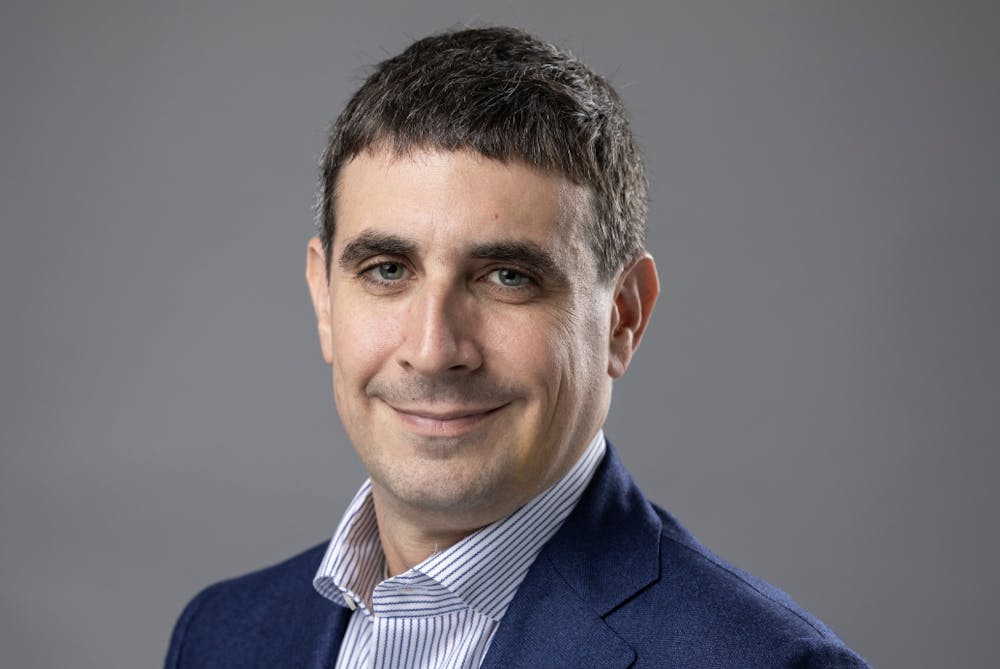
Mike Spector is an investigative reporter for Reuters’ legal team, where he covers legal and political news, and a former Editor-in-Chief of The News-Letter. In an interview with The News-Letter, Spector reflects on his time at Hopkins, his career in journalism and his recent accomplishment in winning the 2026 Pulitzer Prize in Journalism for National Reporting.
The News-Letter: How did you become interested in journalism and reporting in general?
Mike Spector: It probably started when I was about six years old because my mom worked on political campaigns. She was a press secretary, and she would be on the phone with reporters in our house in Northern Virginia all the time. One time, I picked up a phone in another room – this was back before smartphones, when there were just phones on the wall or on a nightstand – and I eavesdropped on a call she was having with The Washington Post. She heard me and told me to get off the phone, and I said, “But I want to talk to The Washington Post.”
When I was growing up, I was around a lot of political campaigns, and, because of my mom's job, it seemed like what was going on in The Washington Post was always more important than the campaign itself. So immediately starting in middle school, I started taking journalism classes, and then I worked on my high school newspaper at West Springfield High School in Springfield, Virginia.
I took a little bit of a break when I got to Hopkins, but a friend of mine asked me to come work on The News-Letter. I went along and did News & Features for a little bit, and then pretty quickly I [became] a News & Features editor, and then got elected Editor-in-Chief [in] my senior year. I completely fell in love with it, and it was all that I wanted to do.
N-L: How was your experience as Editor-in-Chief of The News-Letter?
MS: It was the most fun I’ve had, among the most fun things I've done in my life. [There were] a lot of late nights [...] trying to meet deadlines, and unfortunately oftentimes missing class the following morning, [which] happened more than I would care to admit, but it was a really thrilling experience, and just a good way to learn, make mistakes and make great friends. I met my wife at Hopkins. She was in student government, so there was often a joke that we were the power couple.
N-L: What did your experience as a part of The News-Letter teach you that transferred over into your professional career?
MS: I would actually say it probably took me a little bit longer to internalize this lesson, but it taught me some humility because you can think that your way is the right way and you know everything, but you can make mistakes. I also learned a lot about making sure everybody has a voice and treating everybody with respect, but balancing that with making sure that a paper gets created. It also taught me about experiencing big joys but also big disappointments. Finally, it taught me how to make decisions on my own because there’s not a lot of oversight, so it's up to you to make the best decisions.
N-L: How did you realize you wanted to pursue reporting professionally?
MS: I just loved it and wanted to be able to do it for a professional news organization. Out of college, I applied to every newspaper you can think of, and was rejected by all of them. I ended up at a tiny newspaper in Maryland. I went to the Columbia Graduate School of Journalism after that, and I was fortunate to get an internship at the Wall Street Journal. They kept me on, and I ended up being there for about 12 years before I moved over to Reuters, where I am now.
N-L: Reuters recently won the 2026 Pulitzer Prize in Journalism for National Reporting for investigating Trump’s retribution campaign. How did you first become involved with this project and how did the series evolve over time?
MS: The leader of the political investigations team came up with the idea to do a series of stories on Trump's retribution campaign, since he was targeting so many of his political enemies. One of the reporters on his team was working on a short-term story about threats to judges, and I said, "Oh, that's in my wheelhouse. I'd love to help you with that.” He connected me with other reporters on the team, so we started working on that story.
After we published that story, one of my colleagues had the idea to focus on how families of judges were also being threatened. At the time, Elon Musk, Trump and others were attacking judges and their families, accusing them of being politically biased and calling for them to be impeached, which was really unprecedented.
Then, Trump went after law firms, which was firmly in my wheelhouse, so I was asked to do a story about that. Along the way, I was also doing some reporting with other colleagues about January 6th rioters and how their prosecutors were being targeted. Toward the end of the year, that story came together and it ended up being the capstone of the series.
N-L: What was the reporting process like for these stories, particularly when it came to gathering evidence and information from judges and legal officials?
MS: Judges almost never talk to reporters, because it's against their professional code to do so, but we found judges who were willing to talk to us. Be it judges or federal prosecutors or others who were targeted by the Trump administration, I'm really grateful to sources who spoke to us and that they were able to share what they were experiencing. That was crucial to the stories, so it was important that they trusted us.
N-L: What was your reaction to winning the Pulitzer Prize? Did you expect the pieces to have such a significant impact?
MS: I was completely stunned. I was not expecting to win at all. I knew that our editors had submitted the series for consideration in two different categories, but I had no inkling that we were even a finalist, let alone a winner. When it got announced, it was pandemonium. Everyone was so happy and excited. I felt then, and still feel about a month later, really grateful to have achieved it and to stand on the shoulders of all my colleagues. None of this gets done by one person, and I couldn't have done it alone.
N-L: Many of the pieces in this series dealt with issues of power, retaliation, and accountability. Why do you believe investigative journalism is especially important today?
MS: Investigative journalism is crucial right now, because the powerful, more than ever, want to keep people from finding out information about corruption or other uncomfortable truths, including abuses of power. You need investigative journalists to uncover that information, because the powerful are rarely going to volunteer it themselves.
Thomas Jefferson said, “Were it left to me to decide whether we should have a government without newspapers, or newspapers without a government, I should not hesitate a moment to prefer the latter.” That tells you everything you need to know. An informed citizenry is crucial to a functioning democracy, and investigative journalism is crucial to uncover corruption and abuses of power.
N-L: What advice would you give to students interested in journalism?
MS: Pick up the phone, call other human beings and go see them in person. You get amazing stories by meeting people in person or by talking to people on the phone. For anybody who aspires to be a journalist, those are my key pieces of advice. Get off the texting and social media. Call people and meet people. That’s the best way to get stories.
Another piece of advice is, when you’re first starting out, be willing to go anywhere and do anything. Be willing to work for a small newspaper or media outlet you’ve never heard of. When I was graduating from Hopkins, I applied to The New York Times, The Wall Street Journal, The Washington Post and every other major newspaper, and I was summarily rejected by all of them. I ended up working at a very small newspaper in Elkton, Maryland for two years covering cops and courts. That’s where I learned how to be a journalist. I was forced to go to car accidents and house fires and talk to people who had just lost loved ones. I lived in a small town, and I was forced to see the people I wrote about in the newspaper every single day, so if I made a mistake, I was going to hear about it.
Finally, remember that life is long. I never in my wildest dreams thought that I would be doing what I’m doing right now and have achieved this milestone. But hard work does pay off. Don’t worry about chasing those kinds of dreams too much; worry about being passionate about your work. If you love your work, you want to make a difference and you work hard at it every day, the rest will take care of itself.