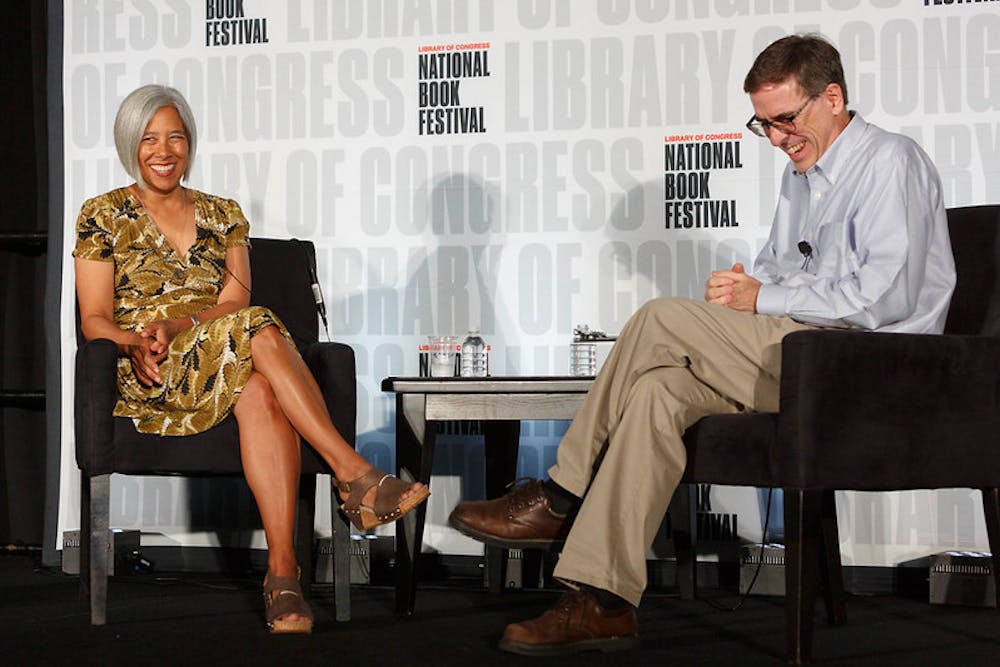
On Wednesday, March 25 the Writing Seminars department hosted an event featuring Professor Susan Choi, who teaches creative writing at Hopkins. During the event, Choi presented her latest novel Flashlight. Published in 2025, the novel follows Korean father Serk and his daughter Louisa in 1978. Flashlight was shortlisted for the 2025 Booker Prize in the U.K. and was longlisted in the 2025 National Book Award in the U.S.
Choi’s other writings include The Foreign Student (1998), American Woman (2003) and Trust Exercise (2019), which won the 2019 National Book Award for fiction.
Choi began the event by introducing her novel and reading an excerpt from it. The excerpt follows 10-year-old Louisa, whose father had just died and whose mother is in a wheelchair, forcing them to move in with relatives she barely knows.
In the excerpt, Louisa’s aunt takes her to see a child psychologist, Dr. Brickner, who speaks with her about her father’s death. During the session, she deflects his questions and refuses to interact with the various activities in the room. When she finally plays with a flashlight in the darkened room, Dr. Brickner mentions her deceased father, leading Louisa to become tense and withdraw emotionally.
Afterward, Choi transitioned to a later excerpt, after Louisa goes to college and spends the summer in London. At the end of the summer, she travels to Paris to meet her college friend Tamar. She stays in the apartment of Tamar’s brother, Daniel, living with Tamar, Daniel and his fiancée Christiane. During her visit, Louisa gets swept up in their Parisian lifestyle of late nights, parties and eating out.
In the excerpt, Daniel takes Louisa and Tamar to an archaeological dig at the Louvre, where his friend Yves gives them a tour. During this, Louisa feels disconnected, uninterested and overwhelmed. She does not join the rest of them for lunch afterward, instead returning to the apartment, where Christiane gives her a salad to eat. Louisa struggles to eat it.
“The leaves in the salad were very large and natural-looking, as if Christiane had just ripped them out of the ground. And Louisa couldn’t understand how to eat them... And she was too ashamed, eating her unasked-for salad alone under Christiane’s gimlet eye and the sinuous thread of Christiane’s cigarette smoke, to rip all the leaves into pieces at the outset, with her knife in her right hand, and then swap the knife for the fork, which was the method she usually used,” Choi read.
The event concluded with a question-and-answer session, in which Choi discussed the inspiration behind her novel, the writing and editing process, and how she researched background information.
When asked about the inspiration behind writing Flashlight, Choi drew on her own experiences visiting Japan and living in an unfamiliar environment when she was about the same age as Louisa.
“[My father] had a visiting professorship in Japan in the late ‘70s. I was about nine,” Choi said. “We suddenly went to Japan... I was sent to a school with all Japanese kids. No one spoke any English. I spoke no Japanese. I think that kind of shock was the initial inspiration for writing a book set in that time period and set in Japan, but the secondary inspiration was a series of actual disappearances that took place in Japan at the same time as when my family was there.”
Choi also addressed the scene with Dr. Brickner, noting that she was initially worried about writing it because she lacks personal experience with child psychology. However, she decided to focus more on creating an interesting dynamic between Louisa and Dr. Brickner, depicting the scene as a power struggle in which Louisa meets someone who challenges her intellectually.
Additionally, when asked about her research process, Choi stated that many phases of research are required, depending on the stage of her draft and how detailed it is.
“There was a very long, vague initial period of research where I was reading about these disappearances. I was going very broad, trying to figure out the context, and what kind of story might happen in that context,” Choi explained. “But then there were at least two subsequent phases of more focused research, because once the story started taking shape, I realized that there were all these things I needed to figure out... like how would the higher educational system of Japan work for a non-citizen?”
Choi also spoke about writing from Louisa’s perspective as a child and making sure readers understood her thoughts. She aimed to balance Louisa’s intelligence with her childlike behavior and the limitations of her young age, and she also utilized chapters written from other characters’ perspectives to allow the reader to receive multiple perspectives.
The event concluded with a discussion of literary archives. Just two weeks ago, Choi visited the University of Tulsa in Oklahoma, which houses a major archive of Irish novelist James Joyce’s work. She talked about how the experience reinforced the importance of archives, although most of her writing exists digitally in hard drives. For Choi, the idea of having her own archive seemed flattering but also frightening.
Professor Andrew Motion, a professor of the arts at the Hopkins Writing Seminars department, offered his thoughts on the event in an interview with The News-Letter.
“The reading is timed to celebrate the recent publication of her novel, Flashlight,” he wrote. “I hope people will find in it intellectual excitement, emotional fulfillment, and pleasure.”