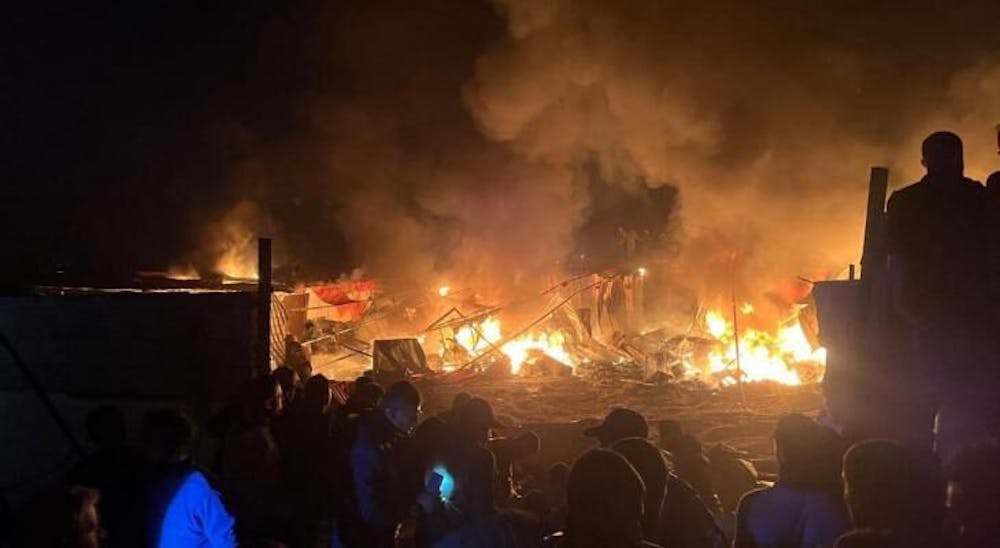
On Wednesday, Feb. 25, a united effort between the cross-institution group of faculty, staff and students from Krieger School of Arts and Sciences, Bloomberg School of Public Health, the School of Medicine and the School of Nursing hosted the panel discussion, “Humanitarian Medical Care: Reports from Doctors Returning From Gaza,” to raise awareness regarding the ongoing crisis in Gaza through a medical humanitarian lens.
The panel featured Dr. Terry Jodrie, emergency medicine physician and assistant professor of emergency medicine at George Washington University, and Dr. Yipeng Ge, primary care physician and public health practitioner based in Ottawa, Canada. Jodrie completed two deployments, the first from February to March 2024 and the second from April to May 2024, where he worked at a trauma stabilization point in Khan Yunis. During his visit in February 2024, Yipeng worked in multiple primary care clinics in central Rafah. Together, their firsthand medical testimony offered insight into the realities of conflict, civilian suffering and challenges of delivering care under extreme conditions.
Jodrie was the first to share his experience, and he began by presenting slides to showcase the Gaza Strip geographically. One of his first slides included a side-by-side comparison of the Gaza Strip in 2022 and 2024 to highlight the transformation of Khan Yunis into a tent community as a result of displaced Palestinians from the north seeking refuge in the south, particularly around Khan Yunis. Jodrie also acknowledged the absence of public resources to manage waste, hygiene and sanitation in the Khan Yunis region, and specifically noted the location of the trauma stabilization point on a soccer pitch.
“We had two critical care tents and one more,” Jodrie said. “Our configuration was such that we had five resuscitation beds and four general care beds, and we were embedded with the Palestinian Red Crescent Society. Our team consisted of two physicians, a German and myself, two nurses, a Bosnian and a Brit, and two paramedics who were both Brits. The Palestine cohort was all Palestinian, typically two doctors and a smattering of nurses.”
Jodrie also presented pictures that provided a glimpse of the life inside the trauma stabilizing unit. He explained that, although it appeared chaotic, there was no chaos; rather, it was organized trauma. From his experience stabilizing trauma patients in Afghanistan and Iraq, Jodrie revealed that there are certain cases that should be treated immediately, such as tension pneumothorax, a collapsing lung and cardiac tamponade, which is the accumulation of fluid around the heart. He used these examples to clarify the purpose of the trauma stabilizing point.
“It is not definitive care,” Jodrie said. “We have found that within ten minutes from the point of injury, if you can be stabilized, then your chance of surviving when you get to more definitive care increases exponentially, and this is the way it works universally. Unfortunately, in Gaza, downstream resources were eliminated as they bombed hospitals. In our particular case, the closest hospital, closest tertiary hospital, was the Nasser hospital, [which was] again and again attacked. There were fortunately some field hospitals, these were hospitals that were built on tanks. These hospitals sort of took the place of the tertiary care hospital.”
Due to the inaccessibility of hospital care, Jodrie emphasized that the main objective at the trauma stabilizing unit was to decompress the hospital, usually by performing lifesaving care. He added that the collapsing of the medical infrastructure does not affect trauma alone but detrimentally affects the management of other health conditions like diabetes.
Considering the most common injuries they observed, Jodrie mentioned that extremity injuries relative to the torso and head combined were incredibly common. He explained that this was the case because of a shooting technique called a double-tap.
“A double tap is a lethality measure,” Jodrie said. “When you shoot, you shoot two in the chest and one in the hip. They see someone running down the street, looking suspicious, typically a young man [and then] double-tap. If they can’t get him, he runs into a tent, and they fire indiscriminately into the tent, getting 15 to 20 patients at a time because of this maneuver.”
Following Jodrie’s presentation, Yipeng shared his clinical experience serving in Rafah, providing a more structural outlook at the crisis. Yipeng first addressed how he does not necessarily consider himself a humanitarian physician, as he came to learn about Palestine through his background in Indigenous rights and health work in the context of Turtle Island.
“I didn’t have a choice of growing up in a settler colonial state like Canada,” Yipeng said. “When I understand what happened and continues to happen to indigenous peoples on this land, I am bound to learn about what struggles against colonialism looks like in other parts of the world, including in Palestine.”
Similarly to Jodrie’s statement regarding the absence of resources, Yipeng also expressed the troublesome unavailability of supplies such as Tylenol and Advil, the basic forms of medicine to treat pain, as well as other antibiotics to treat common infections. Although they were personally able to bring some supplies, Yipeng stressed that it is not a viable solution.
“When I worked in these primary care clinics, we were able to use some of the supplies and medicines that we brought with us,” Yipeng said. “[However], you know, the countless patients that kept coming in did not only need these medicines but they also needed nutritious food, clean water, decent shelter, and all of these things were systematically unavailable for the majority of patients.”
One particular outcome of the lack of basic survival necessities he witnessed was malnutrition.
“I remember going to the WHO coordinating meetings, in the morning, where they would say we should screen for malnutrition with a measuring tape for an upper arm circumference,” Yipeng said. “I didn't need an upper arm circumference measure to know that all these children that were coming through the clinic were severely malnourished, because they were skin and bones. I remember one patient who wasn’t even walking anymore [and] had to be carried in by his mother or guardian that was with him.”
Furthermore, Yipeng shared how he was diverted from the emergency department at the Nasser Medical Complex to primary care clinics in Central Rafah because the Israeli military had surrounded the Nasser site with tanks when he was in Rafah. He also attempted to return to Gaza in May 2024 but found that the clinics he had worked for no longer existed because the Israeli military had raided and destroyed them.
“Over that course of an invasion, they [the Israeli military] went into that hospital [at Nasser], killed patients, killed healthcare workers, detained healthcare workers and a couple hundred [healthcare workers] still remain in detention,” he said. “We know of healthcare workers who've been killed in detention in these Israeli torture camps.”
Yipeng stated that his reason for sharing these stories was to illustrate how systematic the destruction of not only the conditions necessary to sustain life were, but also the health care system itself. He shared another story where he explained the psychological impact of the crisis, especially on young Palestinian children.
“Young kids were just like running around playing [and then a] missile lands probably a few kilometers away,” Yipeng said. “The building shakes, you hear the whistle of the missile strike [and] myself and the colleagues that I was with [felt like] ‘okay, that’s it.’ Our hearts dropped, we went quiet and the kids didn't bat an eye. They kept playing it as if nothing had happened. This is what these kids have lived throughout all their lives. This does something to one’s psyche.”
Yipeng concluded his presentation by encouraging the audience to seek the voices of Palestinians directly, which an event coordinator mentioned as a limitation of this panel discussion.
“I am grateful that you’re listening to me [and] doctors who’ve worked in Gaza, but there are voices you can listen to on a weekly basis that are [from] Palestinian healthcare workers based in Gaza,” Yipeng said. “When I can I join a webinar hosted by Doctors against genocide. It happens every Sunday [and] we usually start the call by hearing healthcare updates from our health care worker colleagues in Gaza.”
On the topic of Palestinian voices, the organizers of this event expressed the need for more events like this on the campus, especially ones that feature Palestinian voices directly. They hope to see that others across departments and schools will take it upon themselves to convene more discussions and ensure this dialogue continues.