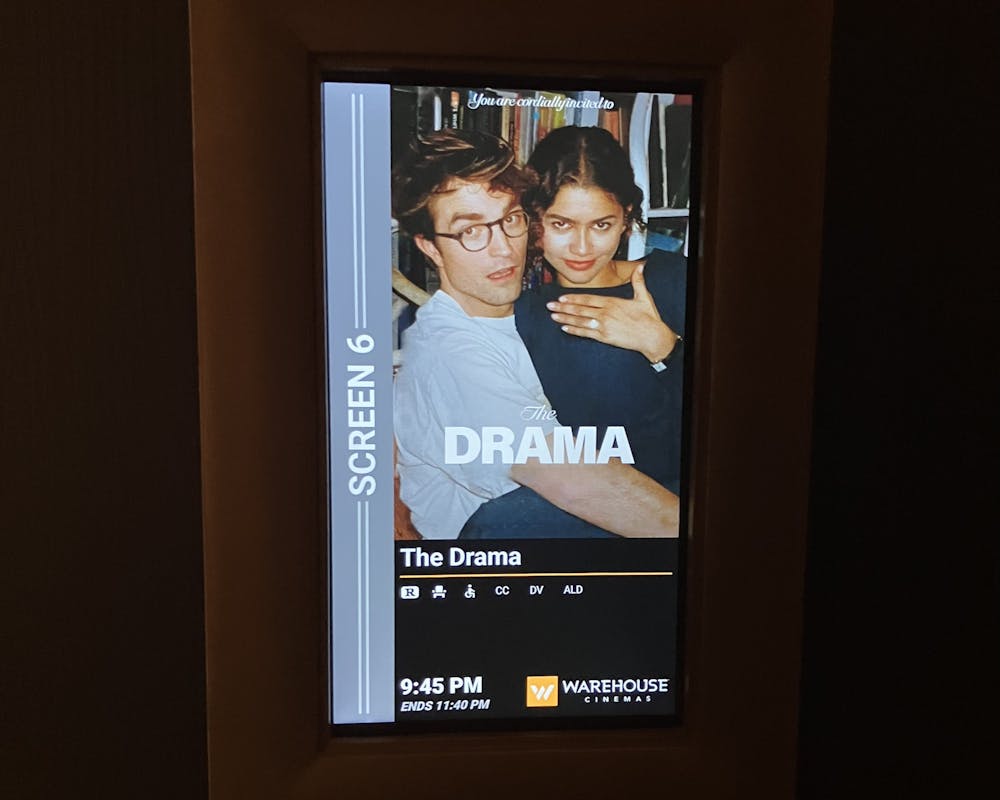
I laughed; I swooned; I tried to disappear into my seat. Kicking off Zendaya and Robert Pattinson’s year of cinema domination with a bang, Kristoffer Borgli’s The Drama is a brief study of performative empathy.
We begin with a flashback of Emma and Charlie’s “meet-cute” in a coffee shop — a perfect snapshot of the future of their relationship. Charlie, instantly smitten, tries to tell Emma how much he loves the book she is reading (he has not read it). However, he receives no response since Emma, listening to music with one headphone in, is deaf in her other ear. Once she realizes what he was trying to do, he flails around for a minute before she lets him off the hook with a “Can we start over?” This line becomes a through line in their relationship as well as the film at large, which contemplates what it means to truly know and accept a person through Charlie’s frenzied unraveling.
One night, as Emma and Charlie are finalizing their food and wine selections for their wedding with their married maid of honor Rachel and best man Mike, they begin a game of what’s-the-worst-thing-you've-ever-done: the trigger of the rest of the film. Charlie doesn’t really have one (foreshadowing), but Emma reveals that she had planned a school shooting when she was a young teenager. Although she ultimately did not go through with it, she planned it meticulously.
Everyone is horrified. Rachel, in particular, turns on Emma with an incredibly self-righteous spiel about how her cousin is wheelchair-bound as a result of a school shooting, and the night comes to a close. Emma frantically tries to salvage her relationships, especially with a deeply conflicted Charlie. Through all their appointments in the lead up to the wedding, Charlie tries to come to terms with the woman he is going to marry, and he spirals determining if he ever truly knew her at all.
The marketing for The Drama was impeccably executed; the trailer teases but never reveals the horrific thing Emma could have done. While this secrecy would normally be around a third-act twist, in this case, it is the entire premise of the film. In doing so, this allows the viewer to find out about Emma’s past right alongside Charlie and their friends, and it truly puts us in his shoes during the fallout.
It’s soon clear that this, Charlie’s reaction to Emma’s secret, becomes the worst thing that he has ever done. The Drama is about Charlie. We see many scenes of a young Emma, but it’s left ambiguous whether these are real or simply his troubled imaginings. Robert Pattinson is at his best when he’s playing a handsome weirdo (#teamedward), and The Drama is no exception.
From the beginning, it was evident that Emma and Charlie’s relationship was not terribly deep, and that Charlie had cast Emma as this platonic (in Plato’s sense, as beings in their best and purest forms) ideal of a woman — now that this image has been shattered, he has no idea what to do with himself. In a particularly fraught moment of distress, he kisses and nearly has sex with his coworker. This is revealed to Emma (and all their guests) in a classic wedding-gone-wrong: where Emma flees and Charlie is beat up by his coworker’s boyfriend.
Aside from Charlie and Emma, Borgli touches on the nuance between one’s thoughts and actions through Rachel. Although he doesn’t explore this so much as point it out, he holds a mirror up to modern society’s reactionary approach to ethics. While Emma’s crime was a series of thoughts, Rachel’s was locking a neighbor implied to have special needs in a cabin in the woods as a child. She said nothing even as his father asked if she had seen him, and her unconvincing excuse is that people must have eventually found him. Rachel’s outrage is performative, and performance is the central tenet of the film.
Emma and Charlie’s first dance choreographer points out early in the film that weddings are inherently performative, and the almost voyeuristic camera work never lets us forget it. This extends to Charlie himself, who cannot accept that Emma is anything less than perfect — until, having ruined everything, he suddenly needs her forgiveness. It’s worth noting that he is British, which perhaps explains his inability to grasp the unique and visceral relationship that Americans have with guns and school shootings, and why Emma's confession lands so differently for him than it does for Rachel (and us). Although Borgli claims that he was not trying to make a statement about cancel culture in this interview with Popcorn Podcast, the pieces are there (and he also might be using this to distract from his own worst thing, but I digress).
On a technical level, The Drama’s editing, done by Joshua Raymond Lee and Borgli, was engrossing, and it kept my eyes glued to the screen with slow zooms and quick cuts reminiscent of Succession (Charlie and Emma’s Architectural Digest-worthy Boston town-home didn’t hurt either). Despite its anxiety-inducing visuals and soundtrack, The Drama leaned into its darkly comedic edge in a way that felt entirely natural. In a world where streaming has dominated the cinema, this is a strong argument for the relevance of the theatrical release. The resounding gasps and inappropriate giggles united the audience in a way that I haven’t experienced in a while.
Ultimately, The Drama was a fun thought experiment — an intriguing venture if a bit shallow due to its insufficient interrogation of nuanced morality. This didn’t really bother me personally since it led to a lively post-movie discussion with the friend I watched it with. Sometimes a film’s greatest achievement is making the audience want to argue about it on the way home: and on that front, The Drama delivers.