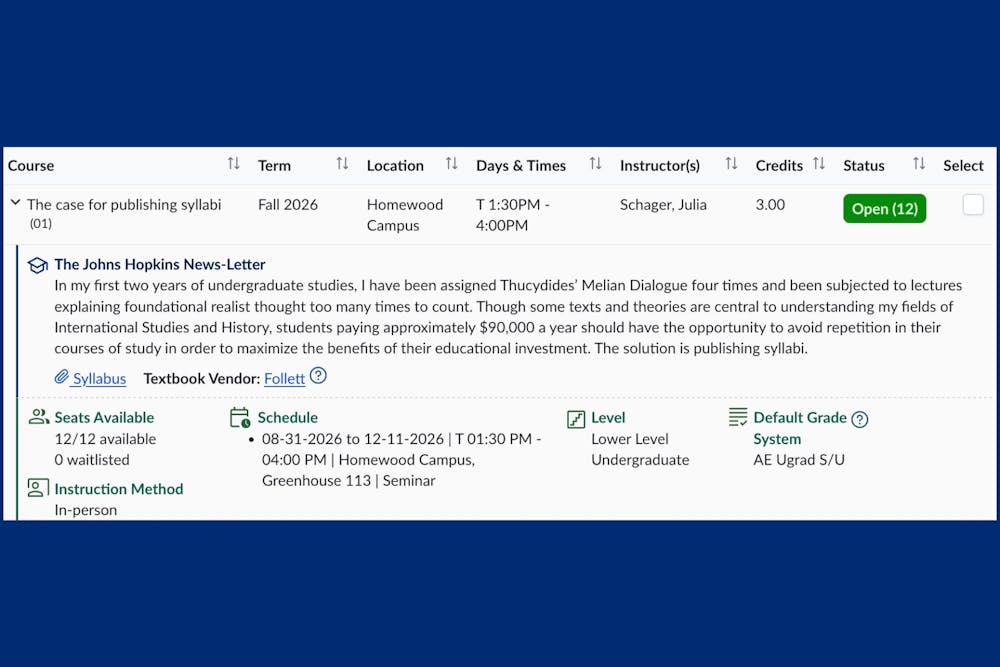
In my first two years of undergraduate studies, I have been assigned Thucydides’ Melian Dialogue four times and been subjected to lectures explaining foundational realist thought too many times to count. Though some texts and theories are central to understanding my fields of International Studies and History, students paying approximately $90,000 a year should have the opportunity to avoid repetition in their courses of study in order to maximize the benefits of their educational investment. The solution is publishing syllabi.
This is not only an issue for current students. Prospective freshmen who have yet to commit to the school should be able to weigh their options by mapping potential path projections of their upcoming degree. Though information is available on the Hopkins Public Course Search website, further investigation yields a number of courses with misleading titles and one-sentence descriptions without mention of a semester schedule, course readings or required assignments.
Students already enrolled at Hopkins should be awarded the same information. While a Molecular and Cellular Biology major can predict that Organic Chemistry I and Organic Chemistry II will be unique courses, it is much more difficult for a humanities student to predict whether a given course will require them to read the same texts — for example, Karl Marx’s The Communist Manifesto, Niccolo Machiavelli’s The Prince or Hannah Arendt’s The Origins of Totalitarianism — which they very well may have already studied at Hopkins. In addition to identifying redundancies in coursework, students should be able to evaluate ahead of the registration period whether a syllabus is reductive, one-sided or simply not expansive enough.
Last semester, I enrolled in an upper-level undergraduate course that was revealed on the first day of class to be structured around reviewing and critiquing the professor’s manuscript. By the time I realized that this class was not well-suited to my interests, all other equivalent classes were full and I was given few options but to remain in the course.
Syllabi are almost always made available by professors on the first day of class, characterizing the first two weeks of the semester as a period where students regularly use the conditional add/drop feature to switch out of courses that they wrongly predicted would be beneficial to them. If syllabi were published before this hectic window, registration and the add/drop period would be much less stressful.
This is not to say that professors shouldn’t have the opportunity to edit syllabi post-registration; a general guideline should be sufficient for students to make informed decisions regarding their schedule. If this guideline has not been created prior to registration, it is unclear on what grounds the professor’s department is approving their course.
There are a few potential reasons that Hopkins might shy away from making such information available, like the fear of political backlash or a desire to include timely material that cannot be easily predicted in advance. Should course syllabi be published, staff, alumni, board members, investors and the general public will have free rein to criticize the institution’s learning principles and standards, which has the potential to damage its efforts to develop a reputation of being politically balanced. Professors should be able to update syllabi as the semester progresses, but should also be required to provide an outline.
Such concerns have been raised at other institutions of higher learning and should Hopkins require syllabi to be published, they would not be the only prestigious university to do so. As of the 2026–2027 academic year, the University of North Carolina at Chapel Hill (UNC) will release all syllabi as public records. By redacting instructor names from the documents, the school is protecting its faculty while also providing critical information to its community and the general public regarding grading policies, semester calendars and required course materials. Though some students base their course selection on the professor for the course, this is still considerably more information than is offered when syllabi are not published at all.
This decision was reached following the submission of dozens of public information requests for UNC syllabi by The Oversight Project, an attorney-led coalition founded in 2022 and backed by the Heritage Foundation. The organization which, according to Heritage Foundation President Kevin Roberts, is “dedicated to investigating and exposing the Biden administration, policymakers, and anyone else engaged in the destructive work of implementing radical leftist policy,” sought to discover whether syllabi were compliant with President Donald Trump’s executive orders regarding the removal of diversity, equity and inclusion programs at publicly funded institutions through these requests, as reported by The Daily Tar Heel.
Though UNC’s adoption of a new syllabi policy is a direct response to these controversial political tactics, the detrimental effects of failing to publish syllabi remain clear. Under the current system at Hopkins, students are left at a course-selection disadvantage, and members of the community are left in the dark about the specific nature and quality of the education provided by the University — and, therefore, about whether their investments in the University are being made under misleading pretenses.
Julia Schager is a sophomore majoring in International Studies from Stamford, Conn. She is a News & Features Editor for The News-Letter.