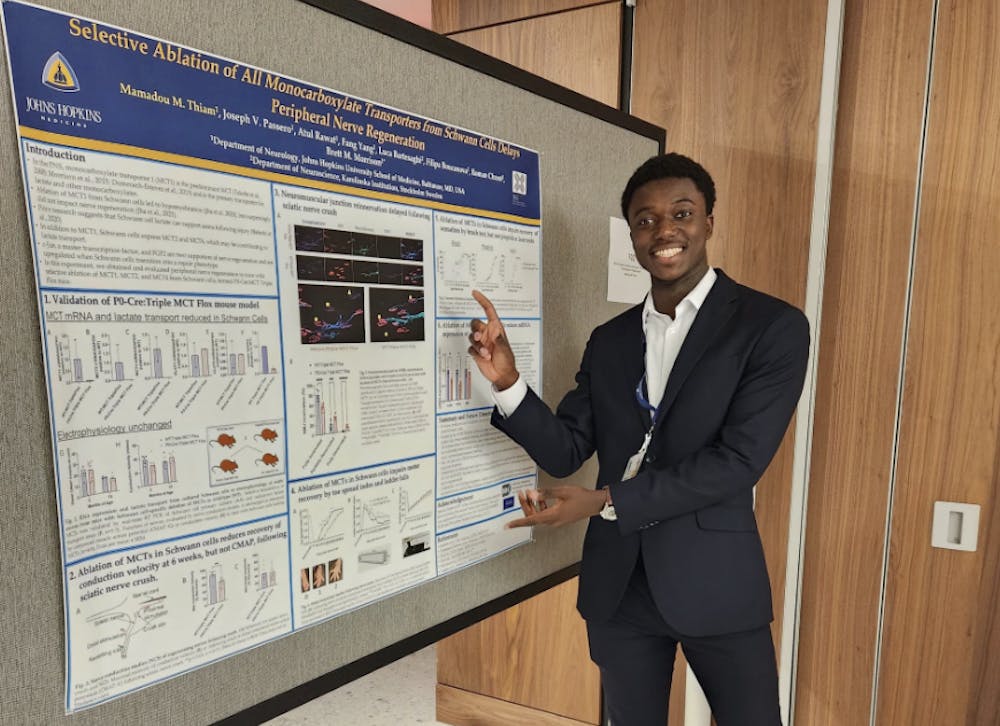
Mamadou Thiam is a junior majoring in Molecular and Cellular Biology as well as a University Undergraduate Research Fellow conducting research in nerve regeneration and energy metabolics. In an interview with The News-Letter, Thiam discussed his research under Dr. Brett Morrison, a neurologist at the Hopkins School of Medicine focusing on neuromuscular medicine.
Thiam credits his interest in biology to taking AP Biology in high school, which led him to become interested in the detailed, molecular perspective of biological systems.
“Seeing how [the body has] trillions of cells all with their own jobs and the way that they're able to interact [with each other] was really, really cool… Once you start to take all these different classes, you really begin to understand the degree to the specialization, [and how] specific everything that has to be, and what specific conditions have to be present for our bodies to work as they are.”
Thiam looks at how monocarboxylates such as lactate and pyruvate impact nerve regeneration. He specifically examines the circumstance where metabolic transporters, special transmembrane proteins that deliver molecules like monocarboxylates essential for energy production to the cells, are removed. Previous literature has shown that blocking monocarboxylate transporters to prevent lactate release led to faster axon degeneration of Schwann cells. This implies the importance of transporters in the role of nerve injury and nerve regeneration.
His day-to-day research consists of molecular assays like RNA sequencing and running behavioral tests with mice. In his experiments, there are two groups of mice: (1) control mice, and (2) transgenic mice that have their transporters removed. Each mouse undergoes sciatic nerve crush to induce injury, and then their recoveries are examined over time under the context of multiple behavioral tests like walking on ladders, evaluating the strength of their grip over time and nerve condition tests that measure the speed and strength of impulses.
Clinical applications for Thiam’s research include supporting potential nerve regeneration therapeutics for peripheral neuropathy or other nerve injuries.
“So if there is a difference [between the two mice genotypes], we want to see if not having these transporters results in reduction in nerve regeneration. From there, we can look at how to upregulate, or how to induce a better change in nerve regeneration. So if you have someone who has a nerve injury in their arm, nerve regeneration either cannot happen because the injury is too severe, or it's super, super slow, meaning that the effect is almost negligible. But if we can find a way to increase a nerve's capacity for regeneration, we can improve patient outcomes at a very large scale.”
Thiam pointed to electrophysiology tests, which are used to examine how fast a nerve conducts an impulse, to be one challenge he’s experienced in the lab.
“[It] can sometimes be pretty difficult to do. Sometimes, the results aren't believable, or the actual process itself is a little bit convoluted, because you have to have very specific placement with these electrodes. Sometimes, whenever I'm doing it, I can't get signals. [I have] to troubleshoot, making sure that I'm placing the electrodes in different places. It takes time. [But] once you do get good results, it's such an amazing feeling.”
After establishing the effect of energy transporters for nerve regeneration in mice, Thiam is currently trying to study the mechanism of failure behind nerve regeneration through continuing to run mice behavioral tests.
After his undergraduate education, Thiam plans to take at least one gap year before attending medical school. Thiam is currently serving as the Vice President of Operations for the Muslim Student Association and the President of the Hopkins Sport Taekwondo Club. He is also a research ambassador for the Office of Undergraduate Research, Scholarly, and Creative Activities and an emergency medical technician.
Lastly, Thiam offered advice to aspiring undergraduate researchers.
“You don't have to have any prior experience. I had no research experience whatsoever. But the thing I love about Hopkins is that even without that experience, there's so many resources there to guide you and to help you get involved within research, and once you're involved, how to become successful. So the resources and the opportunities here are phenomenal. Being able to take advantage of those, knowing where they lie and finding them and taking advantage of those is very important, and once you do, you will be in a really good place. Don't be afraid to go for it, even if you have no experience.”
Research on the Record spotlights undergraduate students involved in STEM research at Hopkins. The goal of the column is to share reflections on the highs and lows that Hopkins students experience in their contributions to undergraduate research. If you are an undergraduate researcher interested in being profiled, reach out to science@jhunewsletter.com.