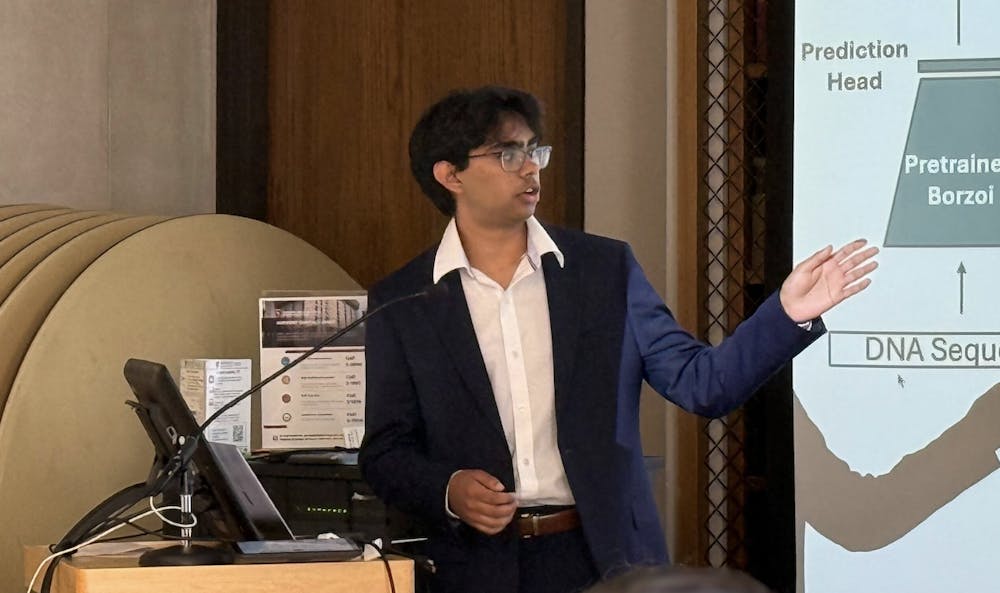
Sameer Gabbita is a junior at Hopkins, majoring in Biomedical Engineering. In an interview with The News-Letter, he reflects on his research journey and his recent achievement becoming a Goldwater Scholar.
The News-Letter: Could you describe your main research project or research interests?
Sameer Gabbita: My interests are in applying AI to study gene regulation, seeing how certain genes are regulated and improving our understanding of diseases and how they manifest. The project that I talked about for my Goldwater application was about an AI model designed to study regulatory DNA and how it modulates the expression of genes. In particular, I described my initial roles in developing that model, as well as more in depth, I was able to validate that the sequences that we generated had functional activity in cells.
N-L: What drew you to this particular field of using AI to model and understand gene regulation pathways?
SG: I've always been interested in the intersection of technology and medicine, and early in high school, I did a couple of internships applying AI to diagnose medical disorders. I think I kept coming back to what really were the underlying molecular drivers that led to these disorders. So that's when I first started really exploring these genomic and epigenomic scales of data, and that's when I first joined labs to really study this more in depth.
N-L: You’ve done research in a lot of different labs, and a lot of these different labs are using different approaches and different projects, but they're all centered around using AI to understand gene regulation. Could you describe how your different projects connect to what your main research interests are, and how they've led to these research interests developing over time?
SG: In each of these different labs and different projects, I've explored gene regulation in different ways. In the project that I talked about for my Goldwater application, it was more of a generative aspect. We're designing DNA — that involved developing DNA using our AI models to understand some of the regulatory grammars of DNA, and really being able to use that to design new sequences. In that project, I really performed more of a validation role exploring these landmarks of regulatory activity. I really focused on how that regulation differs between the synthetic sequences that we generated compared to sequences of the human genome. But more recently, I've also been exploring other aspects of AI modeling. I've been focused on perturbation modeling: if we knock out a gene, how does that affect the expression of genes across the genome? So that's been more of a mechanistic way to model gene regulation. I think these different approaches have really opened my eyes to know how diverse this field is and the different ways of understanding the human genome today,
N-L: One of the projects you've done focuses on perturbation, the other one focuses on developing synthetic DNA sequences. Different labs can use generative AI in different manners. Has there been a single experience or multiple experiences that have stood out to you and changed how you think about the usage of generative AI in genetics?
SG: I'd say my Goldwater project has been one of my most formative research experiences. It's really been my first foray into research. In the media and in pop culture today, we see a lot about using AI to text and different videos and things like that, but I view AI in biology as really trying to understand patterns within the data. You know, we have petabytes upon petabytes of data today of uncharacterized functional aspects of the human genome. I really feel like these generative AI models are a way of synthesizing all this information that's out there and being able to use that for novel use cases. The project that I talked about in my Goldwater application has applications in potentially correcting disease and the dysregulation of genes that arise from disease. But in other projects, we're using AI to predict how the state of a cell changes in response to the perturbation of a gene.
N-L: Moving forward, are there any specific gene regulation pathways or methods that you'd like to model using AI going forward?
SG: Something that I'm particularly interested in is modeling transcription factor binding and chromatin accessibility — how the interaction between DNA and proteins give rise to and affect the expression of different genes. As someone who aspires to be a physician scientist, I'd really love to translate these findings and identify potential biomarkers of disease and even identify therapeutic targets that we can develop therapies for.
In particular, I hope to develop self-supervised foundation models on genomic and single-cell data that capture how regulatory programs evolve across cell states and how genetic perturbations impact downstream cellular pathways, ultimately illuminating disease progression and identifying targets for therapeutic intervention.
N-L: Was the Goldwater Scholarship something you'd planned for since freshman year, or was it something that you discovered later on in your research career at Hopkins?
SG: I first heard about the Goldwater Scholarship from some upperclassmen. I actually had a couple friends who got the Goldwater at their institutions. I've been aware of it, and I was thinking about applying for a couple years. I was debating whether I should apply my sophomore year, but I ultimately just went for it this past school year, and I think it's definitely been a really important journey. It provided a lot of time for me to reflect on what I hope to do with the rest of my career, and I just thought it was great.
N-L: Using the support from the Goldwater Scholarship, what are your plans for the rest of your undergraduate degree, as well as after your undergraduate experience?
SG: I hope to study regulation using AI this summer. I'm going to be continuing some research that I started this past summer. So I'm really looking forward to that. And, as I mentioned earlier, I hope to become a physician scientist and be able to translate these basic science discoveries to develop new therapeutics, technologies and diagnostics.
N-L: You're in labs on the Hopkins campus as well a lab at the Harvard Medical School. What are your different takeaways from your experiences at Hopkins labs, and what have you learned from labs outside of Hopkins — what are those two experiences like as an undergraduate researcher?
SG: Here at Hopkins, I’m a research assistant in the Department of Neurosurgery, where I work on developing and applying data science approaches to enhance how we're able to care for neurocritically ill patients. One of my biggest takeaways is formulating the right clinical questions: sometimes, we see these models with 99% accuracy on these different biomedical data sets, but oftentimes it's really about how robust these models are and whether they really enhance the way that physicians are able to use them to treat patients. So I think that's been a really formative approach, both by interacting with physicians here at Hopkins, and shadowing firsthand, seeing how we’re able to integrate these technologies in the [neuro intensive care] unit.
Beyond Hopkins, I focus more on basic science approaches. Elsewhere, I am involved in Harvard Medical School, Massachusetts General Hospital and Boston Children's Hospital. That's more to look at some of the mechanistic properties underlying gene regulation: the perturbation modeling and generative approaches. It's been a good mix where I've been able to see firsthand how we're able to translate these technologies to the point that they can be used by clinicians to support patients, but also on the other hand, really understanding how we go from this ocean of data into some actionable insights into what a gene does or how that can just enhance our understanding of lesser known biological processes.
N-L: You're involved in the Executive Board of the AI society at Hopkins. How has that role informed or complemented your research?
SG: I think the AI society has been great. We have a lot of members that are really passionate about applying AI, not only to medicine, but to many other domains. One of the really exciting parts about being on the AI club is being able to interact with so many diverse members with unique perspectives. I think one of the really cool parts about the AI societies is that we have different club-wide projects. In my freshman year, there were members who created an ASL interpretation app. This year we're working on emergency department triage systems. Overall, working with a lot of people and applying AI to problems has been really inspiring.
N-L: You're in so many different labs and also in campus organizations; how do you go about managing all of these different experiences? Do you have any advice for students hoping to get involved in research or on a similar path as you for an MD-PhD?
SG: My biggest philosophy is that if you're really passionate about something, you'll find a way to make the time for it. So I'm very, very passionate about the type of research and the type of work that I do on campus. I think it's also just about having good expectations set with your mentors — having open communication with everyone you're interacting with, so you’re not hanging people out to dry.
I also have been fortunate to have some of the most supportive mentors during my research journey. When you're finding a lab, make sure that the lab culture is really, really supportive, and that it's a place where you actually want to spend time. Your lab is also there to guide you and really support you when you need it.
Most importantly, find mentors and [principal investigators] who genuinely care about your growth as a researcher, such as giving you the intellectual freedom and independence to pursue your own ideas, rather than treating you as someone who is simply there to execute assigned tasks.