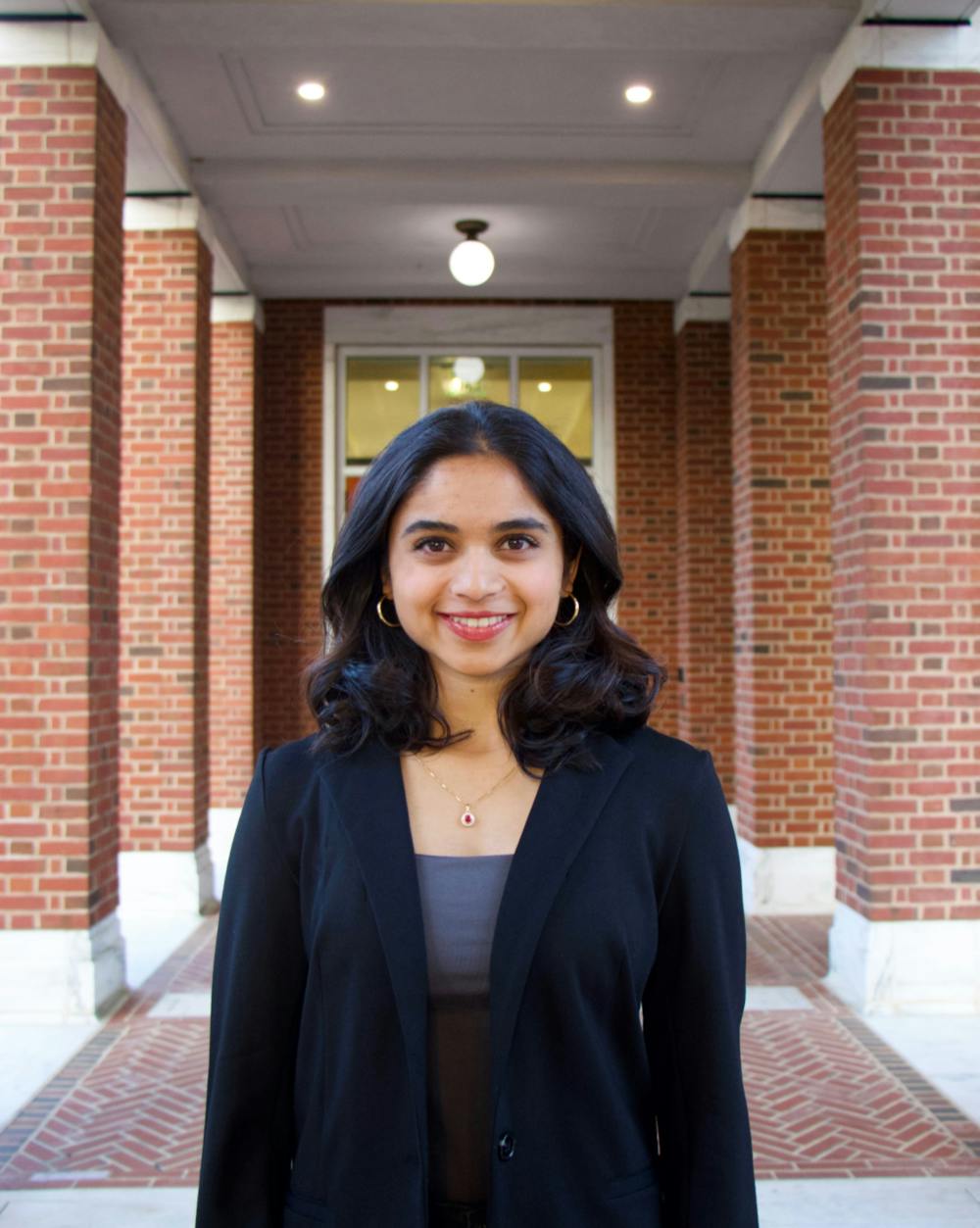
Roma Desai is a junior pursuing a Bachelor of Science in Biomedical Engineering. She is a recipient of the 2026 Barry Goldwater Scholarship, which awards undergraduate students interested in pursuing a career in scientific research. In an interview with The News-Letter, Desai described her research experience and future plans.
The News-Letter: Could you give a brief description of your research projects?
Roma Desai: I started doing research my freshman fall in the Kim lab, which is a biomedical engineering lab. In that lab, they work on microphysiological systems, which essentially model organs on the chips. The project that I've been working on since my freshman year is on modeling the neuromuscular junction in vitro. We want to develop a test or biological assay, so you can assess different concentrations of drugs… and model neuromuscular junction disorders like or peripheral neuropathies. We're co-culturing motor neurons with skeletal muscle tissue and trying to grow those over a span of a few months.
N-L: For these chips, where do you start from, and then where do you end up?
RD: We start with induced pluripotent stem cells (iPSCs) and differentiate them in motor neurons. We seed the skeletal muscle tissue a week before innervating it with our motor neurons. It takes a while for the tissue to become fully functional. And you know when they're functional because they'll spontaneously twitch. We can also use optogenetics to cause the skeletal muscle tissue to respond. We also do tissue stiffness testing.
N-L: Do you have other significant research experiences you’d like to elaborate on?
RD: In my summer between freshman and sophomore year, I did an internship at the Wake Forest Institute for Regenerative Medicine. There I had the opportunity to work with liver organoids. The problem with organoids is that once they aggregate, the center begins to undergo necrosis. So our hypothesis was, if there's a perfusion system where it simulates human blood flow, then we could maybe improve oxygenation delivery. I think overall, from those experiences, I've really developed an interest in tissue engineering and regenerative medicine.
N-L: What grew your interest in tissue engineering?
RD: Very honestly, joining the Kim lab in freshman year. My BME focus area here is also cell and tissue engineering.
N-L: How do you think being at Hopkins has affected your accessibility to research and your ability to conduct research?
RD: I think it's been very helpful with getting research opportunities. Because of how research-heavy this institution is, I think most faculty have been very open to undergrads joining their labs. They’ve been very encouraging and supportive. I also joined another lab last fall, the Durr lab. He's also a BME professor, and his lab focuses on optics and computational research. The project I'm on is trying to detect infections in patients that have undergone peritoneal dialysis. In some cases, patients can develop infections as a complication. So I’m trying to be able to actively diagnose that. In today's age, you can't really do research without having a computational side to it.
N-L: What methods do you use in your computational research?
RD: We do a lot of image analysis with machine learning… a lot of different algorithms with real-time object identification.
N-L: Why do you want to pursue a PhD?
RD: I think that at the end of the day, I don't see myself being in an 8-5 job. I really enjoy the ability to formulate your own questions and your own ideas. And I think one of the only career paths that bring me up to do that and explore is academia. I always think of research as, you're forever going to be a student. There's always going to be something new for you to learn. I feel like doing research, if you take the right path, you can have a genuine impact on individuals in the future. I feel like research is very much true delayed gratification, because a lot of times technologies or findings that you may make in the lab don't make it to the clinic. But some do, and I think that's something I really like.
N-L: What are some challenges you’ve faced in your research?
RD: The timeline delays, very honestly. I think that we had fabricated 30 chips last fall, right? We couldn't seed them till the end of January. Also, I'm moreso dealing with small technical challenges of optimization? How do we prevent the chamber from leaking, etc?
N-L: How did you approach the process of applying for the Goldwater, and what advice do you have for prospective applicants?
RD: I found out about it at the end of my sophomore year on Hopkins’ website. I saw that there was a pre-application due in the fall. And I was like, let me just submit it and see what happens. Four students from Hopkins go on to the national level. I think for the application itself, I worked on it over winter break because it was due around January 1. I picked my recommenders based on who I've been working with the longest. I made sure in my application that I was demonstrating scientific thinking. Also, I definitely got advice from my PhD student. He's a great mentor.