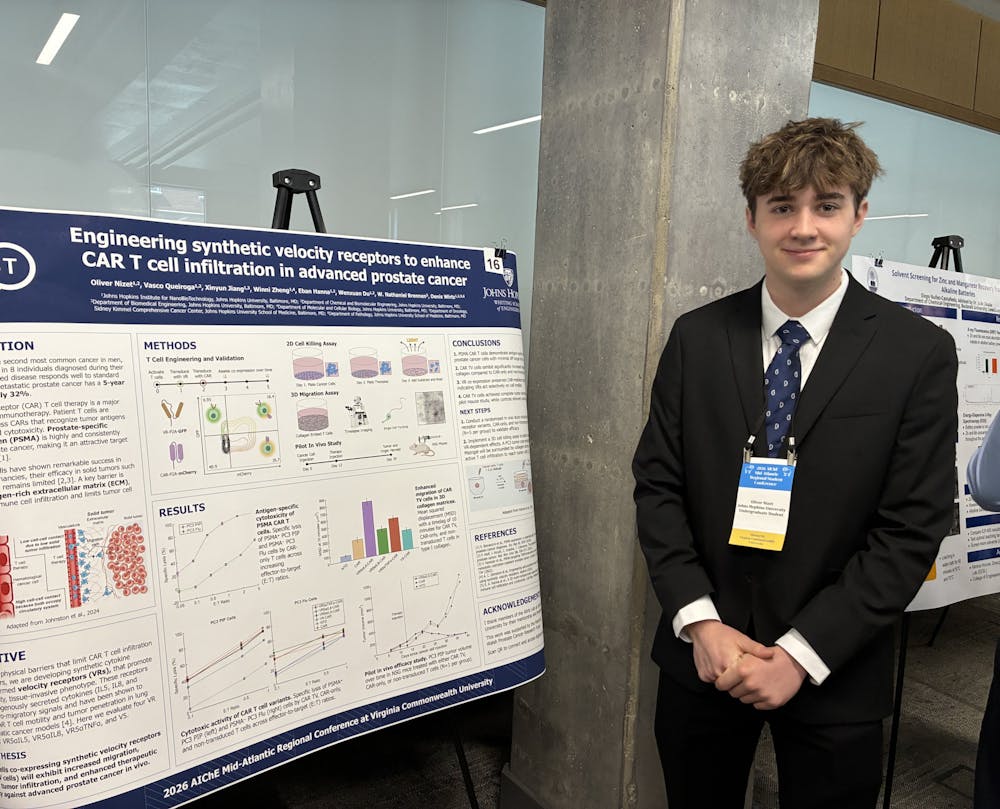
Oliver Nizet is a junior pursuing Bachelor of Science in Chemical and Biomolecular Engineering and Computer Science. He is a recipient of the 2026 Barry Goldwater Scholarship, which awards undergraduate students interested in pursuing a career in scientific research. In an interview with The News-Letter, Nizet described his research experience and future plans.
The News-Letter: Could you briefly describe your main research project or research interests?
Oliver Nizet: My main research project right now is looking at enhancing CAR T cells' ability to infiltrate prostate cancer tumors. I’m doing that by engineering these synthetic velocity receptors that bind to endogenously secreted cytokines to enhance motility. Outside of that, I've also done computational work on 3D multi-omic mapping of human fallopian tubes. I'm generally interested in the intersection of engineering, biology and computation.
N-L: What drew you to this particular field?
ON: I started coding in fifth grade, and that was a big interest of mine. Then when I got to high school, I started taking biology courses, and I felt like that was really where my interest was, [in how] to apply these concepts. I had that computational background, and the biological interest really grew as I got involved in research. In my first research project, I wrote a Python program to automate the determination of minimum inhibitory concentrations for different antibiotics. I used my coding skills here to help accelerate the biological workflow and so that exemplified my interests.
N-L: How did you get started on your research?
ON: I've been in the Denis Wirtz Lab since my freshman spring. Over that time, I've worked on a couple different projects. I started out looking to use CAR T cells against ovarian cancer, and then I moved into that mainly computational project, which was the fallopian tube mapping, and now velocity receptor CAR T cells for prostate cancer. I've had a very supportive group of mentors: my [principal investigator (PI)], Prof. Wirtz, as well as my supervisor, who's a graduate student, Vasco Queiroga. They've been enormously helpful with teaching me all I need to know and supporting my scientific thinking. They teach me how to run experiments, but the more important part is understanding the science behind it and why we're doing things. So those skills are what allow me to come up with my own questions and design experiments in a way to achieve a desired goal.
N-L: What kind of skills have you learned across your research projects?
ON: The project [at Hopkins] to engineer these velocity receptors to increase CAR T cell motility involves cloning and genetic engineering. We have to create viruses, so we have to transfect cells and harvest viruses, then transduce the T cells that have been isolated from patients’ blood. From there, we can integrate these velocity receptors and as well as the CAR receptors into the genome of these T cells. After that, to test them, I've learned how to perform both 2D and 3D cell killing assays, which are in vitro ways to assess the cytotoxicity of our cells. I’ve also learned in vivo skills working with mice, which include injections, blood collections and measuring tumor volume.
At the University of California San Diego (UCSD), [I’ve conducted research there] at the Liangfang Zhang’s lab the summers after my freshman year and after my sophomore year. My primary project there involved isolating cell membranes from induced pluripotent stem cells, which express oncofetal antigens. When these are coated onto a nanoparticle, the induced pluripotent stem cell membranes can be injected as a cancer vaccine. Since oncofetal antigens are present on both stem cells as well as cancer cells, your immune system can build up a response.
N-L: Were there any challenges that you’ve faced during your research? If so, how did you overcome them?
ON: Certainly. When you start out, maybe in a new lab, it's like a foreign environment so that will of course come with challenges, like learning where everything is, how to run certain protocols, how to do an experiment and maintain sterility within your working environment. But just with practice, that initial stress and difficulty goes away.
There's still challenges when it comes to just your results not lining up. One specific one is that when we're trying to transduce these T cells with our CARs and our velocity receptors, we see low transduction efficiencies. So only a small percentage of our cells are actually getting the receptors we want to express. That’s definitely an issue when we're trying to test the therapy, since the therapy is not as potent as we want it to be. We’re just having to navigate that and find ways to optimize the workflow or take a different approach to overcome that.
N-L: What does receiving the Goldwater scholarship mean to you both personally and professionally?
ON: It’s a huge honor. I'm really grateful to be a part of this community, and it's really rewarding, the recognition of the efforts that I've put into, both my lab research here at Hopkins, as well as research I've done at UCSD over the summers [in addition to] my achievements in my courses. That feels really good. Professionally, I feel like it's going to help me immensely going forward. I'm applying to graduate schools in the fall, and the actual application process to Goldwater was incredibly useful in learning how to write a research essay and really reflecting on my past research experiences. [Asking myself] “What were the outcomes?” for both the science itself and on a personal level. Looking back on that journey and compiling and writing is certainly going to be helpful going into my graduate school applications.
N-L: What future plans do you hold career-wise and regarding your research?
ON: For immediate next steps, I also was fortunate to receive the Summer Provost’s Undergraduate Research Award here at Hopkins. I'm going to be staying here over the summer to continue my research project on velocity receptor CAR T cells for prostate cancer. During my senior year, I plan to take on another project in the lab, hopefully something that's more computation oriented, because that's a thing that I'm equally interested in. I will be applying to PhD programs in either chemical engineering or bioengineering in the fall, and I think that kind of hybrid approach is something that I'm going to be putting forth to help me stand out, as well as something that I'm looking for in labs for my graduate study, where they're integrating both wet lab and computation.
N-L: What advice do you have for students who want to apply for a similar scholarship or follow a similar path like yours in research?
ON: To start, I think finding a lab that's a good fit is incredibly important. The primary two labs I've worked with were the Liangfang Zhang lab at UCSD and then the Wirtz lab here at Hopkins. I’ve had incredibly supportive PIs as well as graduate student mentors. You, of course, want to get involved in research early if you're looking to apply for the Goldwater Scholarship, but you need to find a group that's a good fit. So, you should reach out to professors, send an email, talk to a few [professors] and find a lab that seems like a healthy, supportive environment. Then when you get into the application season, they'll be incredibly helpful. Like my supervisor and PI were very helpful with reviewing my Goldwater application and providing feedback. So having that effort reciprocated by them is very much appreciated. Finding a good environment like that and doing as much research as you can while maintaining high effort in your classes is the best way to build a strong application.