As the ongoing U.S.-Israel war against Iran approaches its one-month mark, students have vocalized global repercussions and personal concerns, with many calling for the University administration to take accountability in its connections and efforts towards student support.
The conflict began on Feb. 28 upon U.S.-Israeli strikes on Iran’s territory, escalating the pre-existing hostilities between the two sides. These strikes killed Iran’s leader, Ali Khamenei, in addition to several top administrative officials. The military campaign has since resulted in large amounts of civilian casualties and infrastructural damage. As of March 28, about 1,937 individuals lost their lives in Iran and 1,238 in Lebanon. Over 33,000 across the region have been significantly injured. As retaliation, Iran has since blocked the Strait of Hormuz and targeted U.S. and Israeli interests in the region. U.S. President Donald Trump publicly stated his goal to bring “freedom” to the Iranian people, but U.S. officials later expressed other aims, such as destroying Iran’s military capabilities.
Throughout the conflict’s development, students, including those directly affected, have expressed a wide range of perspectives on the issue and University involvement. In an email to The News-Letter, one student, who spoke under the pseudonym “Rachel,” described the moral complexity behind initial U.S.-Israeli strikes, questioning the benefits of U.S. intervention.
“While I agree the supreme leader was unjust in his ruling and he used his power to allow the killing of tens of thousands of citizens, the U.S. should never get involved in Middle Eastern politics. Democracy is never born from bloodshed,” Rachel stated.
Rachel continued, reflecting on the mixed reactions observed from Iranians directly.
“On the other hand, I see many Iranians and Iranian Americans celebrating, which I understand with the death of such an unjust leader, but at the same time, many Iranians died at the hands of the U.S. and Israel. We should not celebrate the U.S. getting involved in the Middle East ever,” Rachel remarked.
Another student, commenting under the pseudonym “Jordan” shared the importance of the conflict in ushering in regime change. Referring to the government-sanctioned violence towards protestors rallying for a new government (in response to financial crises and worsening living conditions), Jordan highlighted how many Iranians have been stuck with the republic’s authority – until now.
“Many Iranians have long called for change. But the regime has made it clear that it won’t step down in response to internal pressure alone. It has responded to protestors with violence, and to many Iranians, there is little reason to believe that a subsequent uprising like the one in January would end any differently.” Jordan continued, “War is not an ideal solution to an internal conflict, but we need to view Iran’s case differently. If the U.S. and Israel are to step down now and allow the regime to remain, they wouldn't be promoting or keeping peace, they would just be allowing the continued suppression of human rights.”
For other students, the conflict is deeply personal due to cultural and familial ties to Iran and neighboring regions. In an email to The News-Letter, a student choosing to comment under the pseudonym “Jesse” described the conflict’s emotional toll of having family and memories in the region.
“I’m very sad and depressed about [the conflict]. I haven’t been sleeping much at all. I’m sick worried about family, friends, and the places I love in Iran. While the regime in Iran is certainly not good, there is no justification for already thousands of civilians being killed by USA/Israeli military, including over 160 [elementary school] girls, certainly no justification for civilian homes, schools, famous stadiums, UNESCO cultural heritage sites like the Golestan Palace and more being blown up as well.”
Jesse continued to explain the conflict’s effect on their family, describing anxiety around verifying their safety amidst power outages and time zone differences.
“[Dealing with the conflict] has been very hard for me, I’m sick worried about my family in Iran and with the power being cut from Iran, I can only speak to my family for about 1-2 minutes a day where they call me at really late hours in the night given the timezone difference to tell me they are alive; no one should have to live through this worry and stress,” Jesse stated.
In response to the escalating tensions, the University sent out a community-wide email on March 4, describing University-affiliated resources and highlighting the U.S. government’s travel advisory, which discourages any travel to affected countries in the Middle East (including but not limited to Iran, Israel, Palestine, Jordan, Lebanon, Qatar, Saudi Arabia, and the United Arab Emirates). The Office of International Services provides further information for students navigating travel restrictions.
The University recommends all individuals to register University-sponsored international travel with the University’s travel requirements to allow for institutional support during emergencies. While the University has prohibited undergraduates from traveling to affected areas for academic reasons, administration recommends all faculty, staff and graduate students to use Healix, a specific Hopkins security program, which provides real-time alerts and safety resources for international travel. A University spokesperson emphasized that outreach efforts thus far have prioritized communication and support for affected community members in an email to The News-Letter.
“Earlier this month, the university communicated with students, faculty, and staff regarding the ongoing conflict in the Middle East and reached out directly to individuals from the affected areas to ensure that members of our community were aware of State Department guidance for those who may be traveling to countries in the region and to share resources for members of our community who may be impacted. The focus of our communications is on ensuring that our community has access to accurate information, travel guidance, and support resources,” a University spokesperson wrote.
Despite these measures, some students believe the University should expand its support networks. Rachel, for example, highlighted the limited University response in addressing the conflict’s emotional toll.
“I know people who have family members killed during the protests or are unable to reach out to family members during this time. I know the university held an event recently discussing what’s happening, but that can only provide so much comfort in such a difficult time,” Rachel wrote.
In addition to the support session offered on March 2, the University promoted mental health resources for students through Student Health and Wellbeing, TimelyCare and the Behavioral Health 24/7 Crisis Support Line (410-516-9355). Faculty and staff may access confidential 24/7 support through the Hopkins Employee Assistance Program at 888‑978‑1262. However, Jesse noted that, in their experience, University resources have been less productive relative to faculty support.
“I don’t believe the university has made a great public effort to support students in this such tragic time, but my teachers have all been incredibly supporting and accommodating after I told them the situation so I really give credit to the faculty (or at least my teachers) for being so supporting and thoughtful in their responses to my needs as it’s hard to focus on school when you don’t know whether your family is alive,” Jesse wrote.
The conflict has also affected the campus’ political climate, with some Rachel and Jesse describing hesitancy in voicing their perspectives in fear of widespread polarization.
“With my friends, yes I do feel safe [expressing my opinions] but because of the polarizing and different opinions that everyone has, I don't feel safe [otherwise] because it’s so emotionally charged,” Rachel stated.
“I do not feel safe at all expressing my opinions in the public which is really sad because [innocent people] are dying, school girls are dying, places of great culture and beauty are being blown up, and it doesn’t seem like it’s getting the attention it needs,” Jesse corroborated.
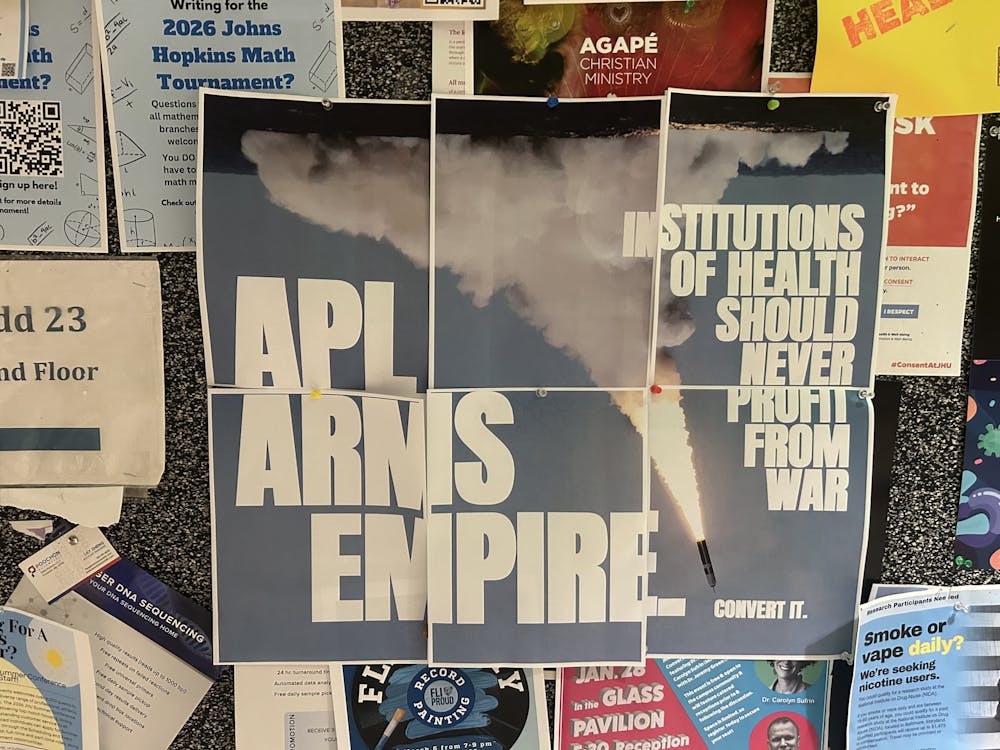
Student voices have also risen through public demonstrations. About ten University affiliates in masks hosted a protest on North Charles and 33rd Street on March 6, calling for the end to US involvement in the Middle East and criticizing the University’s military research in the Applied Physics Laboratory (APL). Protestors chanted slogans including “Ron Daniels take a stand, stop making missiles we demand,” "say it proud, say it loud, we want peace, we want it now” and “APL you can’t hide, you commit war crimes.”
One participant, who noted feeling intimidated by nearby administrative and security presence (including Public Safety, the Johns Hopkins Police and Baltimore Police), framed the protest as a spark to an anti-war movement.
“We’re calling for an end to the forever wars in the Middle East that are enabled by the University.” The participant continued, “We’re calling for the University to end its complicity in war crimes in the Middle East and across the world and also on Johns Hopkins students to use their voices to call for an end to the violence.”
University officials responded to the demonstration upon request from The News-Letter, affirming their support for student expression.
“The university strongly values free expression and fully supports our community members’ right to peaceful protest as long as individuals and groups comply with our rules, policies and guidelines,” a University spokesperson said.
Criticism from demonstrators centers on the APL, a federally funded research and technology development center. According to a University spokesperson, the APL provides technical expertise for “national security challenges” to the U.S. government. Some of these wider projects include developing spacecraft hardware, aircraft precision capabilities, missile tracking technologies and other research focused on enhancing military capacity.
Critics have pointed out the APL’s contribution to the wider development of the Tomahawk Missile in 2002, as APL researchers inputted redirection and messaging software, alongside map-matching guidance systems, for over 1,000-mile travel distances in well-defended airspaces. The U.S. military has been using Tomahawk missiles frequently, due to their long-distance travel abilities, in the war against Iran, including in the vicinity of an elementary school in Minab (killing 175 people); critics question the direct role of the APL for these wartime deaths due to their contributions to Tomahawk technology. The University has not commented on the direct connection between the missiles used in the US-Israel war with Iran and APL’s contributions.
While Jordan noted and understood why many Hopkins students oppose intervention, Jordan also expressed frustration with the lives lost in the student protests of the 1980s, the Green Movement in 2009, the Bloody Aban protests of 2019, the Zan, Zendegi, Azadi movement of 2022, and the protests just this past January amidst government repression. Moreover, Jordan’s experience in a pro-intervention rally pushes him to believe in the new opportunities U.S. intervention can bring to Iran.
“I attended a rally on March 29th in DC, where tens of thousands of Iranians protested in support of this intervention, and I think that one thing became very clear. To many, this looks like one of the last opportunities that Iranians will have for this regime to be removed. If the external pressure is removed now, there is no guarantee that another chance will come for Iranians to have the basic freedoms we get to practice in the West,“ Jordan remarked.
Editor’s Note: The News-Letter has edited the section regarding APL’s involvement with developing the Tomahawk missile for clarity, confirming that the University has commented only on APL’s general function as a research laboratory.