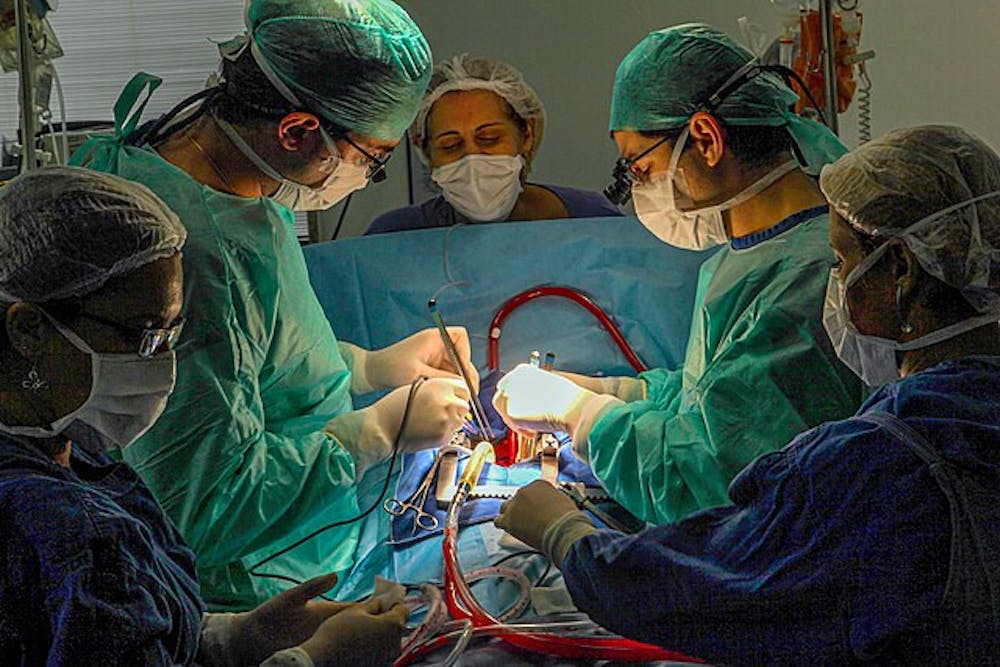
Dr. Gerald Brandacher is the scientific director of the Hopkins Reconstructive Transplant Program and a professor in the Department of Plastic and Reconstructive Surgery at the School of Medicine. Brandacher leads research in reconstructive transplantation, such as hand and face transplants, groundbreaking procedures that offer new possibilities for patients with otherwise untreatable injuries. In an interview with The News-Letter, Brandacher discussed the goals of the reconstructive transplant program and the challenges of vascularized composite allografts (VCA), the process of transferring tissues from donor to recipient, along with the innovations his team is pursuing to improve organ preservation.
Unlike traditional organ transplants, Brandacher explained that reconstructive transplantation is centered on restoring quality of life for patients rather than life-saving interventions.
“Reconstructive transplants are different from solid organ transplants, because the main goal of this field is not to necessarily save the patient's life, but to significantly improve the quality of life for patients with amputations or with devastating tissue defects that cannot be reconstructed with any conventional means of reconstructive surgery,” Brandacher said.
Despite its potential, reconstructive transplantation presents a variety of challenges, particularly in its technical complexity and the demands of donor-recipient matching.
“There's a lot of points that make them challenging because they're so significantly different,” Brandacher said. “Some of the vessels we are trying to reconnect can be very small, [thus requiring] microsurgical techniques.”
Brandacher contrasted this with procedures such as kidney transplants, which involve relatively few connections.
“For kidney transplants, you have one artery, one vein, and a ureter and [these are] all the connections you need to make,” Brandacher explained. “If you do an arm transplant, you need to reconnect the bones, vessels, multiple arteries, multiple veins… tendons, muscle groups and nerve components.”
In addition to surgical complexity, reconstructive transplants require more detailed matching between the donor and recipient. Along with blood type and immunological compatibility, these procedures must also account for visible and functional characteristics.
“You need to take into consideration size, to some extent, age, eventually, gender, skin tone,” Brandacher emphasizes. “All of these become matching criteria, which are not only important for cosmetics, but size, for example, needs to match, so that your remaining muscles are able to power that graft.”
In addition to these challenges, perhaps the most significant limitation in transplantation is the narrow window of time that is available to preserve the grafts and organs.
“Time is of the essence in transplant,” Brandacher said. “The moment you disconnect blood supply, oxygen and nutrients, there's a decline in tissue metabolism and injury that happens to the graft.”
Brandacher explained that transplant teams only have a few hours to complete several critical steps, including organ allocation, transportation, and donor-recipient matching. The narrow time window can make even ideal matches unusable. For instance, transporting grafts or organs from the West Coast to the East Coast would take too long to be viable. The time constraint also limits opportunities to better prepare patients in advance, such as pre-treating or conditioning the immune system to prevent an unwanted organ rejection.
“So all of those treatments take time, which we don't have,” Brandacher stated. “It's actually a fairly sobering thought that in solid organ transplant, we are actually discarding about a quarter of all perfectly good kidney transplants because we simply don't have enough time to allocate and match them.”
To address this limitation, Brandacher’s team is developing new strategies to extend preservation time. One approach focuses on maintaining the organs in a replicated physiological state outside the body by using perfusion machines.
“It's kind of like a bioreactor. You perfuse the organ or the graft with oxygenated donor blood, and you add nutrients. You can monitor it. There is pressure [and flow control. You can have a circulation outside of the body that you can oxygenate,” Brandacher explains.
A second approach focuses on cooling the tissue enough to stop metabolism. However, traditional freezing methods can damage the organ or graft due to ice crystal formation. In order to overcome this barrier, Brandacher and his team have drawn inspiration from nature. Brandacher highlights that certain animals such as Arctic fish and ground squirrels are able to hibernate and survive in areas with freezing temperatures without the formation of ice in their bodies.
“The reason they are able to do so is because they have specific anti-freeze proteins in their system,” Brandacher said. “We were able to reverse engineer these naturally occurring anti-freeze proteins and create a new organ perfusion solution.”
Brandacher argues that addressing these time constraints could transform transplantation procedures.
“It will lead to a paradigm shift,” he said. “Every aspect of transplant will be impacted by this, the most simple one is that logistics won't be a problem anymore. We could think about sharing organs across the entire country, or even beyond.”
As advances in organ preservation, immune modulation and regenerative medicine continue to develop, Brandacher believes that reconstructive transplantation is on the cusp of becoming more accessible and effective for patients.
“I think it's the most exciting time to be in medicine, and it offers so many opportunities that it feels like time might be too short, actually, to get all the ideas that come to mind done in one's career,” Brandacher said.