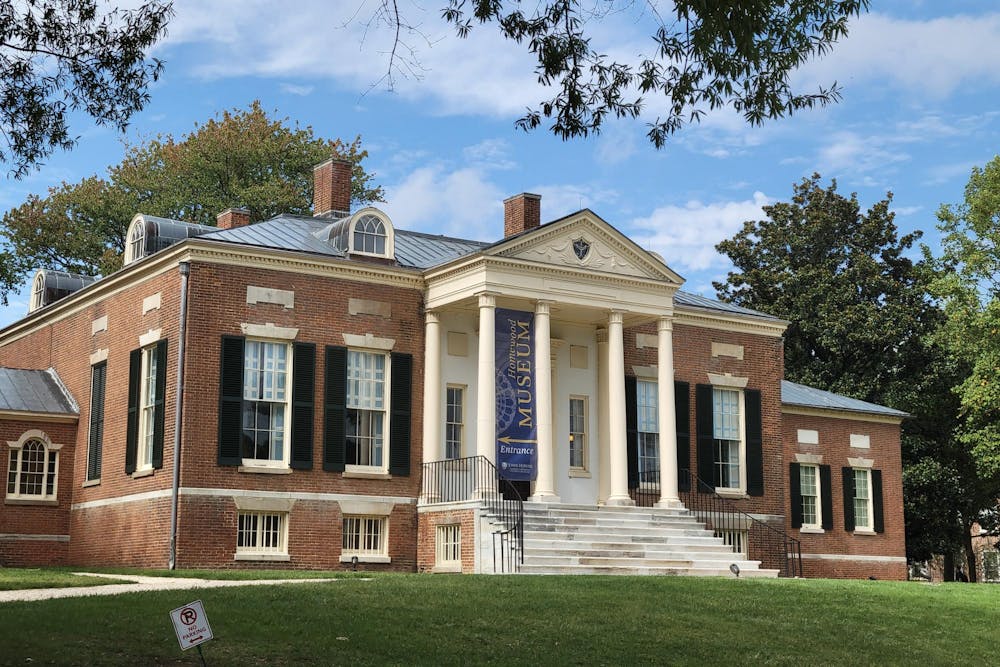
On Thursday, March 5, the Homewood Museum at Hopkins hosted “Decision Points at Homewood House,” where Professor Andrew Jewett presented on the history of the five presidents of Hopkins who resided at Homewood House from 1936 to 1971. Jewett explained the expansion of the faculty and student body of Hopkins, the process of racial integration, the beginning of coeducation and other institutional developments during these years.
Jewett is a professor of Medicine, Science and the Humanities at the School of Arts & Sciences and the author of Science, Democracy, and the American University: From the Civil War to the Cold War and Science under Fire: Challenges to Scientific Authority in Modern America.
Jewett is also the coauthor (along with lecturer Jonathan Strassfeld) of the upcoming book Johns Hopkins: The First 150 Years, which is set to be published on Sept. 15, 2026, in honor of the 150th anniversary of the University’s founding. The history details the development of Hopkins into a top research university, as well as considering its relationship with the city of Baltimore over time.
Jewett’s talk was based on his new book but focuses particularly on the five presidents who lived at Homewood House: Isaiah Bowman (1935-48), Detlev Bronk (1949-53), Lowell J. Reed (1953-56), Milton S. Eisenhower (1956-67) and Lincoln Gordon (1967-71).
In an email to The News-Letter, Jeannette Marxen, the programs and interpretation manager at the Johns Hopkins University Museums, spoke about the inspiration behind hosting this event.
“Our current exhibition on display at Homewood, If Homewood’s Walls Could Talk, is an exhibition that combines the national 250th anniversary of the founding of the United States and the more local 150th founding of Johns Hopkins University. My goal for the public programs in 2026 was to link back to the exhibition and the anniversaries. Homewood House itself played an instrumental role in the formation of Johns Hopkins and I wanted to have a program that highlighted that role,” Marxen wrote.
During his talk, Jewett began by speaking about the presidency of Isaiah Bowman (1935-48), who he described as highly controlling, often clashing with faculty over decisions about Hopkins. He also noted that Bowman held extreme prejudices, as he fiercely opposed admitting Black students to Hopkins and wanted to limit the hiring of Jewish faculty members.
Despite his controversies, Jewett emphasized Bowman’s role in shaping the university’s government research projects, particularly by maintaining the Applied Physics Laboratory, which had been developing the proximity fuse, after World War II. This helped Hopkins become one of the top recipients of government research funding in the United States.
“One of his really important decisions, however you think about it, is keeping the Applied Physics Laboratory after the war’s end,” Jewett said. “There's a question at Hopkins: is the APL going to continue to operate at all? There is some opposition, including in the physics department. But the University believes in the value of this kind of work as a form of national service and a sort of patriotic duty.”
Bowman was succeeded by Detlev Bronk (1949-53), who continued the military-industrial-academic complex of Hopkins, even as more civilian research funding became available in the 1950s.
In particular, Jewett pointed out that even though other universities in the country were expanding, Bronk wanted to keep Johns Hopkins small and exclusive. In 1952, he introduced the “Bronk Plan,” which would reduce undergraduate programs and shift the university’s focus toward graduate or doctoral education, but it received little support and was soon abandoned.
The next president, Lowell J. Reed, mainly carried on Bronk’s policies. Although his tenure (1953-56) was brief, Reed continued the focus on education for a small and elite population, and he limited the growth of the faculty or student body.
Under Milton S. Eisenhower (1956-67), however, Hopkins experienced increased, steady growth, although Jewett stated that it was at a slower rate compared to other universities.
“It feels like a golden age to people in Hopkins, but those who come in from elsewhere are like, What in the world is happening here? This place is so ridiculously tiny. How can you have a physics department with six people in it? How can you really…even teach students what they need to know with these minuscule little departments?” Jewett said.
As a result, Jewett described how William McElroy, a Hopkins professor, started a faculty-led report to call for the dramatic expansion of Hopkins in order to keep it competitive with similar top institutions. Thus, around 1964, there began a more accelerated growth.
Jewett then transitioned into discussing the racial integration of Hopkins. He first mentioned that the first-ever Black student at Hopkins was Kelly Miller, who studied mathematics and physics from 1887 to 1889. Unfortunately, little is known about him and Jewett emphasized that more research should be done.
Jewett explained that by the 1960s, racial integration had become an extremely important issue and that Hopkins was under increased pressure to admit more Black students. Jewett mentioned some of the early Black students, such as Reginald James, the first Black student admitted to the School of Public Health in 1942, and Frederick Scott, the first undergraduate engineering student at Hopkins in 1945. Furthermore, Jewett described the important role that student activists played in the integration of Hopkins, as they were instrumental in calling attention to pressing racial issues.
“This new factor is that students begin pushing for a vote in at least some of the university policies…in particular, questions around race. In the early 1960s, a group of undergraduates and graduates create The Committee for Basic Freedoms, and they describe various forms of discrimination in and around the Homewood campus,” Jewett said. “A lot of the dispute centers on housing. Hopkins publishes an official list of rooms available for rent to students, but…80% of them or more are segregated. So a lot of the emphasis of this report is on housing.”
Jewett also emphasized that Eisenhower was a supporter of integration, although he wanted to do it quietly without upsetting the university’s conservative trustees. For instance, Jewett mentioned how Eisenhower hired Victor H. Dates to help with administrative initiatives related to integration.
Finally, under Lincoln Gordon (1967-71), the University continued its efforts in both racial and gender inclusion. In 1970, Gordon announced full undergraduate coeducation, which was significant as previously, women mainly participated in part-time or summer programs. Also, in 1968, the Black Student Union (BSU) was formed, which played an important role in recruiting Black students.
“The BSU becomes a kind of recruiting arm. The students say, ‘Look, you're all going out into these schools, and these kids aren't going to really respond to you. We need to be the ones going out and doing recruiting work in the schools,” Jewett explained. “And so they go talk to the students in the local schools, they write letters to those who are admitted, and so forth.”
However, Jewett also mentioned that Gordon was an ineffective president due to his lack of administrative or public speaking experience. His presidency was marked by tensions with the faculty over governance, budgeting and expansion issues, which ultimately led to him being ousted in 1971. The event concluded with a question-and-answer session.
When asked about what she hopes audiences will take away from this event, Marxen emphasized the nuanced nature of the history of Hopkins.
“I hope they find the more current history that Homewood witnessed, as an administrative building, as evidence that historic houses don’t just tell one single story,” Marxen wrote. “Themes of power and resistance are a continuous thread throughout the building’s history.”