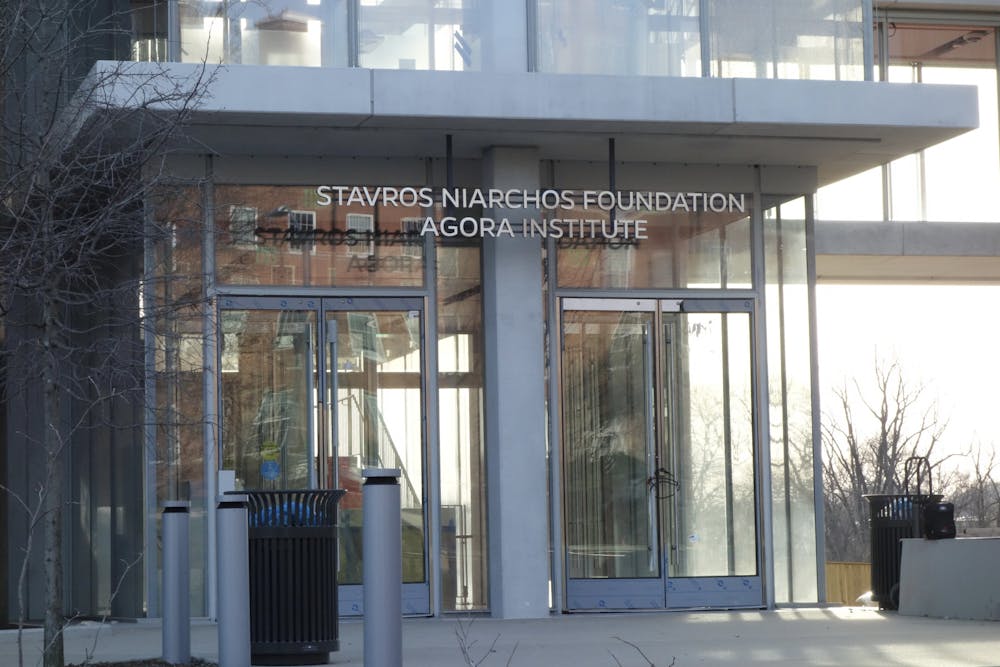
On Wednesday, March 11, the SNF Agora Institute and the Center for Leadership Education hosted Sen. Ben Cardin, former Maryland representative and U.S. congressman. His talk, titled “Engineering Responsible and Effective Civic Engagement,” explored the importance of civic engagement, leadership and being an informed citizen.
Sen. Cardin grew up in Maryland and held office in the Maryland House of Delegates for 20 years (1967-1987), including eight years as speaker. Afterward, Cardin was elected to the U.S. House of Representatives (1987-2007), after which he served three terms as a U.S. senator (2007-2025). Notably, Cardin had never lost an election in his 58 years as an elected official and recently retired in 2025. Throughout his career, Cardin worked to ensure that officials were held accountable for human rights abuses, expanded the State Children's Health Insurance Plan and created the Paycheck Protection Program for small businesses during the COVID-19 pandemic. Earlier this year, in January, Cardin joined the University as an SNF Agora Senior Fellow, holding positions at both the School of Arts & Sciences and the School of Advanced International Studies.
As this event was titled “Engineering Responsible and Effective Civic Engagement,” Cardin began by speaking directly to the engineering students in the audience about their role in government and politics.
“I looked at the definition of an engineer: find scientific, mathematical and creative principles to design, build and maintain complex systems, structures and technologies. Clearly, our government is a complex system, and God knows, we need creative principles and solutions. We need you to help us figure out how our democracy will survive,” Cardin said.
Cardin stressed the importance of civic engagement for all people, regardless of their career path, because it ensures the safety and health of our local, state, national and international communities. Cardin explained that active engagement is especially relevant right now – according to Freedom House, democracy has been on the decline all over the world in the past decade and a half.
Cardin then specifically examined the state of democracy in the United States. He questioned: Given the role of campaign donations on policy, does the U.S. have functionally free and fair elections? Given the acceptance of widespread disinformation, does the U.S. truly have freedom of the press? Is the U.S. truly upholding a democratic rule of law? Cardin mentioned that while the Framers of the Constitution intended for the support of Congress to be necessary before entering a war, the War Powers Act has given more power to the president. Although the act requires the president to notify Congress of military action and limits deployment for over 60 days without congressional approval, it still allows presidents to make decisions in the short term and creates the possibility of stretching these limits.
“Our constitutional protections are really in jeopardy today…our constitution needs your attention,” Cardin said. “John F. Kennedy said no democracy can be stronger than the will of the citizens to direct its affairs. You are our citizens. You need to get engaged. You need to make sure that these protections are there for future generations.”
Afterward, Cardin transitioned to explaining the core pillars of being civically engaged. First, he highlighted the importance of being informed, particularly by studying and understanding the mistakes made in history in order to prevent repeating them. Next, Cardin emphasized the need for civil discourse and to not only respect but also have conversations with people who hold different views.
“When dialogue falters on college campuses, violence and instability will rise,” Cardin said.
Cardin argued that another crucial part of civic engagement is leadership, especially at times when it may be necessary to make tough decisions. Cardin explained the importance of U.S. leadership in history, including when the U.S. entered World War II or when the U.S. led the Nuremberg trials after the war. Cardin also spoke about how upholding values like international human rights and environmentalism is what America is known for and that it takes strong leadership to maintain that. However, civic engagement is not limited to national leaders, and Cardin stressed that this applies to individual citizens as well, who can take on leadership roles in their own communities to uphold policies and advocate for social justice issues.
While it is important to understand leadership, Cardin emphasized that students also need to be willing to compromise with those they disagree with. Cardin talked about his personal experience working with Marco Rubio on the Small Business Committee as the senior Democrat and senior Republican on the committee, respectively. Despite their disagreements, Cardin and Rubio still compromised in order to advance legislation and policies.
Cardin gave the example of the Affordable Care Act in demonstrating the value of compromise. While he believes the act is a great accomplishment for health care policy, it was passed solely with Democrat votes. Cardin said that the absence of Republican support meant that they have no stake in the bill or its success. As such, he argued that bills with bipartisan support are more likely to stand the test of time because both parties hold a significant stake and responsibility in its success.
Finally, Cardin ended his talk by encouraging the audience of Hopkins students to engage in their community, stay politically informed and advocate for important social issues.
“We all have a responsibility to make sure our country does well, that we get back on track, or we move ahead in progress, that we protect our democratic institutions against the abuse of power and protect individual rights,” Cardin said. “Take advantage of what you have here at Hopkins, but give back by helping us make our community stronger, healthier, cleaner, more peaceful. You can do it – you can make a difference.”
The event concluded with a question-and-answer session that discussed issues in voting rights, America’s role on the global stage, students’ roles in civic engagement and the importance of healthy debates.
Attendees from the event reported that Cardin motivated them to play a larger role in their community. In an email to The News-Letter, Brendon Davis, a Ph.D. candidate in Biology and President of the Science Policy & Diplomacy Group at Hopkins, wrote about how Cardin reminded him that civic engagement involves more than just voting.
“The Senator's remarks underscored a significant point worth remembering: voting is just the starting point for being engaged. Civic engagement means being involved more broadly with community and government. Individuals should focus on organizing and mobilizing groups of people on issues that matter to them. Senator Cardin said that while voting itself should be easy and accessible to all, being engaged outside of voting is an active process that takes real work,” Davis wrote.
Andrew Mattson, a doctoral student in physics and science diplomacy coordinator for the Science Policy & Diplomacy Group, also discussed his takeaways from the event in an interview with The News-Letter.
“I thought he made a great point when he said that everybody can have leadership qualities as they try to inspire people to become active in their communities. I thought it was an interesting call to action,” Mattson said. “It also seems like [the University is] able to bring in people who have a wealth of experience and put them in front of students who are still young enough to get involved and bring fresh perspectives to policy and diplomacy. [Cardin] was willing to hang out, have people come up to him, shake his hand, say hi. It was a cool opportunity to see a US senator right in front of you.”
In an email to The News-Letter, a spokesperson from the SNF Agora Institute described how the event was intended to inspire the audience.
“This series seeks to inspire everyone to become active, engaged participants in democracy. We hope that audience members will leave the talk understanding that they have a crucial role to play in democracy regardless of their area of study. Engineers, scientists, literary scholars, humanists, doctors, and every other stripe of human can all contribute to the health of a democracy by making ethical, authentic, human-centered decisions in their daily practice.”